Where television parts company with film
Lay a page of an hour-long drama beside a page of a feature and you would struggle to tell them apart. The type, the margins and the six kinds of line carry straight over. The differences are in how the script is put together. Most shows are cut into acts, many open with a short scene before the titles, and the title page names the series as well as the episode.
The acts come from advertising. A network hour has to stop for breaks, so the script stops too, on a moment strong enough to bring the audience back. Streaming has loosened this, and plenty of streaming dramas now read like four-hour films cut into episodes, but the act structure is still what most readers expect to see in a pilot.
| Format | Typical length | Shape | Layout |
|---|---|---|---|
| One-hour drama | 50 to 65 pages | A teaser, then four to six acts on network television; often no act breaks on streaming | Film layout |
| Half-hour single-camera comedy | 30 to 35 pages | A cold open, two or three acts, sometimes a tag | Film layout |
| Multi-camera sitcom | 45 to 55 pages | Two acts, scenes lettered A, B, C | Dialogue double spaced, action in capitals |
Shows vary, and the habits of one writers' room can differ from the next. When you write for an existing format, the best reference is a produced script of a show like yours.
The one-hour drama
Each act begins on a fresh page with its name centred at the top,
usually underlined, and FADE IN: below it. It ends with
FADE OUT. and a centred line naming the act that has
just finished. Before the first act comes the teaser, sometimes
called the cold open: a page or three that hooks the audience before
the titles.
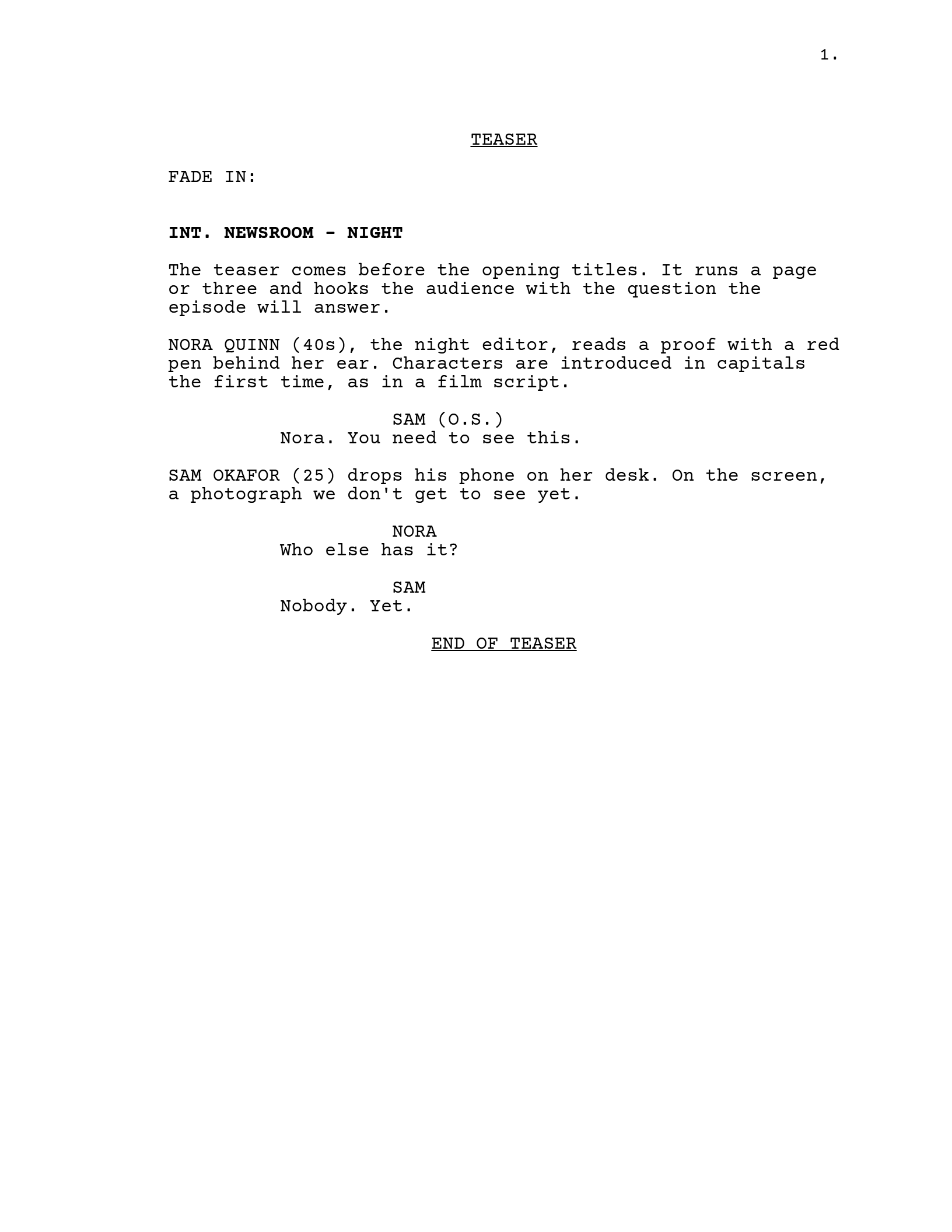
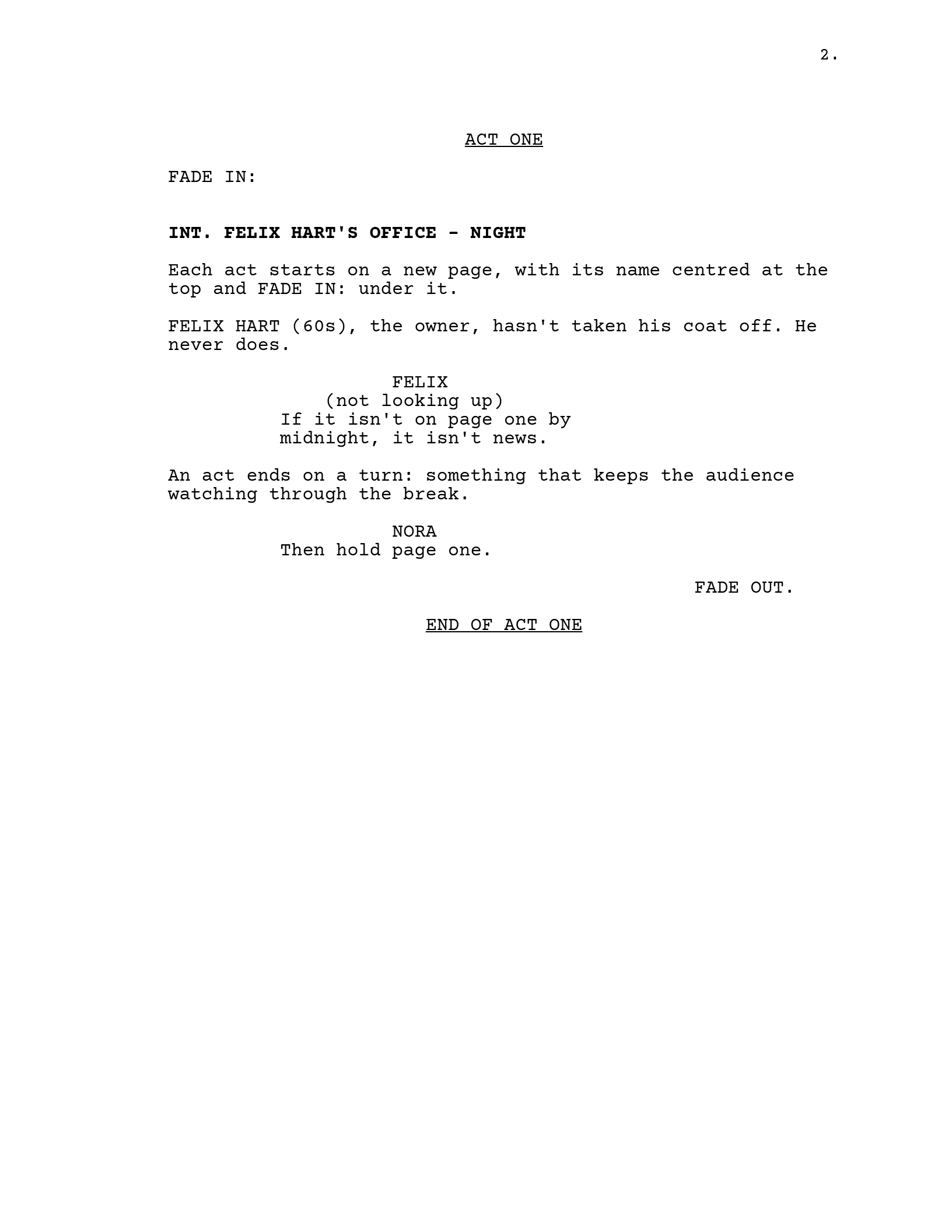
The last moment of an act is called the act out, and it carries more weight than any other moment in the act. It should leave the audience with a question strong enough to sit through the advertisements: a revelation, a reversal, a door opening. Network acts run about ten to twelve pages each, so a writer plans the turns with the page count in mind.
For a streaming drama without act breaks, write it like a film and leave the act headings out. If you are not sure which a reader expects, a pilot with act breaks is the safer choice: the breaks are easy to remove, and they show you can build to a turn.
The half-hour single-camera comedy
Single-camera comedies are shot like films, one camera and one set-up at a time, and their scripts look like film scripts. The usual shape is a cold open of a page or two, then two or three acts, and often a tag: a short scene after the last act, frequently one last joke.
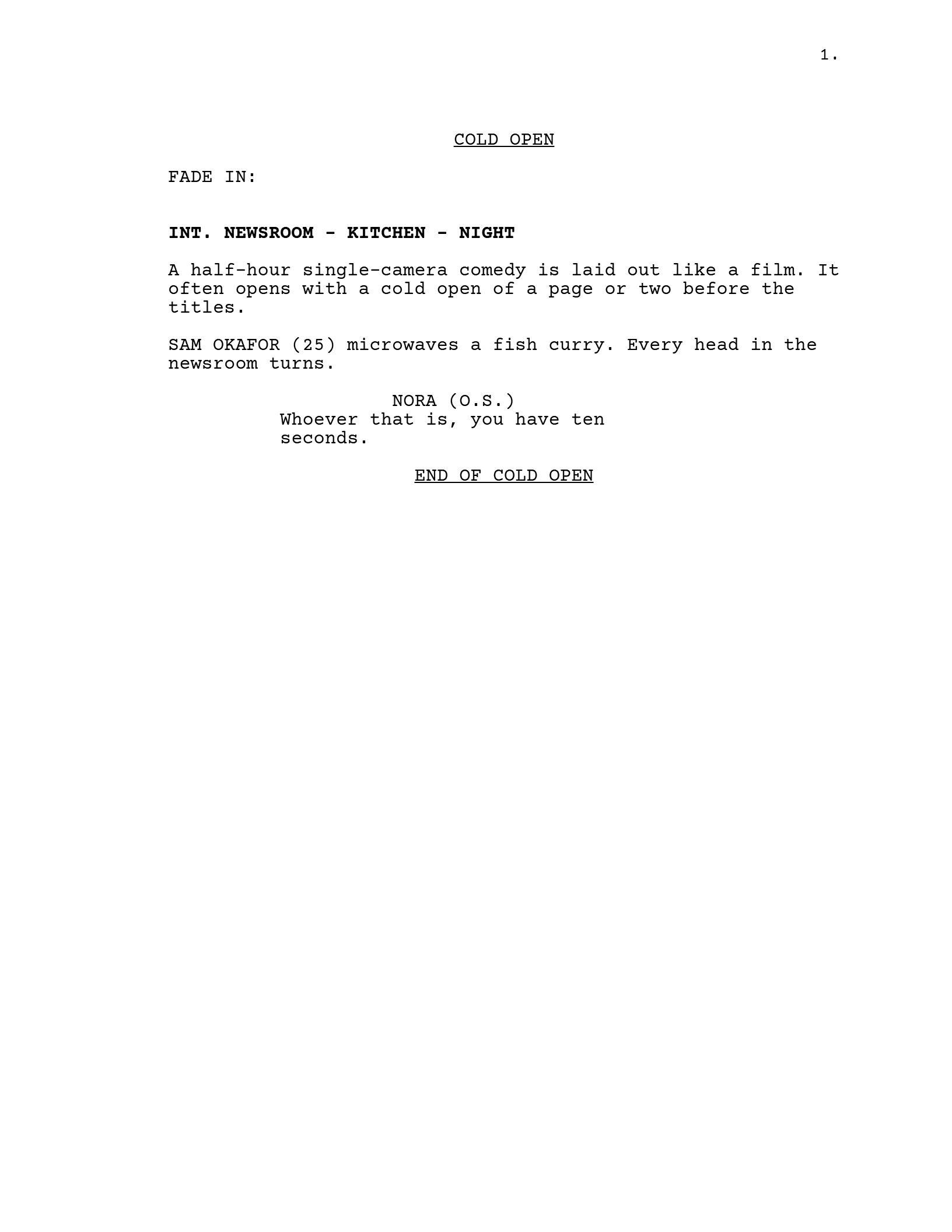
A cold open
A page that stands on its own and sets up the episode's comic problem before the titles. It ends with its own centred line, and Act One starts overleaf.
At thirty to thirty-five pages, there is little room to warm up. Comedy writers often aim to get to the episode's main problem by the end of the cold open or very early in Act One, and to hit the act break on a complication rather than a quiet beat.
The multi-camera sitcom
Multi-camera shows are filmed on a stage in front of an audience, with several cameras rolling at once, and their scripts have a look of their own:
- Dialogue is double spaced, so a page plays in about half a minute and a half-hour script runs forty-five to fifty-five pages.
- Action is written in capitals, and every entrance and exit is underlined so the floor crew can find them at a glance.
- Scenes are lettered rather than numbered, and each one starts on a new page.
- Under each scene heading, the characters in the scene are listed in brackets, and the heading notes which day of the story it is, such as
(NIGHT 1). - Directions to the actor sit inside the speech, in capitals and brackets:
(NOT LOOKING UP).
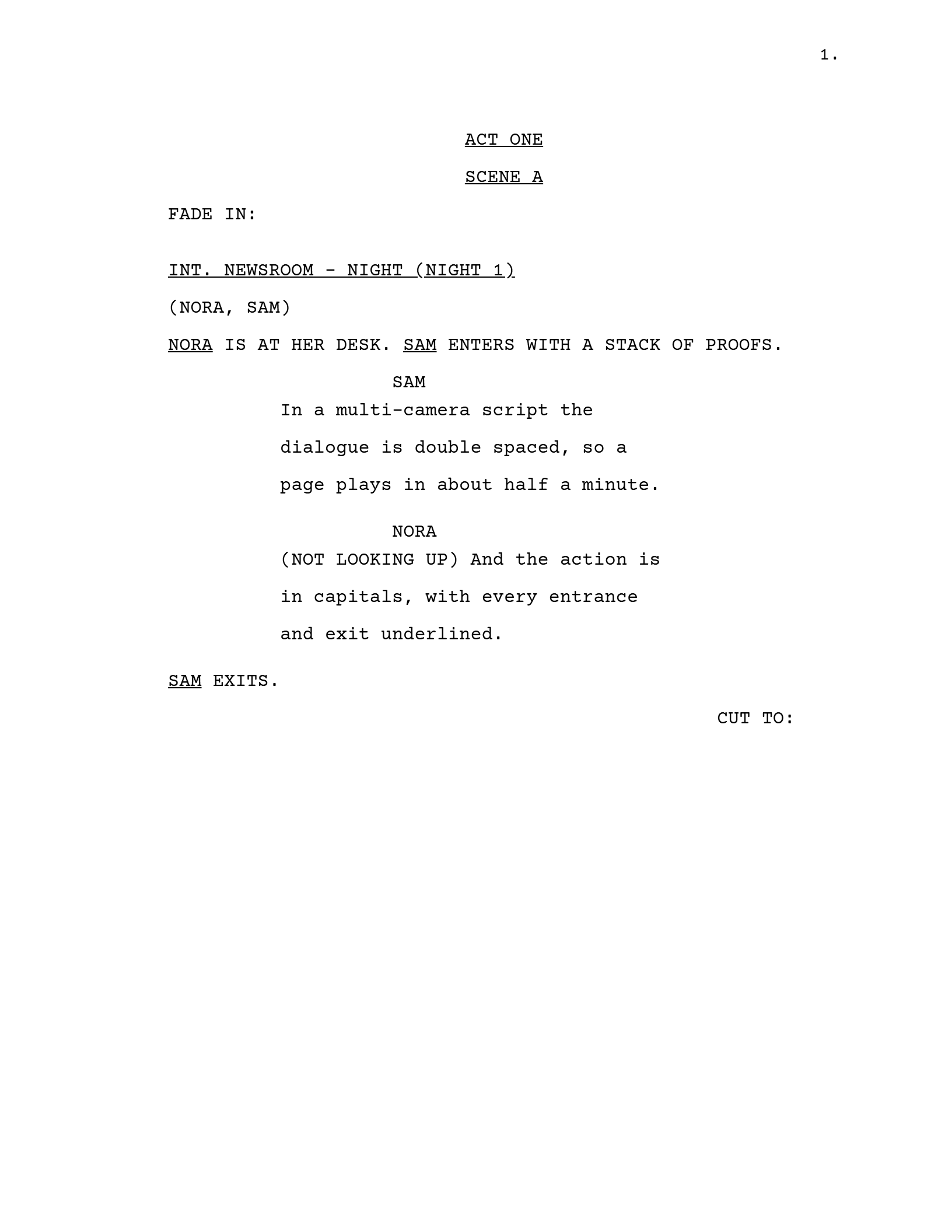
Scene A of a multi-camera script
The double spacing is what makes the page look so different, and why the page count doubles. Underlined names are entrances and exits.
Multi-camera habits vary more from show to show than any other format, from whether the heading is underlined to how sound effects are marked. The template follows the most common conventions; if you are writing for a particular show, match its scripts.
Writing a pilot
A pilot introduces a series, and as a writing sample it has to do two things at once. It must work as an episode, with a beginning, a middle and an end, and it must show the reader the situation that will keep producing episodes for years. Writers call that situation the engine, and a reader finishing your pilot should be able to imagine the next ten episodes without being told them.
Original pilots are now the usual sample for television writers. Spec episodes of shows already on air are asked for less often than they used to be, though some fellowships and competitions still accept them, so read the rules.
The title page carries the series title in capitals with the episode title under it in quotation marks, often just "Pilot"; our title page guide shows one. A series logline, which shows the engine in a sentence, is covered in the logline guide.

In ScriptopusA series project holds seasons and episodes, and every episode has its own script, synopsis, treatment, beat board and title page. The title page's Television design is laid out for an episode.
Download the TV templates
Three templates, each with a title page for the series and the episode, and every act or scene starting on its own page. The example lines come from The Night Desk, a series about a failing London newspaper, and explain the format as you read them. Free, with no sign-up.
One-hour drama
A teaser and four acts, for network or streaming.
Half-hour single-camera comedy
A cold open, two acts and a tag.
Multi-camera sitcom
Two acts, lettered scenes, double-spaced dialogue.
The multi-camera template has no Fountain version: its double spacing is a page setting that a Fountain file cannot carry.
Questions
Should my pilot have act breaks?
If it is written for network television, yes. For a streaming show they are optional. Many writers put them in anyway. They take a minute to remove if a producer doesn't want them, and until then they show a reader that every act lands on something.
Teaser or cold open?
The two words mean the same thing: a scene or two before the opening titles. Dramas tend to say teaser and comedies cold open, but either is understood.
Does each act really start on a new page?
Yes, in every network-style script. The act name sits centred at the top of the new page, even when the previous act ended halfway down its last page.
How long should a pilot be?
For an hour drama, 50 to 65 pages; for a single-camera half hour, 30 to 35; for a multi-camera half hour, 45 to 55. Pilots often run a little long because they have more to set up, but a reader will notice anything far outside those ranges.
Where can I read produced TV scripts?
The Writers Guild Foundation's library in Los Angeles holds a large collection, and many shows publish pilot scripts during awards season. Read several from the kind of show you are writing.
Sources and further reading
- Christopher Riley, The Hollywood Standard, the chapters on television and multi-camera format.
- The Writers Guild Foundation, library and archive.
- Our guide to screenplay format, which compares single-camera and multi-camera pages.
Write it formatted from the first line
Scriptopus sets every line as you type, keeps the beat board and the treatment beside the script, and exports the PDF and Final Draft file you will need. The editor is free on Mac and Windows.
- Every element in its place, with Tab, Enter and Ctrl+1 to 6.
- Beat Board, Treatment and Synopsis in the same project as the script.
- Six title page layouts, Industry Standard first.
- PDF, Final Draft, Fountain and Celtx exports.