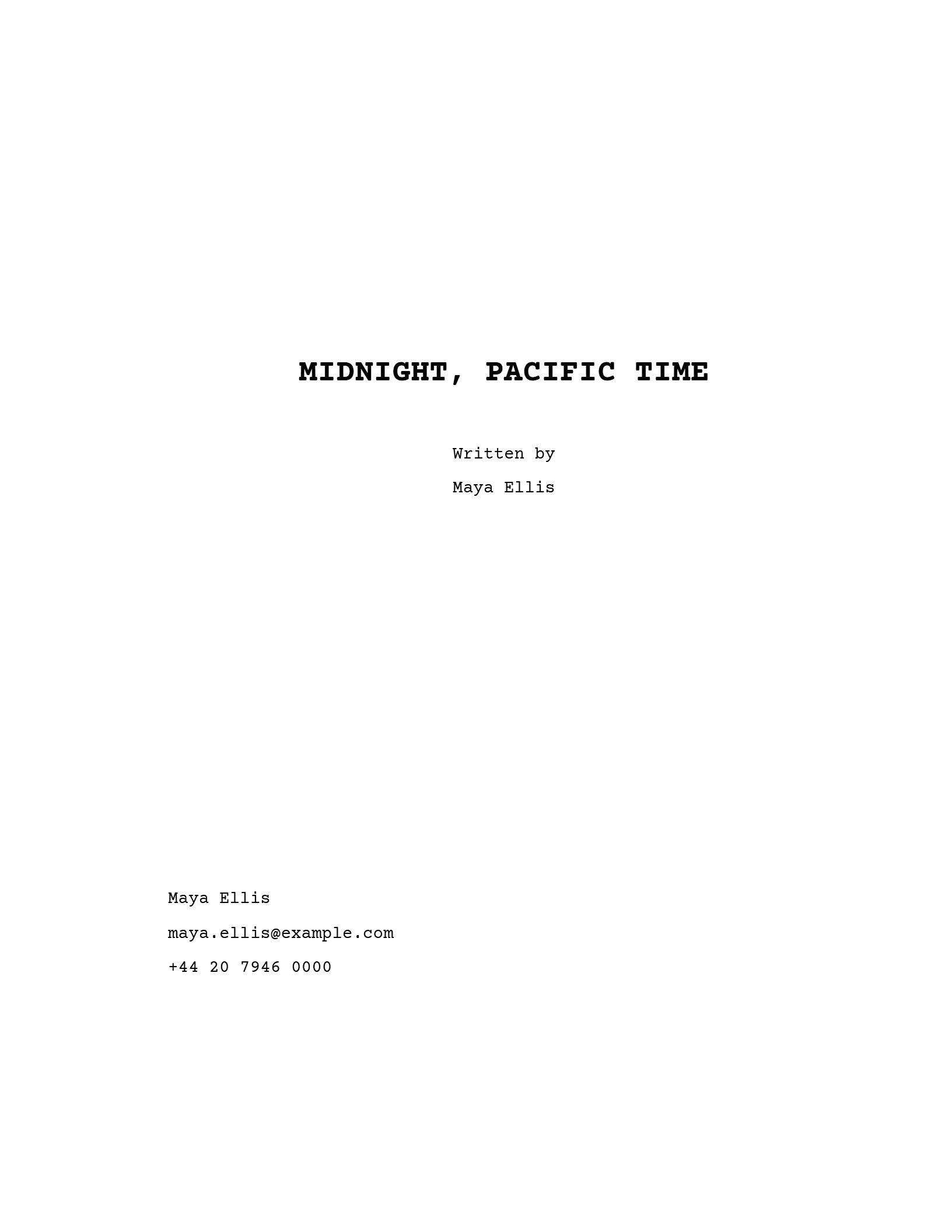
What goes where
A title page holds very little, and nearly every script lays it out the same way. It is set in the script's Courier, carries no page number, and has four things on it at most.
| What | Where | Notes |
|---|---|---|
| The title | Centred, about a third of the way down | In capitals, and it can be a size larger than the rest. Bold or underlined is fine; pick one, or neither. |
| The credit | Centred, a few lines under the title | Written by on one line, your name on the next. |
| The source | Centred, under your name | Only for an adaptation: Based on the novel by and the author. |
| Contact | Bottom left | Name, email, phone. Some writers use the bottom right instead; either is fine. |
Most of the page is left empty, on purpose. A reader takes in a title page at a glance, and anything else on it pulls the eye away from the title.

In ScriptopusEdit cover page, just above the first page of the script, opens the title page for editing, and the PDF prints it in the script's own font and sizes. The design arrows step through six layouts; the first, Industry Standard, is the one on this page, and Adaptation and Television cover the cases below.
Written by, Screenplay by, and the ampersand
On a script you wrote yourself from your own idea, the credit is Written by. The other forms come from the credits the Writers Guild of America sets for produced films, and the spec title page borrows them:
- Written by: the same writer, or team, wrote both the story and the screenplay.
- Screenplay by: the screenplay is yours, but the story came from elsewhere, usually a book, a play or another writer.
- Story by: the story is credited separately from the screenplay, for example when one writer came up with it and another wrote the script.
Two writers who wrote together as a team are joined by an ampersand: Maya Ellis & Leo Ellis. The word and means something different: two writers who worked separately, one usually rewriting the other. The Guild's credits manual uses the two to record who actually did the writing, so a team writing a spec together uses the ampersand.
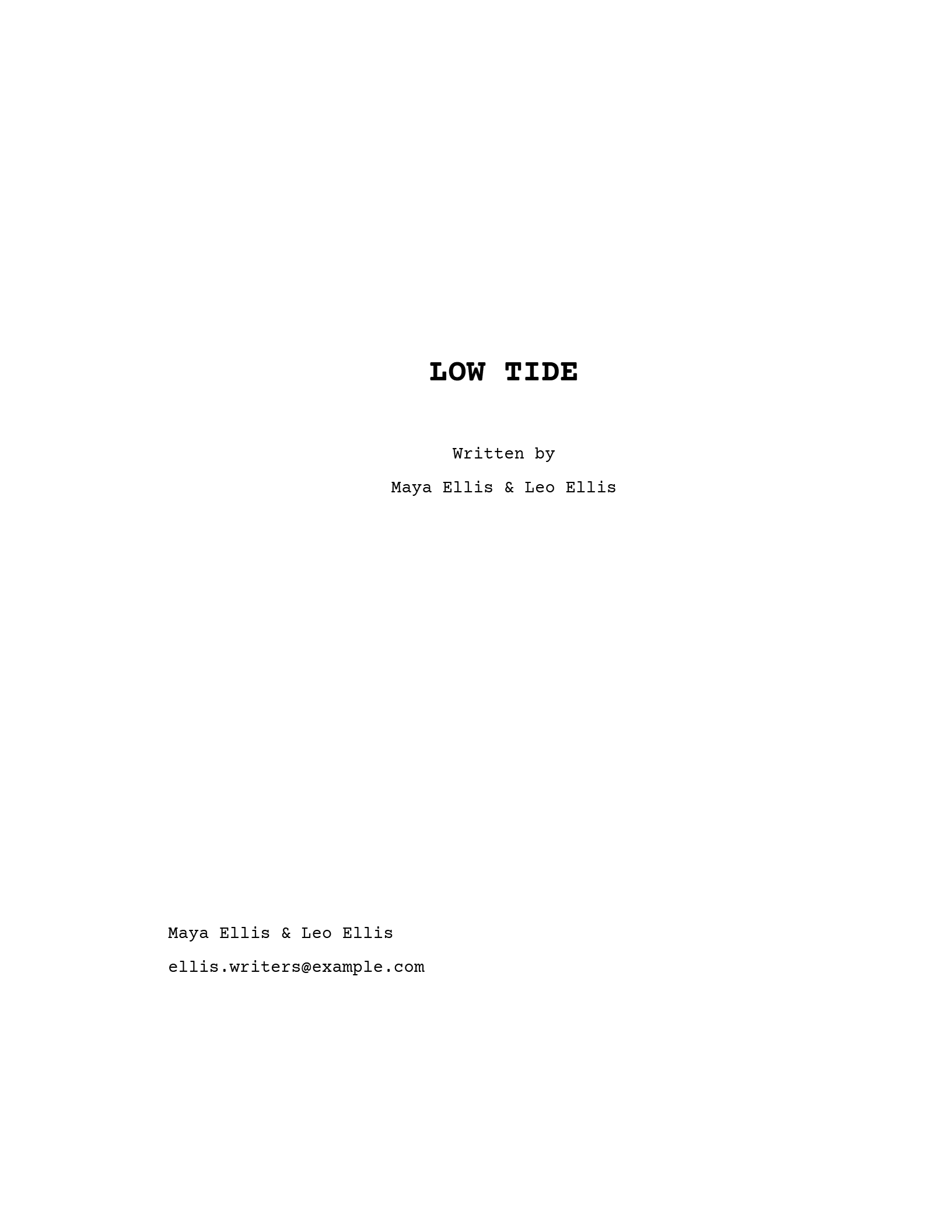
A writing team
Both names on one line, joined by an ampersand, under one credit. The contact block can be shared, or carry both names.
Adaptations
When the story comes from somewhere else, the title page says so, under your name: Based on the novel by, Based on the play by, Based on the short story by, then the author. The credit above it becomes Screenplay by, since the story was theirs.
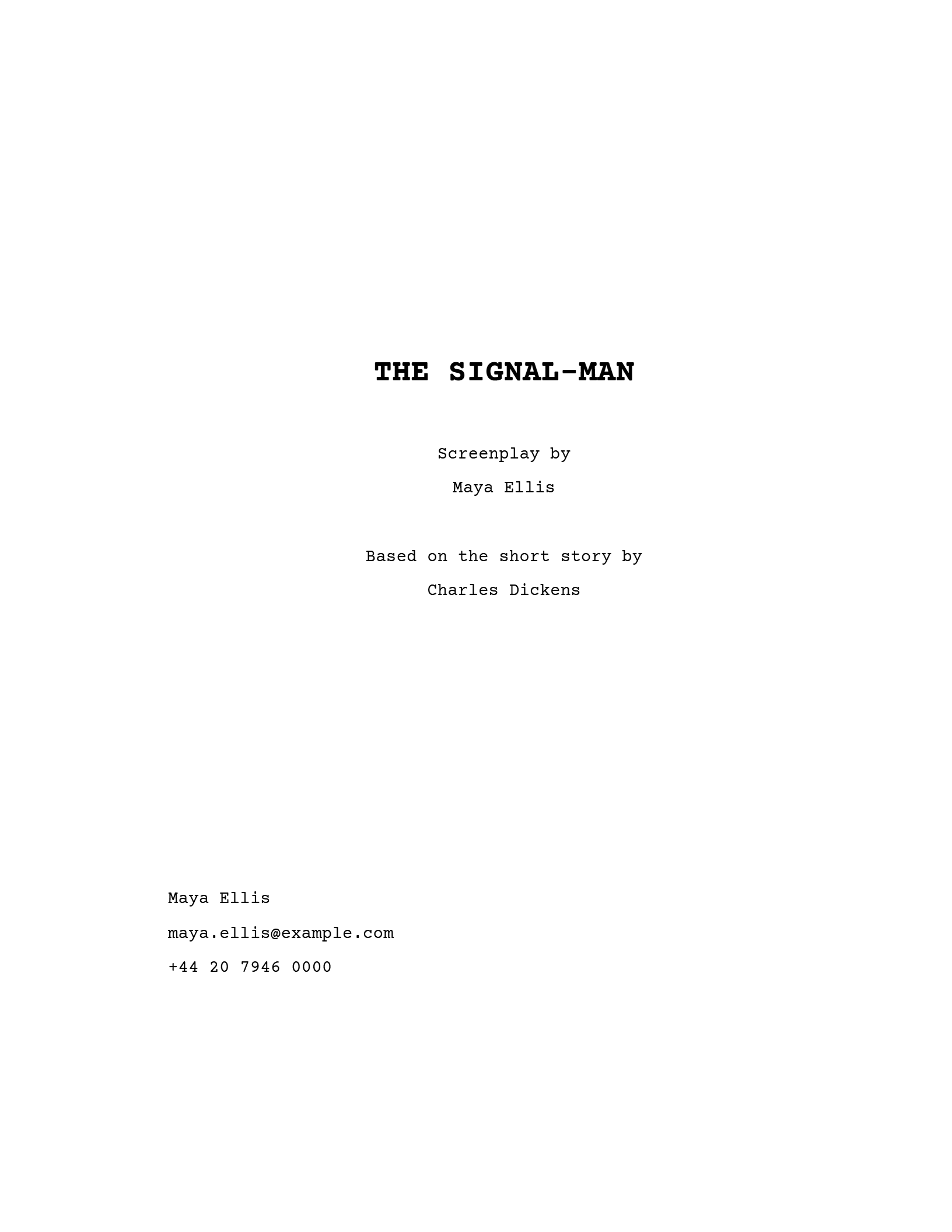
An adaptation
Dickens's story is in the public domain, so anyone may adapt it. A book still under copyright needs the rights before the script can be sold or made, and producers and competitions will ask if you have them.
A script about a real person's life says so in the same place, with a line such as Based on the life of and the name. When a story is only loosely inspired by real events, most writers leave the line off and let the logline say it.
Television
An episode's title page names the series, in capitals, with the episode title under it in quotation marks. For a pilot, the episode title is often just "Pilot". The credit follows as for a film.
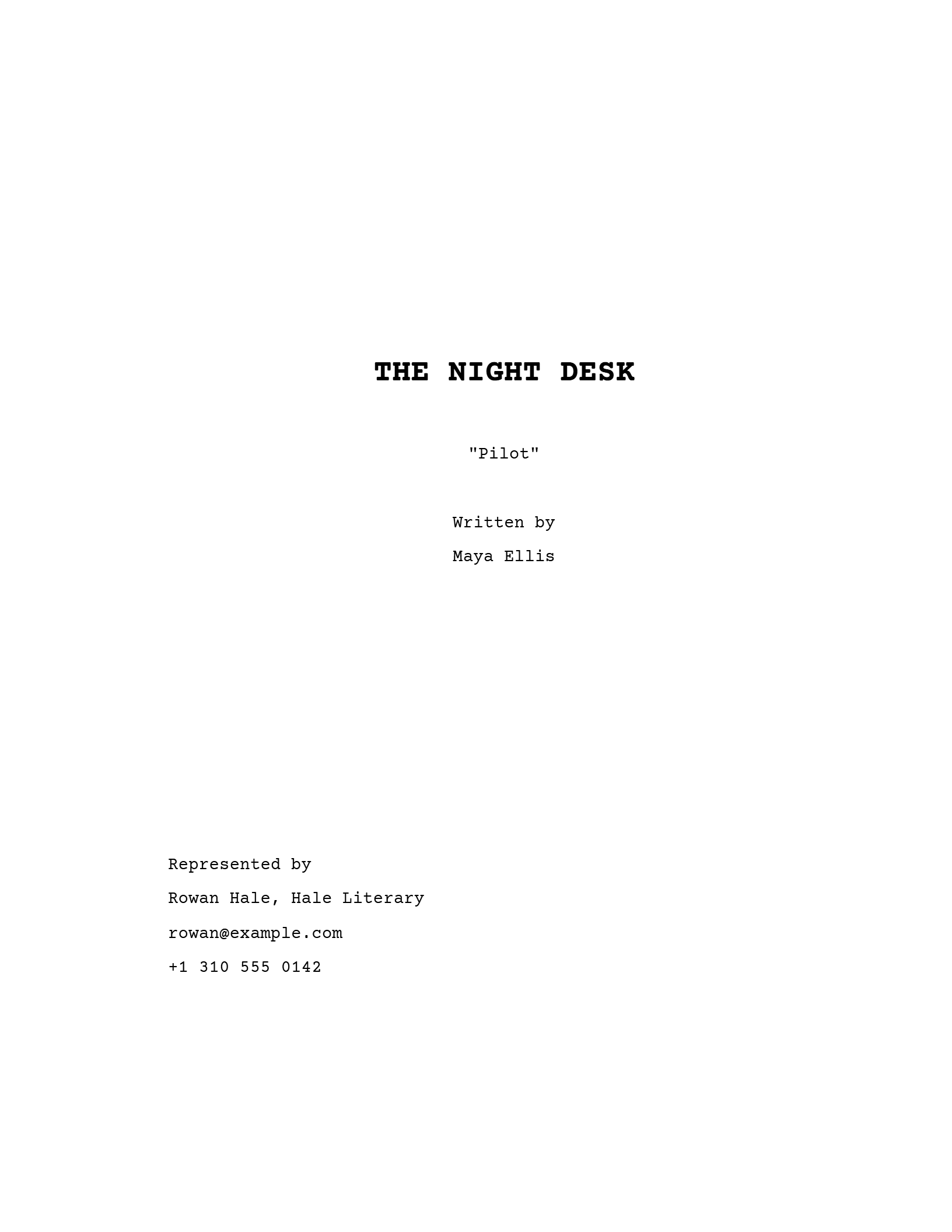
A television pilot
Series title, episode title in quotation marks, credit. This writer has an agent, so the agent's details take the place of her own.
Episodes of a show already on air carry more: the episode number, and sometimes a draft date, because the script is now a production document. A spec pilot leaves them off.
Contact details
Your name, an email address and a phone number, in the bottom left corner. A postal address is rarely needed now. Use an email address you would be happy to see on a producer's desk.
Once you have an agent or a manager, their details replace yours, usually under a line such as Represented by, so that any interest goes through them.
Some competitions and fellowships read anonymously and ask for no name anywhere in the file, title page included. The rules will say so, and a name left on the title page can get the script disqualified. Check before you export, and keep a second version of the title page without your name for those entries.
What to leave off
- The date and the draft number. A date on a spec tells the reader how old the script is, which rarely helps it. Dates and draft numbers come in once a script is in production.
- A copyright notice or a registration number. Your script is protected by copyright as soon as you write it. A notice on the title page adds nothing to that protection, and some readers take it to mean the writer expects them to steal the idea.
- A logline, a tagline or a synopsis. Those go in the query letter or the submission form.
- Pictures, logos and decorative fonts. Courier only, black on white.
A4 changes only the paper. The lines and their order stay the same, and the contact details sit a little further from the bottom edge.
Download the title page template
A title page with placeholders for your title, name and contact details, followed by a blank first page so the file opens as a script. Free, with no sign-up.
Questions
Does the title page count as page one?
No. It has no number, and the first page of the script is page one. When a competition sets a page limit, it means script pages.
Should the title be bold, underlined or in quotation marks?
Capitals are the convention. Bold or underlining is a matter of taste and both are common; quotation marks are kept for an episode title under a series title.
What if I'm writing under a pen name?
Put the pen name in the credit. The contact block can carry your real name, so a producer knows who to send a contract to.
Can I write "by" instead of "Written by"?
You can, and you will see it. "Written by" is the more common choice and matches the credit the film would carry.
Is the layout different outside the US?
Not in any way that matters. The same layout is used in the UK, the rest of Europe and Australia, on A4 paper. If a fund or a broadcaster asks for something else, such as a draft date or a logline on the cover, follow what they ask.
Sources
- Writers Guild of America West, Screen Credits Manual: the forms of credit, and the ampersand for a writing team.
- Christopher Riley, The Hollywood Standard, the title page chapter.
- Our guide to screenplay format, which shows the title page beside the script it belongs to.
Write it formatted from the first line
Scriptopus sets every line as you type, keeps the beat board and the treatment beside the script, and exports the PDF and Final Draft file you will need. The editor is free on Mac and Windows.
- Every element in its place, with Tab, Enter and Ctrl+1 to 6.
- Beat Board, Treatment and Synopsis in the same project as the script.
- Six title page layouts, Industry Standard first.
- PDF, Final Draft, Fountain and Celtx exports.