Why writers reach for one
A montage lets a script skip the weeks it takes to learn a skill, fall in love or fall apart. A handful of short moments stands in for all of it, and by the last one something has changed. Five lines can do the work of five scenes.
Three other devices are easy to confuse with it. A series of shots is one stretch of related action told in quick cuts, over minutes rather than weeks. An intercut moves between two scenes happening at once, such as both ends of a phone call. A flashback goes back in time. A montage moves forward, fast.
Nothing about a montage needs a special element. It is built from the ordinary ones: a heading to open it, short action lines for the moments, and a line to close it.
The standard layout
Open with a heading in capitals that names what the montage shows,
give each moment a line of its own with a dash in front, and close
with END MONTAGE.
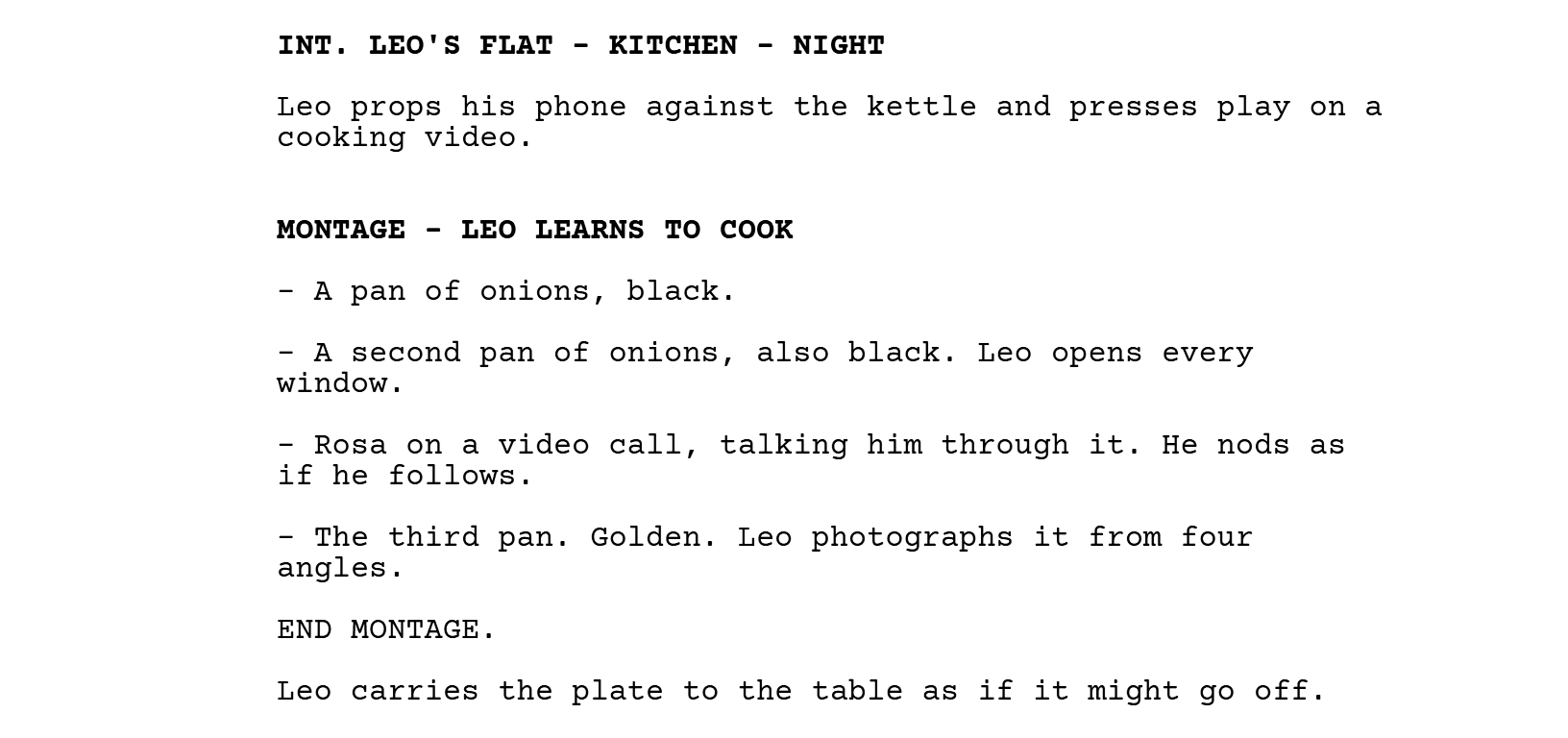
- The heading is
MONTAGE, a hyphen, and what the montage is about:MONTAGE - LEO LEARNS TO COOK. Some useBEGIN MONTAGEinstead, and readers understand both. - The moments are action lines, present tense, one beat each. A dash in front of each is the common habit; short separate paragraphs work too.
- The end is
END MONTAGE. A new scene heading would also end it, but the closing line makes the shape plain, and anyone scheduling the shoot wants to know exactly where it stops.
The order of those four lines matters. Leo burns two pans of onions, Rosa talks him through the next one, and that one comes out golden. Even four lines can build like that, and a reader feels the difference between a montage that builds and a list of pictures.

In ScriptopusSet the MONTAGE line as a Scene Heading (Ctrl + 1) and the moments as Action (Ctrl + 2). The montage then appears in the Scenes list like any other scene, so you can jump straight to it.
A series of shots
When the moments belong to one stretch of action, minutes rather than weeks, the label is SERIES OF SHOTS.
The pieces are often lettered, which helps a reader keep count
and helps a crew talk about shot C.
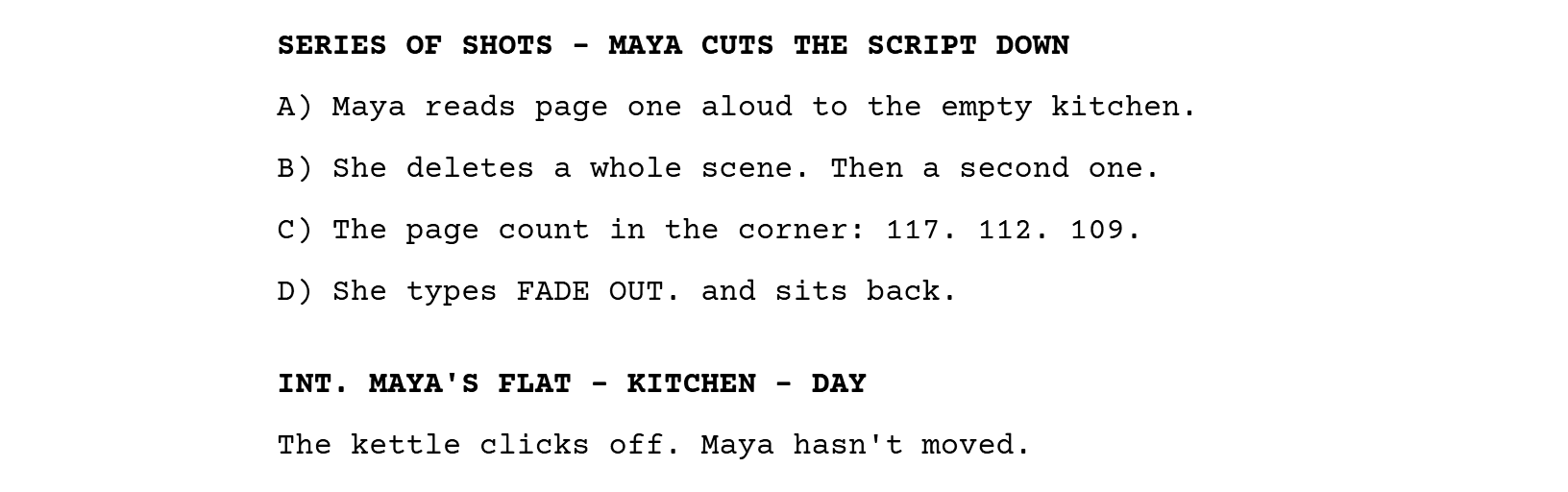
What separates it from a montage is how much time passes. A montage can cover weeks. A series of shots stays with one stretch of action, usually minutes, even when it skips between moments.
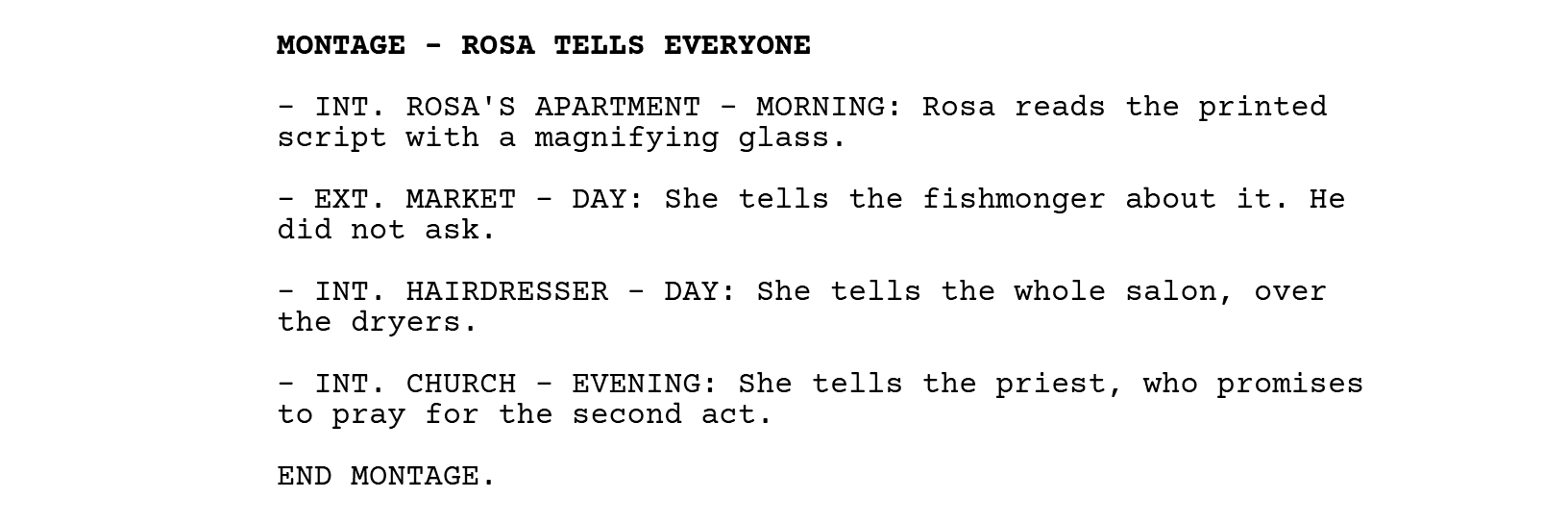
A montage that moves between places
When each moment happens somewhere different, name the place at the start of its line, in capitals, the way a scene heading would. Giving each moment its own heading line would break the montage into scenes. Running the place into the start of the line keeps it moving, and still tells a production how many locations it needs.
Voice-over, dialogue and music
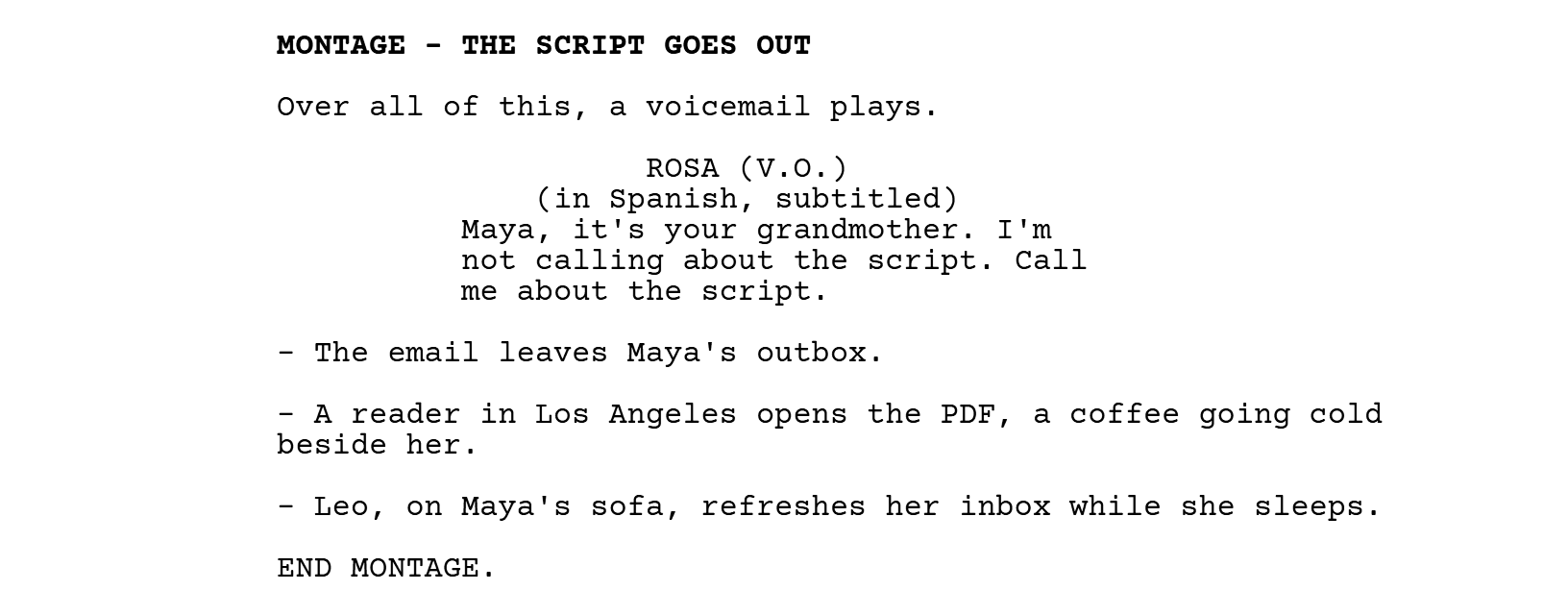
A montage often plays under a voice: a narrator, a letter read
aloud, a voicemail. Put the speech near the top, as ordinary
dialogue with (V.O.), so the reader hears it over
everything that follows.
Short spoken lines inside the moments are fine too, written as dialogue under the moment they belong to. Keep them few. Once two characters start trading lines, think about giving them a scene of their own.
If a particular song matters to the scene, name it in the action. If it only sets the mood, a description does the job, and a song with a borrowed swagger plays over this tells the reader the tone. Either way, the rights to a well-known song cost money, and the final choice usually belongs to the edit.
The quick version, without a label
For two or three beats, a montage heading is more scaffolding than the moment needs. One action paragraph of short sentences does the same work.

When a montage goes wrong
- It runs too long. Past half a page, readers start skimming. Four to six moments is usually plenty.
- Nothing changes. If the character ends the montage where they started, the montage has only filled time.
- It skips the scene the story needed. A montage is for what we can take on trust. The moment that turns the story deserves a full scene.
- Camera directions in every line. A montage already tells the editor to cut fast. Let each line say what we see, and leave the shots to the director.
- No way out. Without
END MONTAGEor a new heading, the reader can't tell where the montage stops and the next scene starts.
Download the examples
All five examples on this page, as a two-page script you can open in any screenwriting program or print.
The five examples
Two pages of script with every montage on this page.
Questions
MONTAGE or BEGIN MONTAGE?
Either. MONTAGE - WHAT IT SHOWS has the advantage of telling the reader what to expect. Whatever you choose, close with END MONTAGE.
Is a montage a scene heading or an action line?
The opening line is laid out as a scene heading, at the left margin in capitals. The moments and END MONTAGE are action.
How long should a montage be?
Most fit in a third to half a page, which plays in well under a minute. If yours runs onto a second page, check whether some moments want to be a scene instead.
Can a montage include a flashback?
Yes, if each moment says so, for example - INT. CLASSROOM - DAY (FLASHBACK): .... A whole montage of memories can say it once, in its heading: MONTAGE - MAYA REMEMBERS (FLASHBACK).
Should I number the moments?
Not in a montage. Letters are a habit of the series of shots, where they help count the pieces of one action.
Sources and further reading
- Christopher Riley, The Hollywood Standard, on montages and series of shots.
- David Trottier, The Screenwriter's Bible, on montages, series of shots and intercutting.
- Our guide to screenplay format, where the montage sits with the other awkward cases.
Write it formatted from the first line
Scriptopus sets every line as you type, keeps the beat board and the treatment beside the script, and exports the PDF and Final Draft file you will need. The editor is free on Mac and Windows.
- Every element in its place, with Tab, Enter and Ctrl+1 to 6.
- Beat Board, Treatment and Synopsis in the same project as the script.
- Six title page layouts, Industry Standard first.
- PDF, Final Draft, Fountain and Celtx exports.