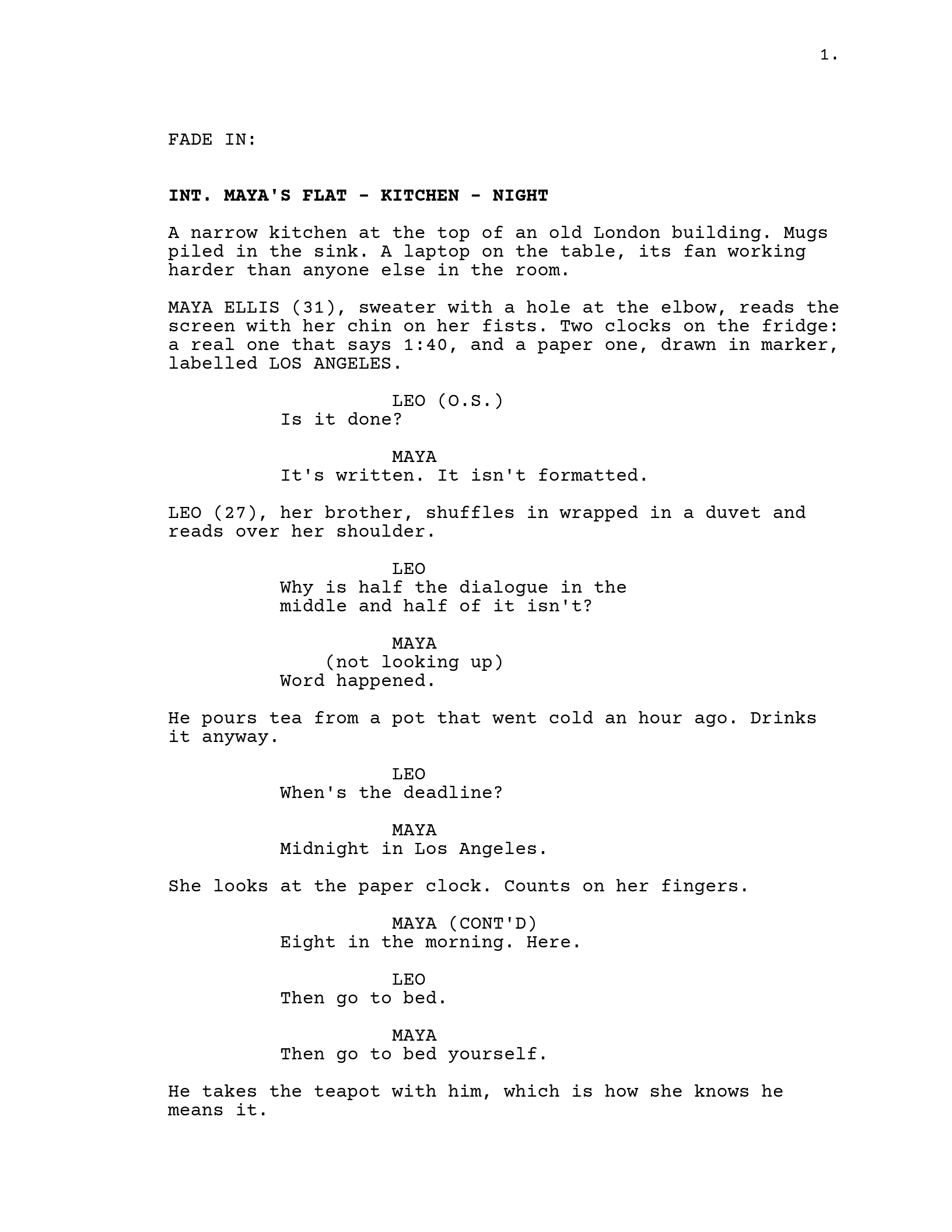
Why the format exists
A screenplay is a working document long before it is a film. A producer budgets from it, an assistant director turns it into a shooting schedule, actors learn their lines from it, and a reader at an agency decides from it whether anyone else should see it. All of that works because every screenplay page behaves the same way: one typeface at one size, the same margins, and a fixed place on the page for each kind of line.
The best-known result is the rule that one page runs about a minute on screen. Treat it as an average. When Stephen Follows compared 2,520 feature scripts with the finished films, the average came out at about 55 seconds a page, comedies ran faster, and fewer than one script in five landed close to a minute. A page of quick dialogue can play in thirty seconds, and a page of battle can take three minutes. Over a whole script the average holds, though, and it is why a page count means something to the people who read it.
The other reason is plainer. People who read scripts for a living read a great many of them, and a page that looks wrong tells them, before they have read a word, that the writer has not spent much time around screenplays. Good format will not rescue a weak script. What it does is let the reader start on your story instead of your margins.
The page
Courier, 12 point, single spaced. Every letter in Courier is the same width, ten to the inch, and every line is a sixth of an inch tall. That regularity is what lets a page stand for a stretch of screen time, and it is why nobody uses a proportional font. Courier Prime was drawn specially for screenplays and is the easiest to read; Courier New and Courier Final Draft are fine too. Resist shrinking the type or the margins to squeeze under a page limit. Readers notice, and some competitions say outright that they count it against you.
US Letter or A4. Scripts in the United States and Canada are on Letter (8.5 by 11 inches); most of the rest of the world uses A4 (210 by 297 mm). Send what the reader will print on, which usually means the paper of the country you are sending to. An A4 page is a little taller and holds four more lines, so the same script comes out a few pages shorter on A4.
Margins: an inch at the top and bottom, an inch and a half on the left, and about an inch on the right. The wider left margin dates from printed scripts held together with brass fasteners, and it has stayed. On A4, screenwriting programs keep the text the same width and let the right margin shrink to about three quarters of an inch.
Page numbers go top right, half an inch from the
top, followed by a full stop: 12. The title page is
never numbered. Page one traditionally isn't either, though plenty
of programs print it and nobody has ever minded.
Explore the page below. Choose an element to see where it sits and how big it is, and switch the paper and units to whichever you work in.
The measurements at a glance
| Element | Starts | Width | Blank lines before |
|---|---|---|---|
| Scene heading | 1.5 in (3.8 cm) | 6 in (15.2 cm) | One or two |
| Action | 1.5 in (3.8 cm) | 6 in (15.2 cm) | One |
| Character | 3.5 in (8.9 cm) | As long as the name | One |
| Parenthetical | 3 in (7.6 cm) | 2.5 in (6.4 cm) | None |
| Dialogue | 2.5 in (6.4 cm) | 3.5 in (8.9 cm) | None |
| Transition | Right-aligned, ending at 7.1 in (18 cm) | One | |
| Page number | Ending at the right margin, 0.5 in (1.3 cm) from the top | ||
All measured from the left edge of the paper, and the same on Letter and A4. These are the positions Final Draft uses, and most other programs follow them closely.

In ScriptopusA new script starts on exactly these measurements, single spaced. For one started earlier, File, Page Setup, then Match Final Draft does the same, on Letter or A4, for that script only. Every element's position can be changed in the same table.
The six kinds of line
Everything on a screenplay page is one of six things. Once you know where each one sits, you can read any script at a glance, and you have most of what you need to write one.
Scene heading also called a slugline
Every scene opens with one, in capitals, answering three questions: inside or outside, where, and when.

INT.for interior,EXT.for exterior. A scene that moves through a doorway, or happens in a moving car, can beINT./EXT.- The location runs from general to specific:
MAYA'S FLAT - KITCHEN. Call a place the same thing every time it comes back, because a production will schedule by it. - The time is nearly always
DAYorNIGHT. UseDAWNorDUSKwhen the light matters to the story.CONTINUOUSsays the action runs straight on from the scene before, andLATERsays time has passed in the same place.
You need a new heading whenever the place or the time changes. Many writers leave a little more space above a heading than above other lines, which makes scenes easy to find when flicking through. Bold headings are common now and accepted everywhere; pick a style and keep it for the whole script.
Action also called description
Action is what we see and hear, written in the present tense across the full width of the column. Write what a camera could catch: what people do, what things look like, what the room sounds like. Thoughts, backstory and feelings nobody can film belong somewhere else, or nowhere.

Keep paragraphs short. Three or four lines is a sensible ceiling, because white space is how a page shows pace: a dense block reads slowly, whatever happens inside it. Give a new paragraph to each new picture or beat.
Introduce each character in capitals the first time they appear,
and in normal type after that. Some writers also put an important
sound in capitals (her phone BUZZES); it is optional and less
common than it was. Camera directions such as CLOSE ON
or WE PAN TO are best left out of a script you are
sending to readers. You can nearly always get the same effect from
what you choose to describe and in what order.
Character the cue
The name of whoever speaks next, in capitals, about 3.5 inches
from the left edge of the paper. Some programs put it at 3.7;
nobody is measuring. Use one form of each name throughout. If she
is MAYA in one scene, she shouldn't be
MS. ELLIS in the next.
Three short tags can follow the name, in brackets:
(O.S.), off screen: the speaker is in the scene's location but not in the picture. Leo calling from the next room is off screen. Television scripts often write(O.C.), off camera, for the same thing.(V.O.), voice-over: the speaker isn't in the location at all. A narrator, a remembered voice, a recording, a voice coming over a radio.(CONT'D), continued: the same character speaks again after a line of action, with nobody else speaking in between. Most software adds it for you. Some writers turn it off in scripts they send out, since the reader can see who is talking. Both are correct.


Dialogue
The words themselves sit in a narrower column, from 2.5 to 6 inches, about 35 characters wide. That narrow column is why dialogue reads quickly, and why a page full of talk usually plays faster than a page full of action.
Write it the way people speak, with contractions, interruptions and sentences that don't finish. Avoid capitals for emphasis. If a word really must be stressed, italics or underlining will do it, and once a page is plenty.
Parenthetical sometimes called a wryly
A short note in brackets between the name and the speech, in lower
case, saying how a line is said or who it's said to:
(not looking up), (to Leo),
(in Spanish). Keep it to a few words, with no full
stop.

Use them rarely. When every line carries one, the reader starts to feel directed, and so do the actors, who will read your script more closely than anyone. If the note describes a physical action longer than a few words, it belongs in an action line.
Transition
An instruction about how one scene gives way to the next:
CUT TO:, DISSOLVE TO:,
SMASH CUT TO:, MATCH CUT TO:. Transitions
sit against the right margin, in capitals, ending in a colon.

A script you are sending out needs far fewer of them than you might
think. Every new scene heading already implies a cut, so
CUT TO: between every scene only uses up lines. Maya
deletes nine of them in our example, and her page count thanks her
for it. Keep transitions for the moments where the way we move
matters: a dissolve into a memory, a smash cut out of a quiet
moment. FADE IN: at the very start and
FADE OUT. at the very end are traditional, and
FADE IN: sits at the left margin.
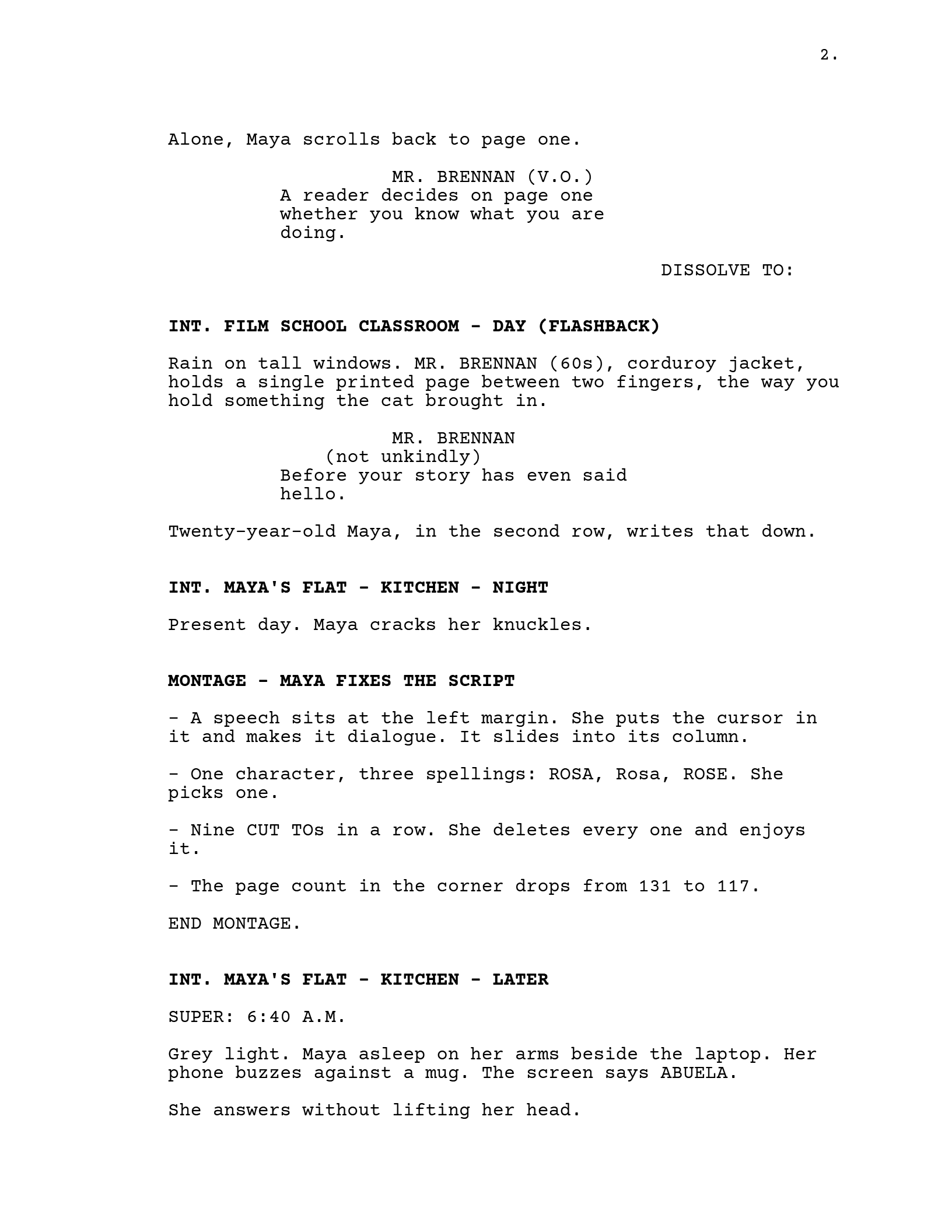
In ScriptopusYou hardly choose elements by hand. Enter after a character name goes to dialogue, and Enter at the end of a speech goes back to action. Tab moves a line between scene heading, action, character and transition, and inside a speech it makes a parenthetical.
Ctrl + 1 to 6, or Cmd on a Mac, sets an element directly, and Enter on an empty line opens the list of all six. Names and scene headings you've used before are offered as you type.
Situations every script runs into
Six elements cover most pages. These are the moments that send writers off to search the internet halfway through a scene. None of them needs a new kind of line: each is a known arrangement of the six.
Phone calls and intercutting
If we only hear the other side of a call, the far voice is
(V.O.), or (O.S.) if the caller is
somewhere in the same location. Some writers put
(on phone) under the name instead; either reads
clearly.
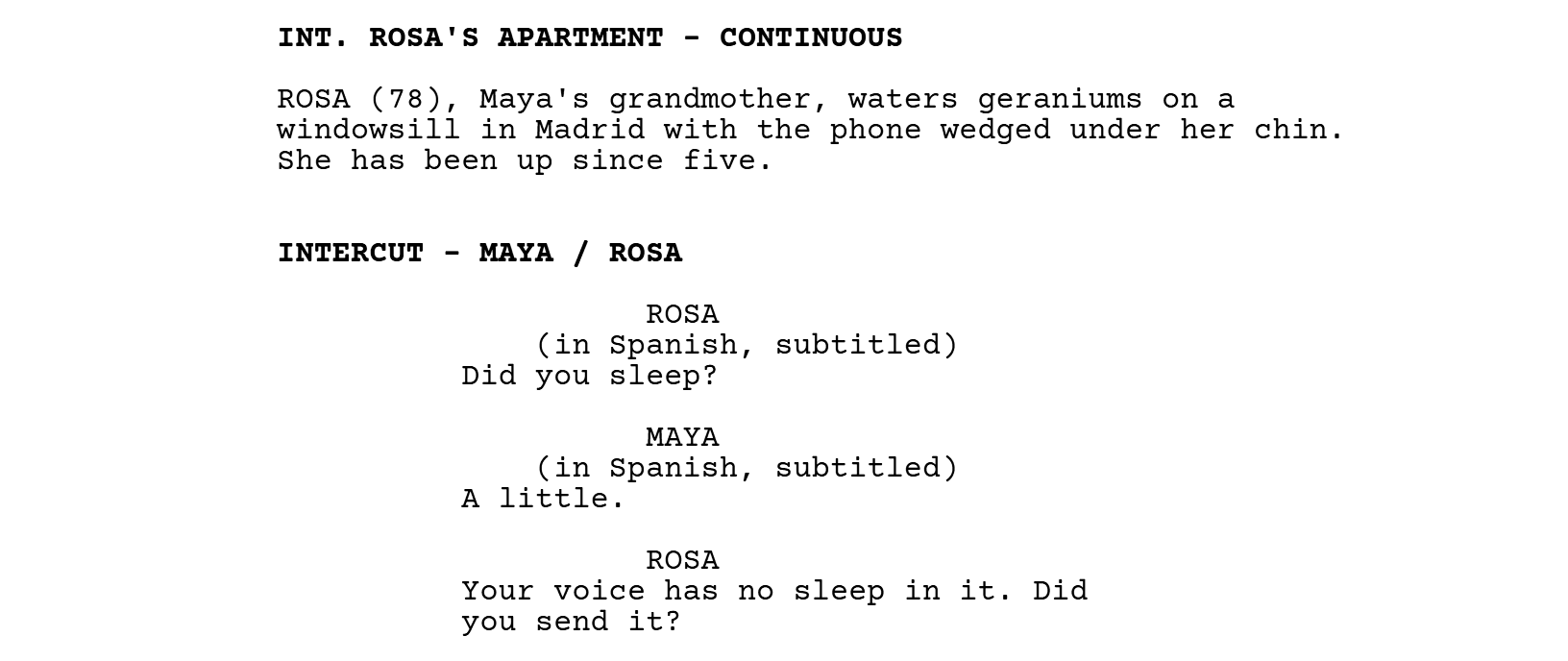
If we see both people, give each location its own heading once,
then write INTERCUT and let the conversation run with
no further headings. The editor will decide where the cuts fall,
and the reader doesn't have to climb over a heading every two
lines. When the call ends, a new heading, or
END INTERCUT, takes us back.
Another language
Write the dialogue in the language your reader reads, and say what
the audience hears in a parenthetical:
(in Spanish, subtitled). Once a scene has made it
clear, you don't need the note on every line. If the audience
shouldn't understand a line, write it in the original language and
say so: (in Spanish, no subtitles). For a long stretch
in another language, a single action line does the job: The rest of
the call is in Spanish, subtitled.
Texts, emails and screens
There is no single standard here, which is freeing. For a short
message, put it in the action line with the words in quotation
marks, so nobody mistakes it for something spoken. For a long
exchange of texts, some writers set them like dialogue, with
(TEXT) after the name. Whatever you choose, do it the
same way every time.

Inserts and words on screen
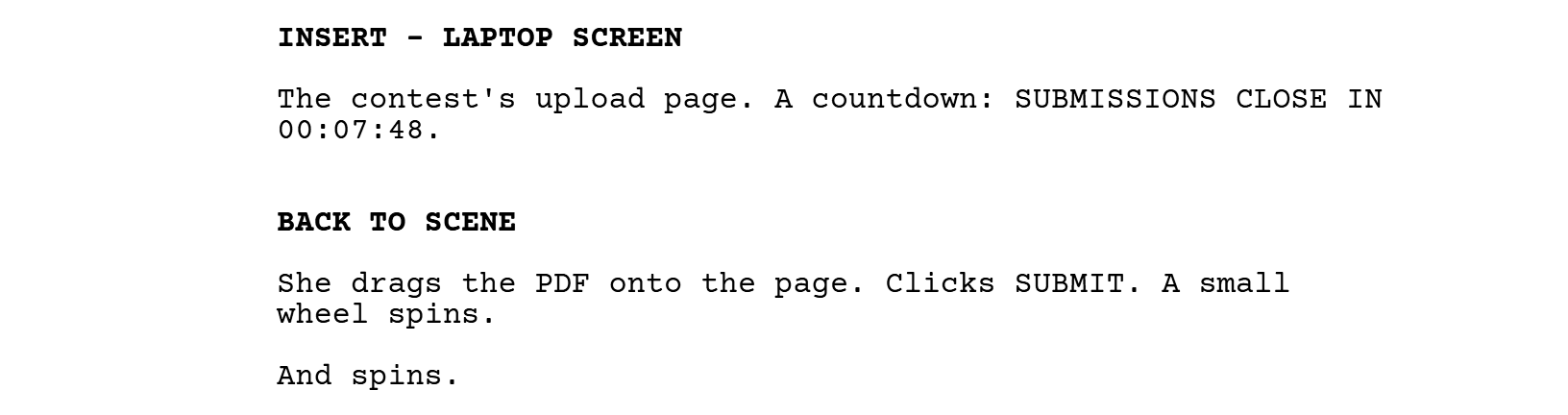
INSERT is a heading that cuts to a close view of
something we need to read: a letter, a phone, a countdown. Write
what it shows, then BACK TO SCENE to return.
Words that appear over the picture, such as a time or a place, are
a SUPER, short for superimpose, written in the action
line. Some writers use TITLE: or
ON SCREEN: for the same thing.

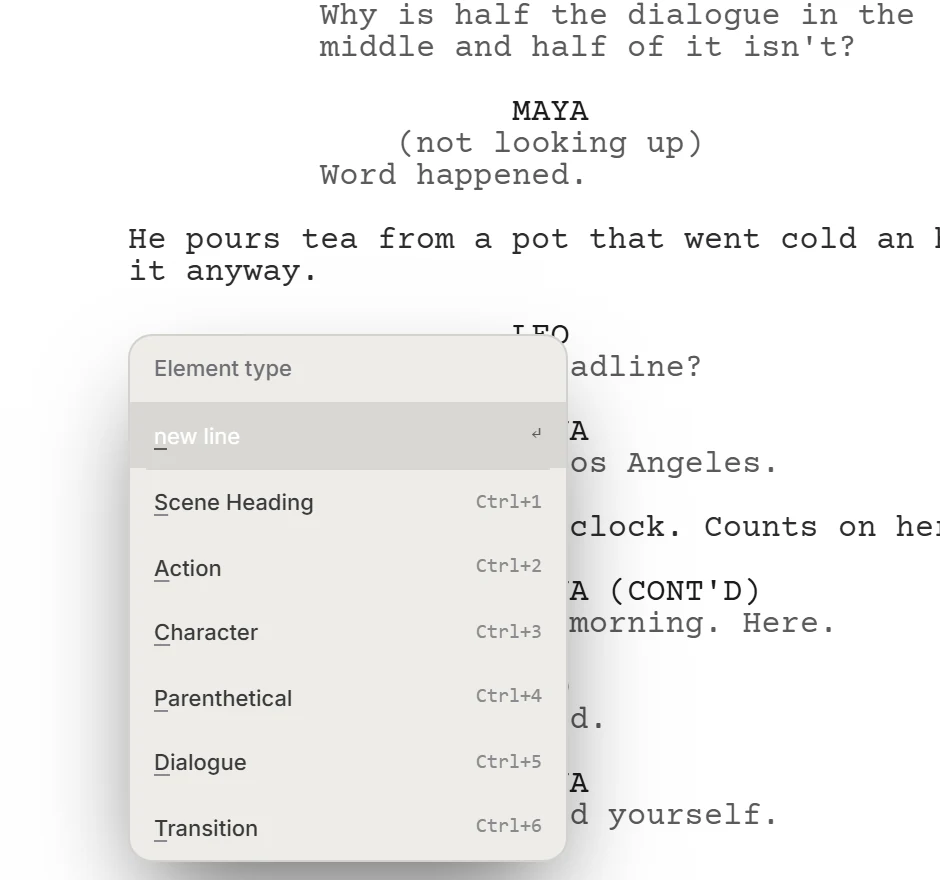
Flashbacks and dreams
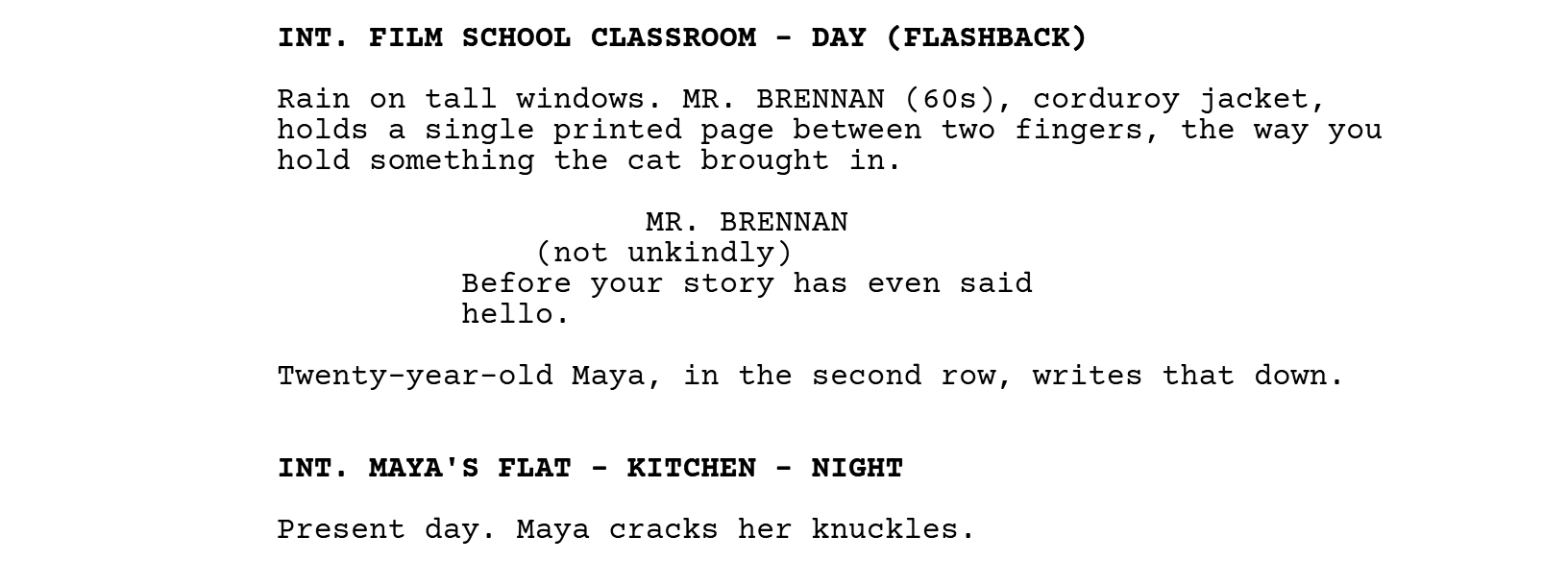
Put the label in the heading:
INT. FILM SCHOOL CLASSROOM - DAY (FLASHBACK). Then
make the way back unmistakable, either with a heading that says
PRESENT DAY or with a normal heading and an action line
that makes it plain, as below. A dream works the same way, with
(DREAM) in the heading.
Montages and series of shots
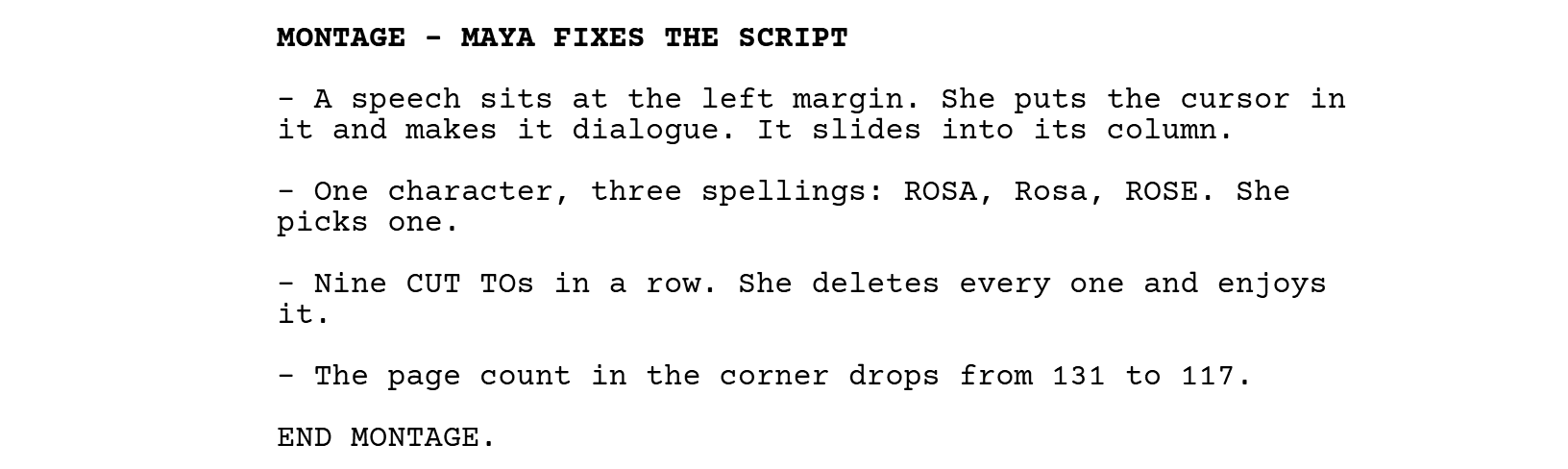
A montage compresses time: a run of short moments that add up to
one change. Open it with a heading, give each moment a line of its
own (a dash in front is common), and close it with
END MONTAGE. A series of shots is the same idea for a
single continuous piece of action, usually labelled
SERIES OF SHOTS. Neither has a fixed layout. The reader
only needs to see clearly where it starts and where it stops.
Two people talking at once
Overlapping speech can be printed side by side in two narrow
columns, which is called dual dialogue. It is harder to read than
it looks, so keep it for the rare moment where the overlap is the
point. Two speeches one after the other, with
(overlapping) under the second name, say the same
thing and work in every program.
MORE and CONT'D at the bottom of a page
When a speech won't fit at the foot of a page, it can be split.
The first half ends with (MORE) under the text, and
the rest starts on the next page under the name again, followed by
(CONT'D). A good split leaves at least two lines on
each side and falls at the end of a sentence. A scene heading, a
character name or a parenthetical is never left alone at the
bottom of a page.

next page
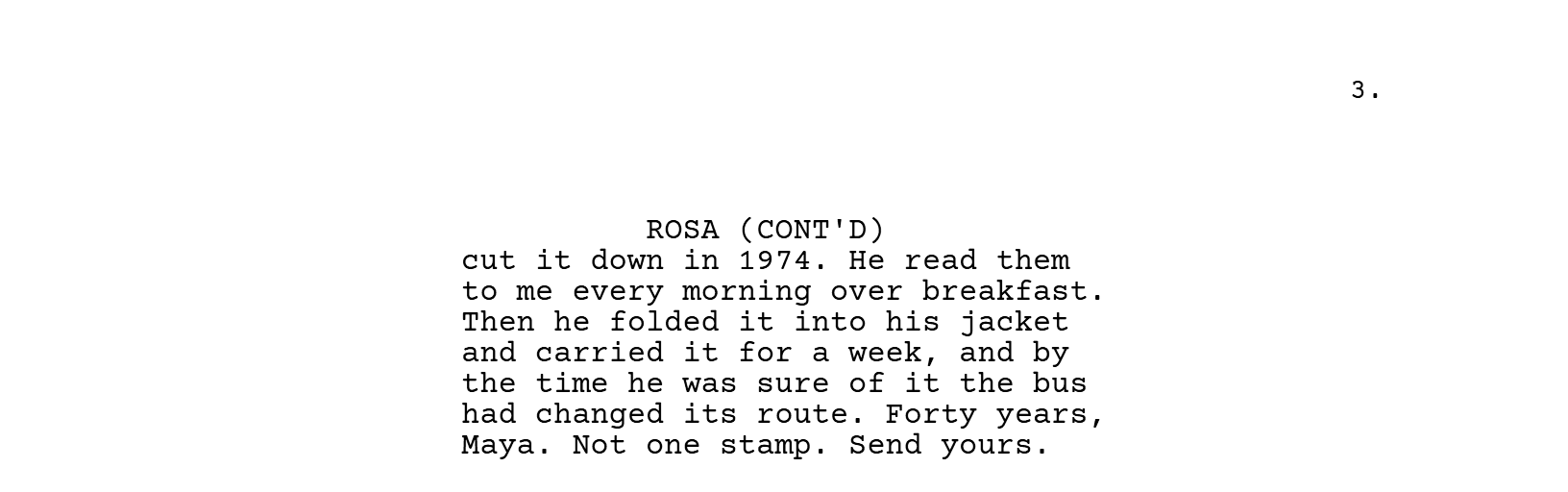
You never type any of this yourself. The program adds the marks
where the page breaks fall and moves them whenever the text moves,
which is exactly why typing them by hand in a word processor goes
wrong. Action paragraphs can also break across a page, at the end of
a sentence. Older production scripts printed CONTINUED
at the top and bottom of every page where a scene ran on; scripts
sent out to readers leave that off.
In Scriptopus(MORE) and (CONT'D) appear at page breaks in the page view and in the PDF, by the rules above. (CONT'D) for a character who speaks again in the same scene is added as you type.
The title page
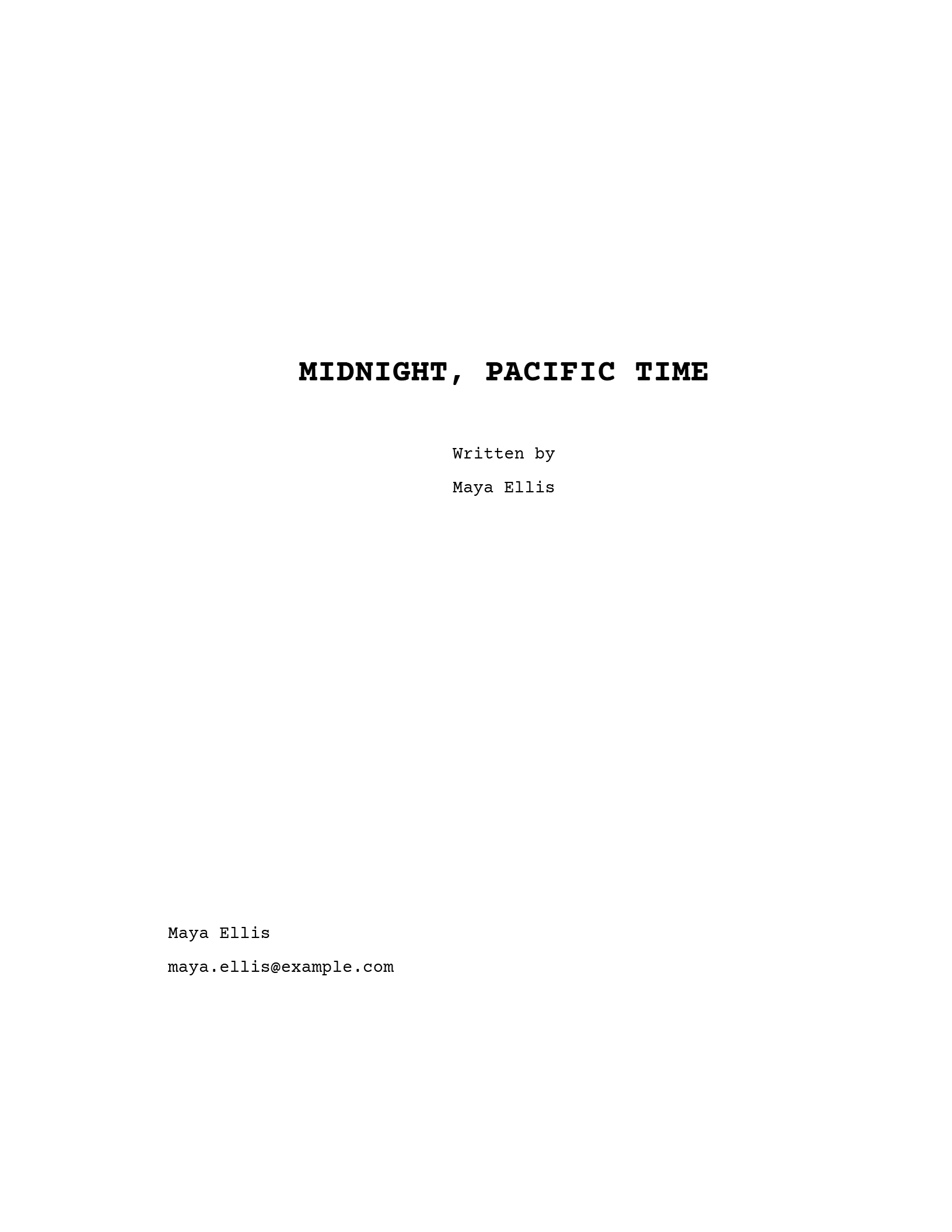
One page, in the same Courier as the script, with no number. The title goes in capitals about a third of the way down, centred, with Written by and your name under it. For television the credit is often Teleplay by or Written by under the episode title.
If the story comes from somewhere else, a novel, a play or a real life, say so under your name: Based on the novel by... Your contact details go in the bottom left corner. An email address and a phone number are enough. Once you have an agent or a manager, their details replace yours.
Leave off a logline, images, a copyright line, a registration number and, on a script you are sending out, the draft date. A date mostly tells a reader how long the script has been doing the rounds; dates and revision colours belong to scripts already in production. Some competitions read anonymously and want no name anywhere in the file, title page included, so check the rules before you export.
In ScriptopusEdit cover page, above the first page of the script, opens the title page. The design arrows step through six layouts; the first, Industry Standard, is the one described here.
Spec script or shooting script
Everything so far describes a spec script, one written to be read by people deciding whether to buy it, make it or represent the writer. Once a film is going ahead, the script becomes a shooting script and picks up things a spec never needs:
- Scene numbers on both sides of every heading, so the whole crew can talk about scene 47.
- Revision marks: an asterisk in the right margin beside every changed line.
- Coloured pages for each round of changes, usually in a fixed order that starts white, blue, pink, yellow, green.
- Locked pages: once the page numbers are fixed, new material becomes page 12A rather than renumbering everything after it.


A spec doesn't need any of this, and most writers leave it all
off. A spec also leaves out CONTINUED marks and keeps
camera directions to the few that are truly needed.
Television is a little different
An hour-long drama or a single-camera comedy is formatted like a
film, with one addition: act breaks. Each act starts on a new page
with its name at the top (TEASER or
COLD OPEN for a scene before the titles, then
ACT ONE, ACT TWO) and ends with
END OF ACT ONE. Many streaming shows have dropped act
breaks. Formats do vary from show to show, so find a produced
script of the show you're writing for and copy its layout.
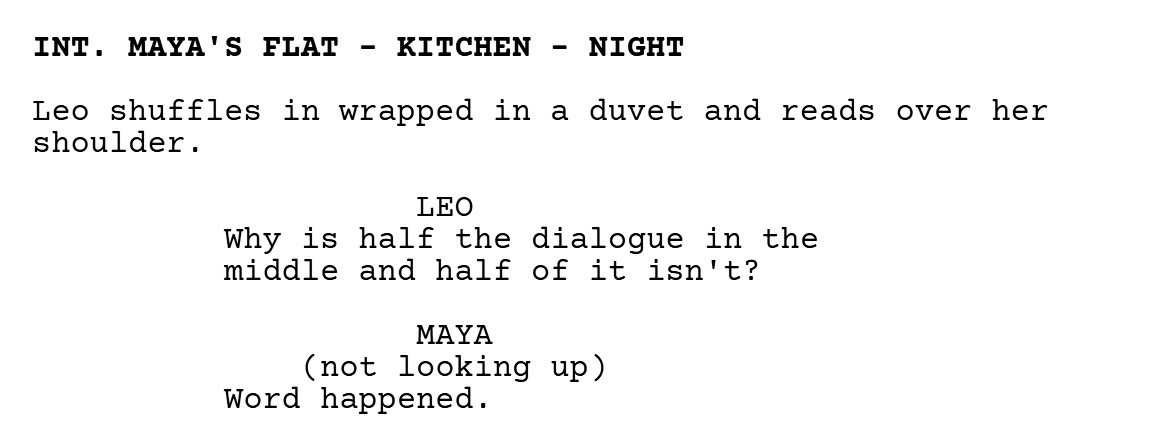
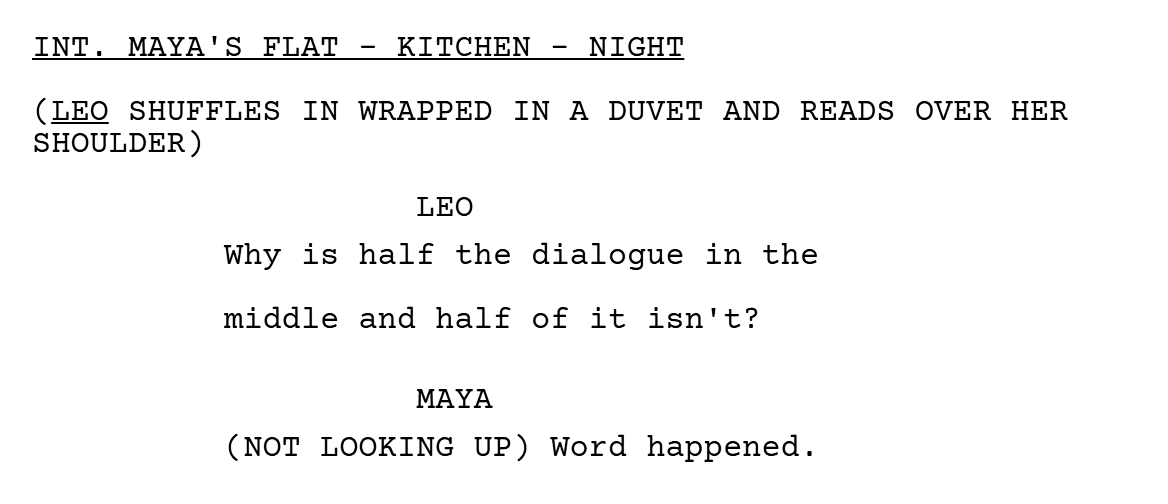
Multi-camera sitcoms, the ones shot in front of a studio audience, look very different. Dialogue is double spaced, action is in capitals, scene headings and characters' entrances and exits are underlined, scenes are lettered rather than numbered, and each new scene starts on a new page. The double spacing means a half-hour multi-camera script runs to roughly twice the pages of a single-camera one.
Single camera, laid out like a film
Multi-camera
Lengths, as a rough guide: a single-camera half hour is around 30 to 35 pages, an hour-long drama 50 to 65, and a multi-camera half hour 45 to 55.
Before you send it
Read through once against this list. It takes ten minutes and catches most of what a reader would notice on page one.
0 of 13 checked
Letting software do the measuring
Nobody formats a screenplay with a ruler any more. A screenwriting program sets every margin and indent as you type and lays out the page breaks, so you can think about the scene rather than the spacing. It also hands you the two files that matter: a PDF to send, and a Final Draft (.fdx) file, which is what productions pass between programs.
Scriptopus is one of them, and its editor is free on Mac and Windows. You type, and each line lands where this guide says it should. The structure panel keeps your scenes, characters and locations in order as you go, and the script exports as a PDF, a Final Draft file, Fountain or Celtx.
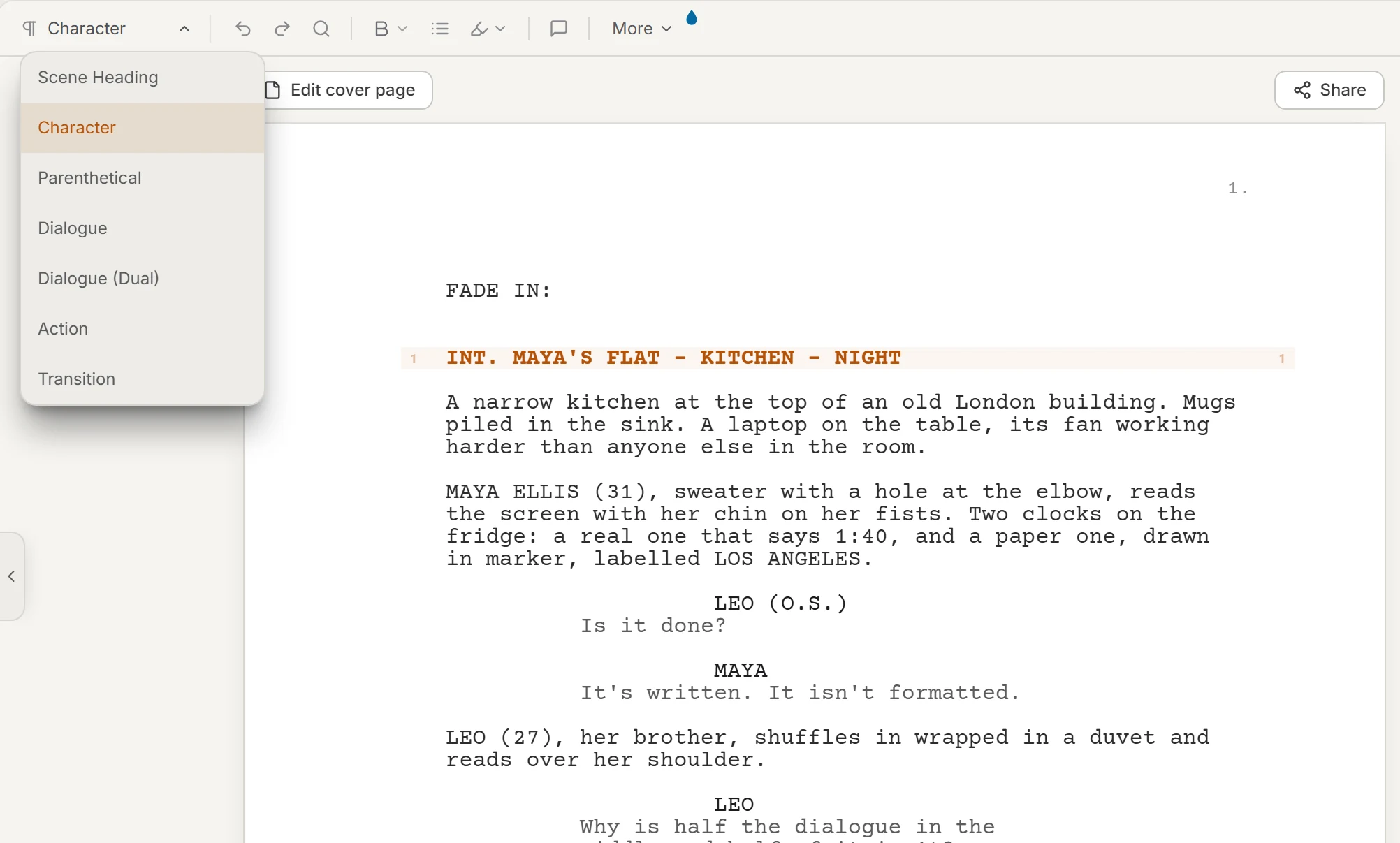
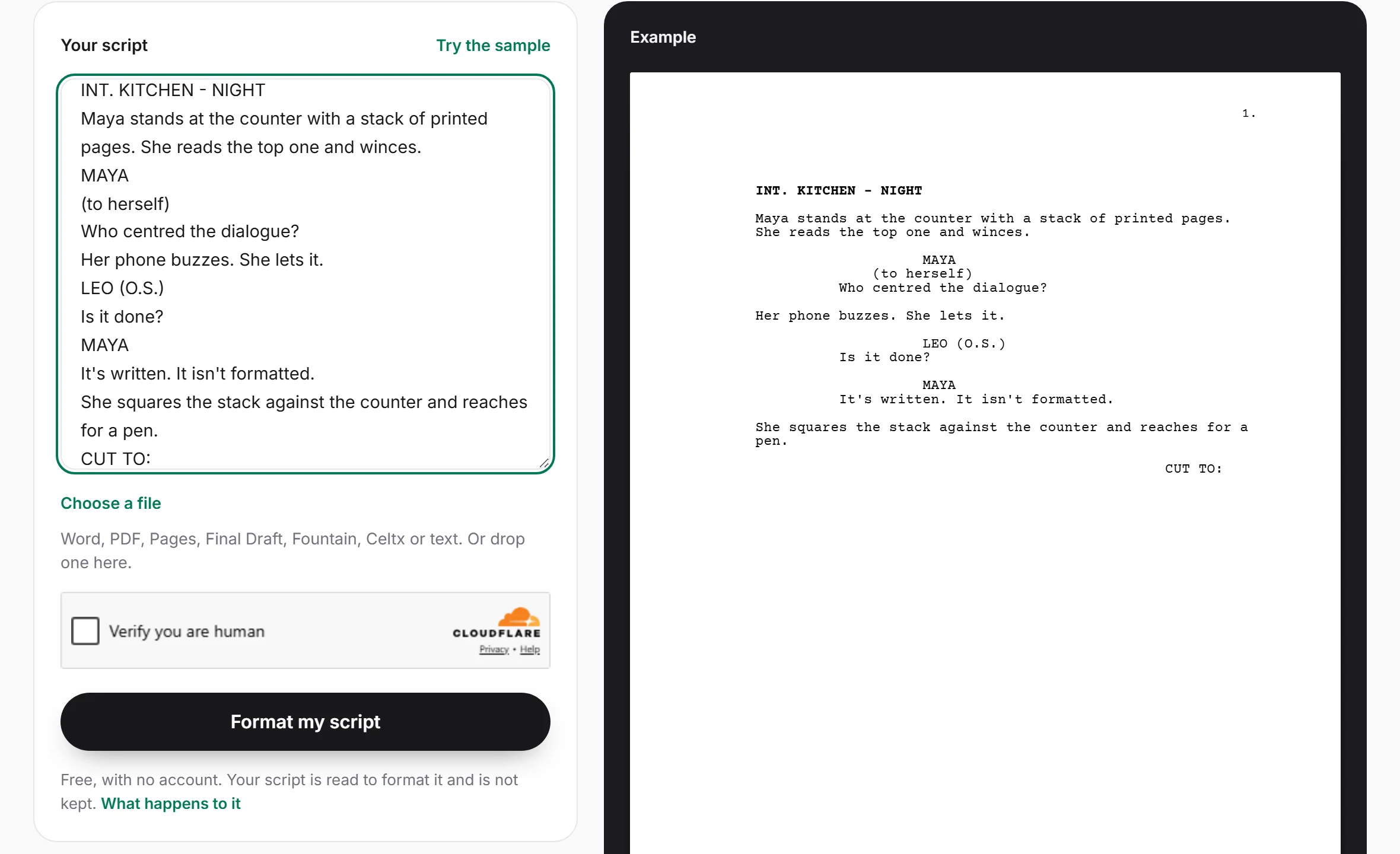
Already have a script in Word, Google Docs or a PDF that came out wrong? The free screenplay formatter on this site reads it, works out what each line is and gives it back in the format above, as a PDF, a Word file, a Final Draft file or Fountain. It needs no account.
Downloads
Both are free to download, print and share. The example script is ours, written for this guide, so you're welcome to use it as a template or take it apart.
The example script
Midnight, Pacific Time: four pages and a title page, with every case in this guide in it. Open it in any screenwriting program.
The one-page cheat sheet
The measurements, the six elements, the common cases and the checklist on a single page, to print and pin above the desk.
Questions
Can I write a screenplay in Word or Google Docs?
You can, with a style for each element and a lot of patience. The trouble starts at the page breaks: a word processor doesn't know that a character name must stay with its speech, or where (MORE) and (CONT'D) belong, and every edit moves them. Most writers who start in Word move to a screenwriting program by the second draft. If you already have a script in Word, the free formatter will convert it.
Do I need Final Draft?
No. It is the program most American productions use, and its .fdx file is how scripts move between programs, but readers only ever see your PDF. Any program that writes a clean PDF and an .fdx file covers you.
Which font should I use?
A Courier at 12 point. Courier Prime is the most readable and was made for screenplays; Courier New is thinner but accepted. The size matters more than the cut, because the size is what keeps the page timing honest.
How long should a screenplay be?
For a feature, 90 to 120 pages is the comfortable range. Comedy and horror often come in under 100; a drama can run longer, though past 120 a reader starts to wonder what could go. Competitions set their own limits: the Academy's Nicholl Fellowships, for example, suggested 80 to 125 pages in their 2024 rules. For television, see the section above.
Should I put CUT TO: between scenes?
Not as a habit. A new scene heading already tells the reader we have cut. Save transitions for the moments where how we move from one scene to the next is part of the storytelling.
Should I number my scenes?
Not in a script you're sending to readers. Scene numbers are for a production, where a crew needs to point at the same scene. Some countries' guides ask for them in every draft, though; Screen Australia's suggested layout numbers its scenes, for example.
How do I write a song?
As dialogue, with (singing) under the name. Lyrics are often set in italics so they read differently from speech, and a line or two is usually enough. If a well-known song plays in the background, name it in the action, and keep in mind that its rights cost money.
Is the format the same in every country?
Very nearly. The US layout is understood everywhere, which is why it is the one in this guide. The paper changes: A4 outside North America. Some countries add their own habits, such as bold, numbered scene headings in Screen Australia's layout, or the play-like layouts still used in parts of European television. When a fund or a broadcaster publishes its own guidance, follow theirs.
Do readers really reject scripts over formatting?
Rarely over a stray indent. What they react to is a page that shows the writer hasn't read many scripts: centred dialogue, camera directions in every paragraph, a title page full of copyright notices. Get the basics right and the format disappears, which is the point.
Sources and further reading
- Christopher Riley, The Hollywood Standard. The most thorough book on screenplay format, element by element.
- David Trottier, The Screenwriter's Bible. Format, spec style and selling a script, in one long book.
- Stephen Follows, Does one page of a screenplay really equal one minute of screen time? The study of 2,520 scripts quoted above.
- The Writers Guild Foundation, screenplay primers, with examples from produced scripts.
- Screen Australia, Suggested script layout (PDF), an A4 layout with numbered scenes.
- The Academy Nicholl Fellowships, rules and requirements.
Write it formatted from the first line
Scriptopus sets every line as you type, keeps the beat board and the treatment beside the script, and exports the PDF and Final Draft file you'll need. The editor is free on Mac and Windows.
- Every element in its place, with Tab, Enter and Ctrl+1 to 6.
- (MORE) and (CONT'D) at every page break, on Letter or A4.
- Six title page layouts, Industry Standard first.
- PDF, Final Draft, Fountain and Celtx exports, and Final Draft, Fountain and Celtx files open in it.