The size of story a short can hold
Most good shorts follow one character through one situation that changes them, or changes how we see them. The stretch of time is often small enough to hold in one breath, such as a night, a phone call or a drive. The shorts that stay with people are rarely features squeezed small. They are stories that would be spoiled by being any longer.
Length is a matter of choice up to a point. The Academy counts a film as a short when it runs forty minutes or less, credits included, but most festivals programme far shorter work, and a film of ten or twelve minutes is much easier to place in a programme than one of thirty. At about a minute a page, that puts most short scripts between five and fifteen pages.
A short script also has jobs a feature doesn't. It is often the first thing a new writer gets made, and a common calling card for directors and producers looking for a writer. And plenty of screenwriting competitions run a category for shorts, judged on the page alone.
The format is the same as a feature's
Nothing in the layout changes for a short: the same Courier 12 point, the same margins, scene headings, action, dialogue and transitions in the same places, and a title page in front. If you already know how a feature is formatted, you know how a short is. If you don't, our guide to screenplay format shows every rule on real pages, and the screenplay template works for a short as it is.
Some writers add a short film under the title on the title page. It is optional and harmless; the page count tells a reader the same thing.
An example: Midnight, Pacific Time
Our formatting guide was written around a four-page short, and it makes a useful example of what a short can carry. Maya, a screenwriter in London, has finished her script for a Los Angeles competition and discovers at 1:40 in the morning that it is a formatting disaster. The deadline is midnight Pacific time, eight in the morning for her.
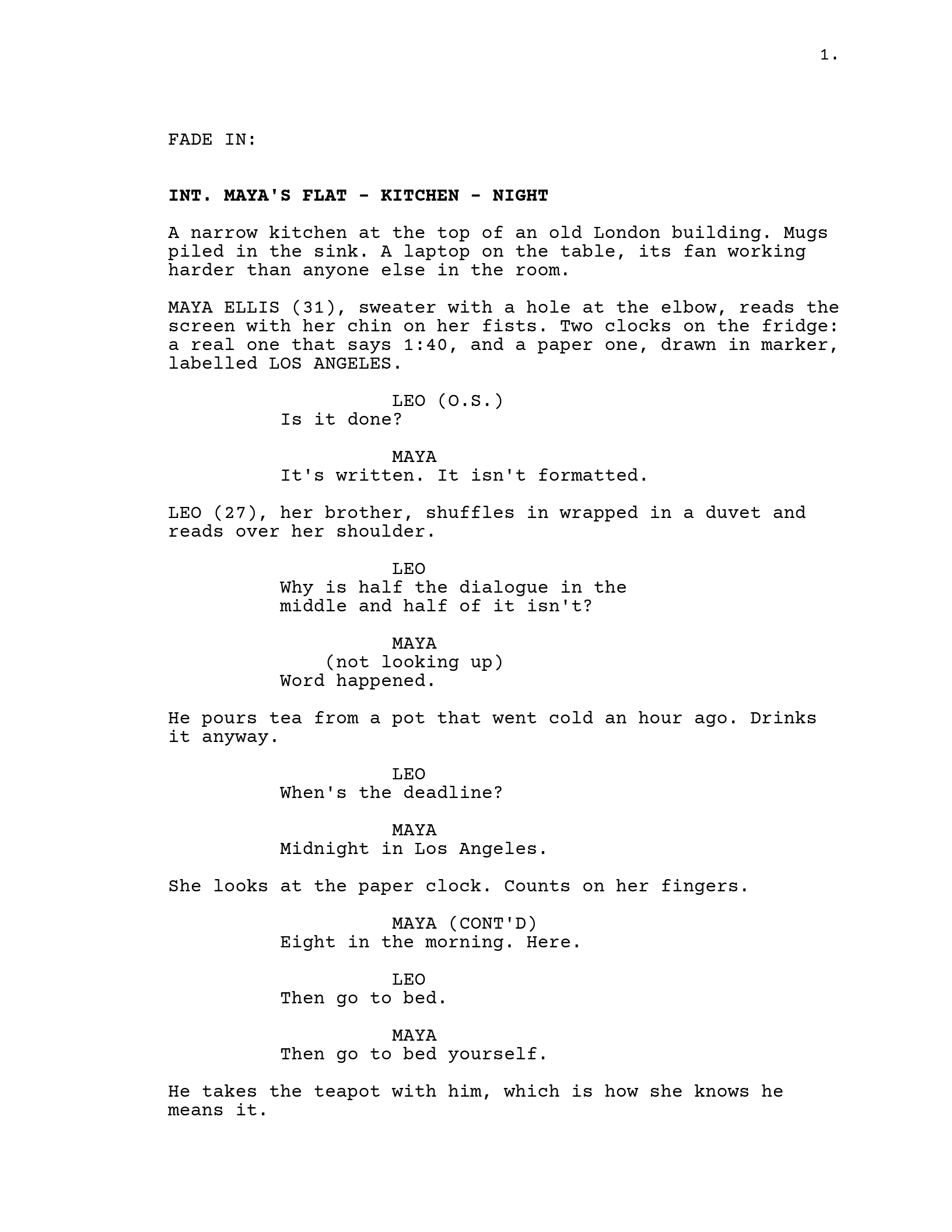
Page one
By the end of the first page we know who she is, what she wants, the obstacle and the deadline. The paper clock labelled LOS ANGELES does the explaining.
What makes it work as a short:
- A clock from the first page. The deadline is set in the first exchange, and the SUPERs (6:40 A.M., 7:52 A.M.) keep it ticking.
- Few places. Her kitchen, a remembered classroom and her grandmother's flat in Madrid. Two of them could be shot on one day.
- Four speaking parts. Besides Maya, each has one clear job. The brother teases, the teacher's voice judges, the grandmother pushes.
- One change. She arrives too tired to finish and leaves having sent it. What tips her is her grandmother's story about a grandfather whose letters to the newspaper never once went off on time.
- An ending that is an image. She lies down on the kitchen floor and says one word.
The whole script is free to download below, as a PDF on either paper size, a Final Draft file and Fountain.
Writing with the budget in mind
Most shorts are made on very little money, and a script that knows that gets made more often. A handful of things cost far more on the day than they do on the page:
- Night exteriors, which need lights, permits and a crew awake all night.
- Crowds and extras, each one a person to find, feed and direct.
- Children and animals, with the rules and the patience both require.
- Moving vehicles, weather and stunts. A rainy scene is a rain machine.
- Period settings, where every car, sign and costume has to be found.
- Lots of locations. Each move costs hours of a short shoot day.
A cheap film can still have one expensive moment, as long as the rest pays for it. A short set mostly in one flat can afford one striking exterior. Writers who can get hold of a location, a relative's café, a friend's boat, often write the story around it.

In ScriptopusProject Info has a Planned Duration field, and the Beat Board lets you give each beat an estimated length in minutes, so you can see a short's running time take shape before you write the pages.
Shape in ten pages
A short still turns. Something happens early, the situation tightens, and something at the end is different from the start, even if it is only how the audience sees the character. What a short doesn't need is everything a feature needs between those points: subplots, several reversals, a long middle.
- Start late. Begin as close to the change as you can. Page one of a short is already a quarter or a tenth of the film.
- One turn, well placed. A ten-page script has room for one real reversal, usually two thirds of the way in.
- Trust the audience. A short can leave things unsaid that a feature would have to explain.
- Be careful with twist endings. A final reveal that recasts everything can be wonderful, and it is also the ending readers see most often. If the twist is the only reason the film exists, test whether the story works without it.
Structures built for features still help as a check. The beat sheet calculator places the fifteen beats in a twelve or thirty page script, and the story circle's eight steps suit a short particularly well.
Where short scripts tend to go wrong
- A feature in miniature. Too many characters and settings, each given a page, none given room.
- Backstory up front. The audience can learn who someone was while watching what they do now.
- Dialogue that explains. A short has no room to spare, and lines that tell the audience what they have just seen are the first to cut.
- Nothing changes. A mood piece can be beautiful, but a reader wants to feel the ground move, however slightly.
Download the example and the template
Midnight, Pacific Time is ours, written for the formatting guide, so you are welcome to use it as a model or take it apart. The screenplay template is the same layout with explaining lines to type over. Free, with no sign-up.
The example script
Midnight, Pacific Time: a title page and four pages.
The screenplay template
The same layout with explaining lines to type over.
Questions
How long should a short film script be?
Most fall between five and fifteen pages, which plays as five to fifteen minutes. Shorter is easier to get programmed. Check the limits of the festivals or competitions you have in mind.
Is a short script formatted differently from a feature?
No. The page, the elements and the title page are identical.
Does a short need a logline and a synopsis?
Usually, yes. Competitions, funds and producers ask for them for shorts as they do for features. Our logline guide includes a short film example.
Can I enter a short script into competitions?
Many screenwriting competitions have a short script category, and some are for shorts only. Our screenwriting events list shows which ones, with their page limits and fees.
How many locations should a short have?
There is no rule, but every location is time on the shoot. Two or three is comfortable for a ten-minute film made on a small budget.
Sources
- The Academy of Motion Picture Arts and Sciences, rules for the short film awards (PDF): forty minutes or less, credits included.
- Stephen Follows, Does one page of a screenplay really equal one minute of screen time?
Write it formatted from the first line
Scriptopus sets every line as you type, keeps the beat board and the treatment beside the script, and exports the PDF and Final Draft file you will need. The editor is free on Mac and Windows.
- Every element in its place, with Tab, Enter and Ctrl+1 to 6.
- Beat Board, Treatment and Synopsis in the same project as the script.
- Six title page layouts, Industry Standard first.
- PDF, Final Draft, Fountain and Celtx exports.