Why scripts get broken down
Before anyone can say how many days a film will take to shoot, or what it will cost, someone has to go through the script one scene at a time and write down everything each scene needs in front of the camera. That means the actors in it and the extras behind them, what they carry and wear, any vehicle or animal, and anything that has to burn, break or get wet. The record of it, usually a sheet for every scene, is the breakdown, and both the schedule and the budget are built from it.
On a feature the first assistant director normally does it, and each department then reads the script again for its own share: the props team for props, the costume designer for wardrobe.
Writers can do the same exercise for their own reasons. A breakdown shows a script the way a producer will see it, as a list of things to find, hire and schedule, and it is kinder to learn from your own sheet that a script has nine night exteriors than to hear it from a producer.
Measuring scenes in eighths
Productions measure each scene in eighths of a page. Picture every page cut across into eight equal bands, each a little over an inch deep, and count how many bands the scene covers. With 54 lines on a Letter page, an eighth comes to about seven lines.
Lengths are written as whole pages and eighths, 1 3/8 or 4/8, and the fractions are usually left as they are, so half a page stays 4/8. A scene shorter than an eighth still counts as one, since even a heading and a single line of action has to be lit and shot.
Eighths exist because a shoot is planned in pages. Adding up the eighths of the scenes planned for one day tells the assistant director whether the day is realistic, and comparing days shows where the schedule is overloaded. They are only a rough guide to effort, though, and a quarter of a page of storm at sea can take longer to shoot than three pages of two people talking at a table.
The colour code
Breaking a script down starts with marking it up. The person doing it reads each scene with a set of highlighters and marks every element in the colour for its kind, then copies the marked items onto the scene's sheet. Colour habits differ between productions, countries and scheduling programs, so the scheme below is one common version among several. It is the one given in Bastian Clevé's Film Production Management.
| Element | Marked with | What goes in it |
|---|---|---|
| Cast | Red | Every actor with lines. |
| Stunts | Orange | Anything that needs a stunt performer or a stunt coordinator: a fall, a fight, a car driven fast. |
| Extras, silent | Yellow | Extras given something particular to do, but no lines. |
| Extras, atmosphere | Green | The people in the background, from a few passers-by to a full bar. |
| Special effects | Blue | Effects made on set, such as rain, smoke, fire or breaking glass. |
| Props | Purple | Objects an actor handles or the story depends on. |
| Vehicles and animals | Pink | Cars on screen and any animal, with whoever will handle it. |
| Sound and music | Brown | Sound or music made or played on set, as opposed to what is added after the shoot. |
| Wardrobe | A circle | Costumes that need particular attention: a uniform, a shirt that gets torn, a coat that gets soaked. |
| Make-up and hair | An asterisk | Wounds, blood, ageing, wet hair, anything beyond the everyday. |
| Special equipment | A box | Kit a normal day doesn't bring, such as a crane, a drone or an underwater housing. |
| Production notes | Underlining | Questions about how something will be done. |
Many sheets add boxes of their own, such as set dressing, visual effects added after the shoot, or extra crew for a big day. Use whichever categories the production uses, and mark every scene the same way, so nothing gets counted twice or missed.
What goes on a breakdown sheet
A breakdown sheet holds one scene, or now and then a run of very short scenes at the same set. Its header identifies the scene, on most sheets in roughly this order.
- Sheet number, with the production's title and the date of the script it was taken from.
- Scene number, and the script page the scene starts on.
- Set, as the scene heading names it:
BEACH. - Interior or exterior, and day or night. Dawn and dusk get their own entry when the light matters.
- Pages, in eighths.
- Synopsis, one line on what happens, short enough to fit on a strip of the schedule.
- Location, the real place where the set will be shot, once someone has found it.
Below the header come the boxes, one for each category of the colour code, and a space for notes. Many productions print or shade each sheet in the colour its scene will have on the schedule, by a four-way habit: white for a day interior, yellow for a day exterior, blue for a night interior and green for a night exterior. Movie Magic Scheduling, a program many productions use, swaps the two night colours.
A worked example: the beach in Low Tide
Low Tide is the sample project in Scriptopus. Mara, a sound recordist, comes back to her late mother's cottage on the day it is sold and finds her estranged father, Des, already there. In scene 6 she walks out onto the flats at low tide to record the sea, Des follows her, and the argument they have both been avoiding all afternoon breaks open.
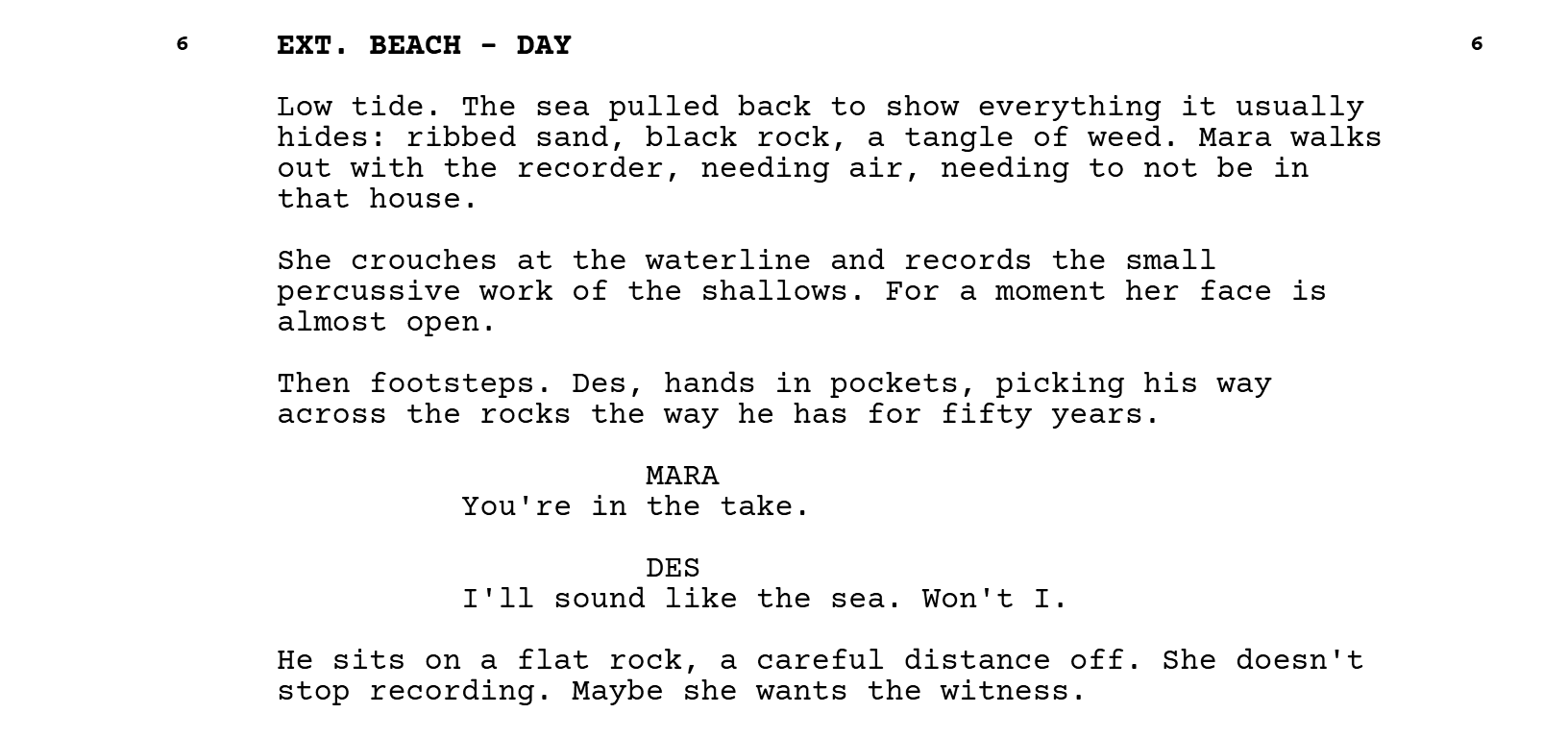
Read with highlighters in hand, the whole scene fills in a sheet like this one.
| On the sheet | Scene 6 |
|---|---|
| Set | EXT. BEACH - DAY |
| Interior or exterior, day or night | Exterior, day |
| Pages | 1 5/8 |
| Synopsis | At low tide Mara accuses Des of keeping her from her dying mother. He has no answer and walks away. |
| Cast | 1. Mara, 2. Des |
| Extras | None written. A public beach may need passers-by kept out of shot. |
| Props | Mara's field recorder, the one she carries all day. |
| Wardrobe | Both as in the scenes at the house; Des in the old jumper from scene 3. |
| Make-up and hair | Wind on the beach, to match on into scene 7 in the study. |
| Special effects | Des's footprints filling with sea water as he walks off, shot for real at the water's edge or prepared. |
| Sound | Mara records the shallows in the scene, and that recording plays again in the last scene. |
| Stunts, vehicles, animals, special equipment | None. |
| Notes | Low water, in daylight, from the tide table. The scene ends as the tide turns. Des crosses wet rock, so check the footing for the actor. |
Most of that is routine. The expensive words are the first two of the scene. Low tide ties the shoot to the tide table: the flats are uncovered only for a stretch either side of low water, that stretch has to fall in daylight on a day when the actors and the beach are both available, and Des's last line asks for the tide to be turning by the end.
Nobody should cut those words, since the tide is the film's central image and its title. But a writer who knows what they cost can help the production. If the argument plays on the rocks above the waterline, with the flats behind, a bad tide day loses the wide shots and leaves the scene standing.
The sheet also catches a link the scene only hints at. The sea Mara records here is the sound she plays in the car at the very end, under her father's voice, so the sound department will want a clean recording of these shallows, at this beach, for the final scene.
Breaking down your own script
A writer's breakdown can be rougher than a production's. You don't need a sheet for every scene; a scene list with a few columns shows most of what a producer will look for. Lay it out the way a stripboard does, a row per scene, with the set, interior or exterior, day or night, the eighths and the speaking parts. The table below is Low Tide set out that way.
| Scene | Set | Int. or ext. | Time | Pages | Cast |
|---|---|---|---|---|---|
| 1 | Coastal road | Ext. | Day | 4/8 | Mara; Elena on tape |
| 2 | Cottage | Ext. | Day | 3/8 | Mara |
| 3 | Cottage, living room | Int. | Day | 1 4/8 | Mara, Des |
| 4 | Cottage, kitchen | Int. | Day | 1 1/8 | Mara, Des |
| 5 | Cottage, hallway | Int. | Day | 7/8 | Mara, Des |
| 6 | Beach | Ext. | Day | 1 5/8 | Mara, Des |
| 7 | Cottage, Elena's study | Int. | Day | 7/8 | Mara, Des |
| 8 | Cottage, living room | Int. | Dusk | 2 | Mara, Des; Elena on tape |
| 9 | Cottage, porch | Ext. | Dusk | 1 1/8 | Mara, Des |
| 10 | Cottage, living room | Int. | Dusk | 1 | Mara, Des; Ruth's headlights |
| 11 | Coastal road | Ext. | Night | 4/8 | Mara; Des on tape |
Sorted by set, the list turns into a rough shooting plan. Six of the eleven scenes are inside the cottage and two more just outside it, so most of the film can be shot in one house, and a beach close by would bring scene 6 into the same block of days. The two coast road scenes need a car, a quiet road and a way to film someone driving, and only the last is at night. Two speaking actors carry the whole script, with a third heard only on tape and a fourth seen only as headlights in the window.
A writer holding that list can describe the film to a producer in one sentence: a two-hander in one house, with a day on the beach and one night drive. In your own script, these are the totals to add up.
- Sets and locations. Each move to a new location costs hours of a shooting day.
- Night exteriors. They need lights, permits and a crew working through the night.
- Speaking parts. A character with even one line has to be cast, and usually costs more than an extra. Check whether the waiter or the receptionist could make the point without speaking.
- Extras. Every one of them has to be found, dressed, fed and directed.
- What nobody fully controls. Children, animals, water, weather and moving vehicles all add time, and a period setting means finding every car and shop sign in the frame.
- Effects and stunts. Even a small one brings specialists and a rehearsal.
None of these is a reason to cut a scene the story needs. They are things to know before a producer raises them, and sometimes a scene can keep its point and lose most of its cost, as when a conversation in a moving car plays just as well in a parked one.

In ScriptopusSelect a word or a phrase in the script and the bar that appears has a Tag button with six kinds: Character, Prop, Location, Wardrobe, VFX and Sound. A tagged phrase is underlined in its kind's colour on the page. In the toolbar, More, Breakdown tags opens a panel beside the page that lists every tag in the script by kind, and clicking one selects it in the text. The panel covers the whole script at once, so a single scene still gets gathered on a sheet like the template below.
Download the breakdown template
A breakdown sheet with the header and a box for every element in the colour code, a scene list laid out like a stripboard, and the Low Tide beach scene filled in as an example. The spreadsheet adds up the eighths for you and opens in Excel, Numbers and Google Sheets.
Print it
The breakdown sheet, the scene list and the Low Tide beach scene filled in, to work on in pencil.
Fill it in on screen
A workbook with the sheet and the scene list, which adds up the eighths for you. Numbers and Google Sheets open it too.
Questions
Who does the script breakdown?
On most productions the first assistant director, who turns it into the schedule. Each head of department then breaks the script down again for their own department. On a very small film the producer or the director may do all of it.
Should I send a breakdown with my spec script?
No. Readers are judging the story, and a breakdown would raise questions about cost before they reach page two. Do it for yourself, and keep it to hand for the day a producer asks what the film needs.
How do I count eighths when a scene starts halfway down a page?
Count the lines the scene takes on each page, from its heading to the last line before the next heading, and divide each count by about seven. Add the pieces together if the scene runs over a page break.
What is the difference between a breakdown and a shot list?
A breakdown lists what each scene needs in front of the camera, and can be made from the script alone. A shot list is the director's plan for filming the scene, set-up by set-up.
Does a voice heard only on tape count as cast?
Yes, as a part to be cast and recorded. In Low Tide, Elena is never seen, but an actor still has to voice her tapes, and the scenes where a tape plays on set need the recording ready to play back, which goes in the sound box.
Sources and further reading
- Wikipedia, Script breakdown, for the element categories and their colours, after Clevé.
- Bastian Clevé, Film Production Management, the source of the colour scheme on this page.
- Ralph S. Singleton, Film Scheduling, the long-standing book on breakdown sheets, eighths and the stripboard.
- Wikipedia, Production board, for the strip colours and Movie Magic Scheduling's variation on them.
Write it formatted from the first line
Scriptopus sets every line as you type, keeps the beat board and the treatment beside the script, and exports the PDF and Final Draft file you will need. The editor is free on Mac and Windows.
- Every element in its place, with Tab, Enter and Ctrl+1 to 6.
- Beat Board, Treatment and Synopsis in the same project as the script.
- Six title page layouts, Industry Standard first.
- PDF, Final Draft, Fountain and Celtx exports.