Two versions, two kinds of reader
A spec script is written on speculation. Nobody has paid for it yet, and its job is to persuade someone that it should be made: a producer, an agent, a financier, the reader for a competition. It is read in one sitting, usually once, by a person deciding whether to turn the page, so everything on it serves the story.
A shooting script is the same screenplay after a production has said yes. Its readers are now a crew. The assistant directors build a schedule from it, each department works out what it has to supply, the actors learn their lines from it, and the script supervisor follows it shot by shot. They go back to it every day for weeks, look things up by number, and need every copy in the building to match.
Most of this page is about the machinery a shooting script picks up for those readers. There are numbers in the margins and marks beside changed lines, pages arrive in different colours, and a set of rules governs any change once the crew has a copy.
What changes, side by side
| Spec script | Shooting script | |
|---|---|---|
| Scene numbers | None | In both margins beside every heading, fixed once issued |
| Page numbers | Change whenever the text moves | Locked once issued; extra pages become 45A, 45B |
| A scene that is cut | Deleted | Keeps its number, marked OMITTED |
| A changed line | Rewritten without a trace | An asterisk in the right margin |
| A round of changes | A new draft | New pages on the next colour of paper, dated in the header |
| Page breaks | Plain | In older scripts, CONTINUED at the foot and head of a page where a scene runs on |
| Camera directions | Only where the story depends on them | The shots the director wants may be written in |
| Title page | Title, credit, contact details | Adds the draft and its date, then the date of each round of revisions |
| Extras at the front | None | Sometimes a cast list |
Scene numbers, and why they never change
Once a film is in preparation, scene numbers are how everyone talks about the script. The call sheet lists each day's work by scene number, the editor's assistants file material by it, and on many productions the camera slate carries it too. So the number goes in both margins, beside the heading, where it can be found from either edge of the page.


When the numbers are first issued they are locked, and after that no scene ever changes its number. A scene that is cut stays in the script as its number and the word OMITTED, so nobody wonders whether a missing scene 23 is a printing error, and every note already written against scene 24 still points at the right scene.
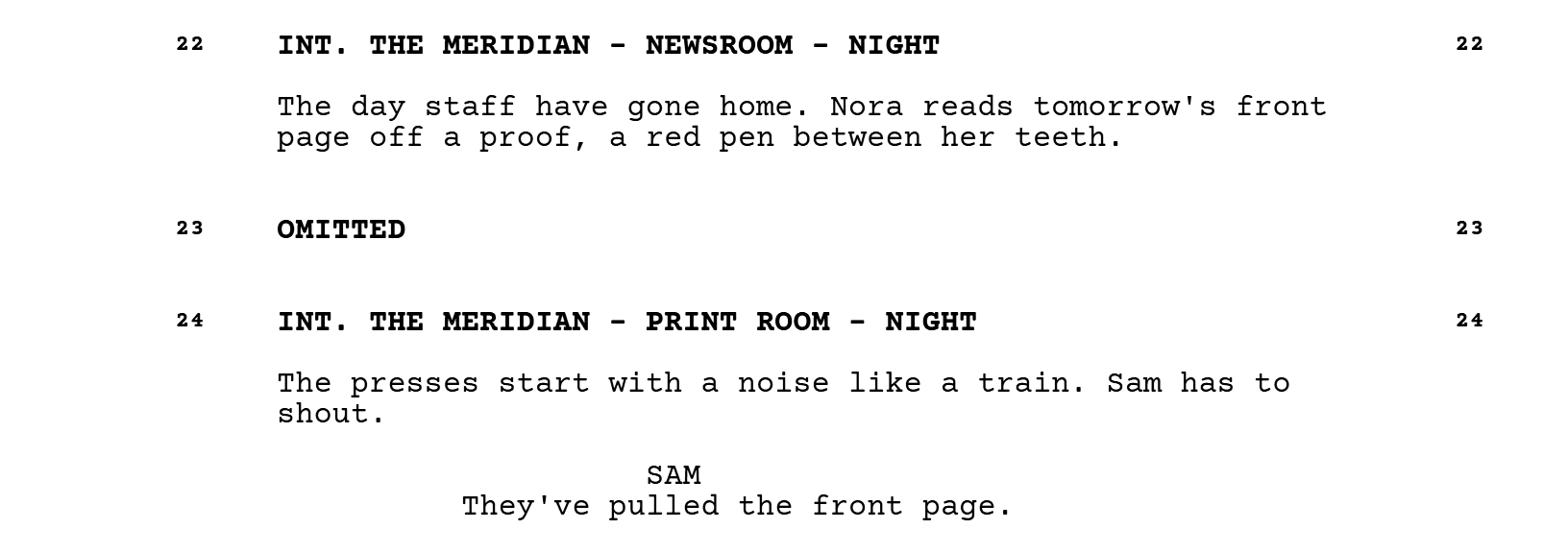
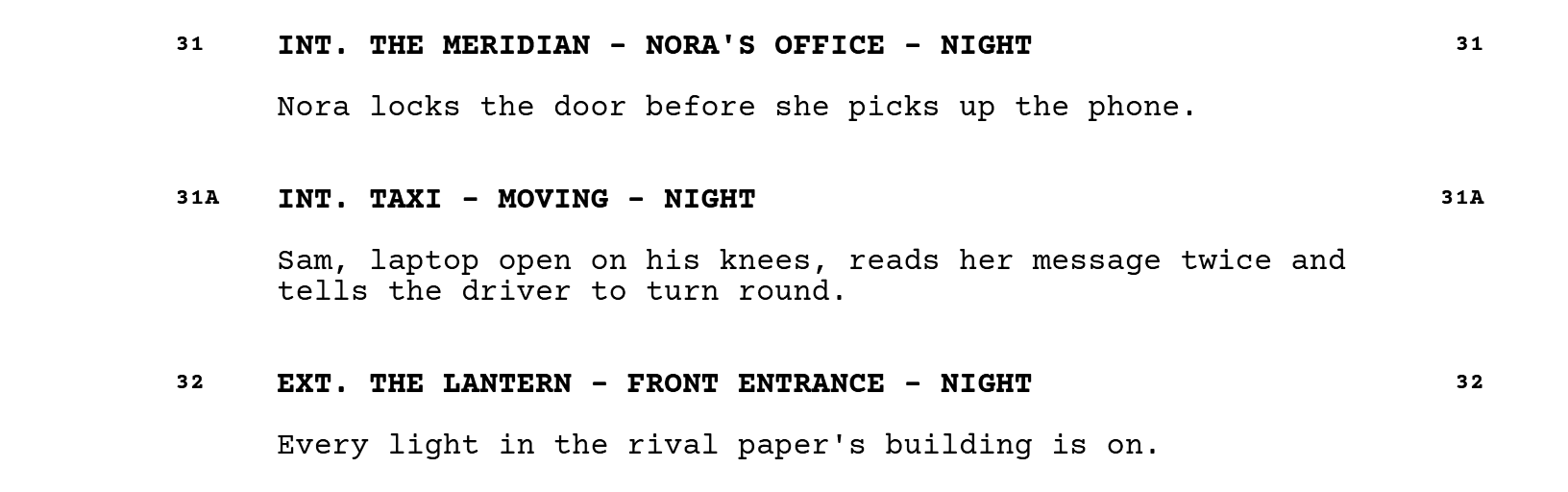
A scene added between two locked numbers takes the number before it and a letter. A new scene after 31 becomes 31A, and the one after that 31B. Some productions, many of them American, put the letter in front of the next number instead and call it A32, because on their slates 31A already means another camera set-up within scene 31. The production picks one style at the start and keeps to it.
Pages lock in the same way. After the script has gone round the crew, page 45 stays page 45. If a revision makes it overflow, the spill becomes page 45A and every later page keeps its number, so the people who have already marked up pages 46 onwards don't have to start again.
Revision marks and coloured pages
A script keeps changing all through preparation and shooting, as locations fall through and the schedule loses a day here and there. Reprinting the whole thing every time would be slow and would wipe out everyone's notes, so the production sends out only the pages that changed. Each changed line carries an asterisk in the right margin, and each round of new pages goes out on its own colour of paper, with the name of the colour and the date in the page header.
The colours follow a fixed sequence, so anyone holding a page can tell at a glance whether it is current. A common American order:
| Issue | Paper |
|---|---|
| The first shooting script | White |
| First revisions | Blue |
| Second | Pink |
| Third | Yellow |
| Fourth | Green |
| Fifth | Goldenrod |
| Sixth | Buff |
| Seventh | Salmon |
| Eighth | Cherry |
After cherry the lists differ. Some continue with tan and ivory, and many then begin again with double white, double blue and so on through the colours. The production office tells everyone which list it uses before the first revisions go out.
An asterisk goes beside a revised line even when the change is a single word. When most of a scene has been rewritten, productions often put one asterisk beside the heading in place of a column of them down the margin.
When a spec becomes a shooting script
The change happens at a definite point, when a project is going ahead and the script is about to reach the whole crew. On a feature that falls somewhere in pre-production. In television each episode makes the crossing in turn. It usually runs in this order.
- A production draft. The writer, or whoever is writing by then, makes the changes the director, the budget and the locations call for. Camera directions the director wants can go in now.
- Numbering and locking. The scenes are numbered, the page breaks are fixed, and the draft goes out as the white shooting script, with its date on the title page.
- The breakdown. The assistant directors and every department mark up the script for what each scene needs, and the schedule is built from that. Our script breakdown guide shows how it is done.
- Revisions. From here on, changes arrive as coloured pages with asterisks, never as a fresh draft.
- Sides. During the shoot, each day's scenes go out in a small bundle of their own.
In television much of this falls to a script coordinator, who keeps the numbering, the colours and the distribution in order while the writers carry on writing. On a small independent film it may be the writer, the director or the first assistant director, working in the program the script was written in.
Sides
Sides are the script pages for one day's shooting, taken from the current shooting script and handed out with the call sheet, often reduced to half size so they fit in a pocket. Scenes on those pages that are not being shot that day are usually crossed through, so nobody learns lines for tomorrow by mistake.
The word has a second meaning in casting, where the sides are the few pages an actor is given to read at an audition. They come from the same script, chosen to show the character at full stretch in a scene or two.
Shooting scripts on A4
In the UK and across Europe, production scripts are printed on A4, and the same conventions travel with them: numbers in both margins, asterisks beside changes, coloured revision pages and lettered scenes. British productions usually put the letter after the number, as in 31A. Colour sequences vary from one production office to the next, so follow the list it sends round.
The paper also changes the arithmetic. An A4 page holds about four more lines than a Letter page, so a scene measures a little shorter on A4, and a production that schedules by page count should count on the paper it actually prints. The same goes for a script that moves between Letter and A4 during development: expect its page count to move with it.
Some funders and broadcasters ask for numbered scenes long before production, in every draft they receive; Screen Australia's suggested layout is one example, as our formatting guide notes. Where a funder publishes its own layout, follow it, even for a script that is still on spec.
What a spec leaves out, and why
A spec drops the whole production apparatus, for the plain reason that none of it helps anyone read a story. Writers sometimes leave pieces of it in by accident, because their software added them or because the script they learned from was a published shooting script.
- Scene numbers. They make a script look like a production draft, add clutter beside every heading, and fix nothing in a script that is going to be rewritten anyway. Turn them off for the PDF you send.
- CONTINUED at page breaks. Two extra lines on every page, across a hundred pages, is a lot of room spent on something no reader needs.
- Asterisks, colours and draft dates. A spec has no earlier issue in anyone's hands to compare against, and a date mostly tells a reader how long the script has been doing the rounds.
- Most camera directions. The shots are the director's call, and a page full of them reads slowly. Keep the few the story can't do without, such as an insert of a note the audience has to read.
Published scripts are a good way to learn, but many of those online are shooting scripts, complete with numbers and revision marks. Read them for the writing, and set your own spec out the plain way.

In ScriptopusScene numbers sit in both margins of the editor. In the web app, the Export dialog's "Scene numbers in the Script PDF" box, ticked to begin with, decides whether the PDF prints them; untick it for a spec. For a production draft, the toolbar's More menu has Lock scene numbers, which keeps every scene's current number (click a number on the page to change it, to 31A for instance), Track changes, which stars every line you change from then on, in the editor and in the PDF, and Lock script, which asks before the script is edited again.
Questions
Should my spec script have scene numbers?
Not unless someone asks for them. A producer giving notes may want a numbered copy so everyone can refer to scene 40, and some funders' layouts number scenes in every draft. Otherwise leave them off.
What does a spec script mean in television?
It can mean an original pilot written on spec, or a spec episode of a show already on air, written as a sample. Most readers now ask for the original pilot; our TV script templates cover its layout.
What does a locked script mean?
A script whose scene and page numbers are fixed. Changes still happen, but they arrive as revision pages, with lettered scenes, asterisks and a new colour. Locking settles the numbering; the writing can keep moving.
What does OMITTED mean in a script?
The scene with that number has been cut. The number stays in the script, so the numbers of all the other scenes stay the same.
Why are some pages of a script a different colour?
They are revision pages. Each round of changes goes out on the next colour in the production's sequence: blue after the white first issue, then pink, yellow and green in the usual American order.
Sources and further reading
- Christopher Riley, The Hollywood Standard, on scene numbers, revisions and the production draft.
- Wikipedia, Shooting script, for the sequence of revision colours, omitted scenes and the two ways of lettering an added scene.
- Our guide to screenplay format, where the spec and the shooting script first meet.
Write it formatted from the first line
Scriptopus sets every line as you type, keeps the beat board and the treatment beside the script, and exports the PDF and Final Draft file you will need. The editor is free on Mac and Windows.
- Every element in its place, with Tab, Enter and Ctrl+1 to 6.
- Beat Board, Treatment and Synopsis in the same project as the script.
- Six title page layouts, Industry Standard first.
- PDF, Final Draft, Fountain and Celtx exports.