The range readers expect
A feature script that runs between 90 and 120 pages raises no questions about its length. A reader glances at the page count, sees a normal number and starts on page one. Outside that range, the count tends to be the first thing anyone forms an opinion about.
Where a script settles inside the range has a lot to do with its genre. Comedy and horror tend to be lean, often under 100 pages, since both live on pace and both wear out their welcome quickly. Thrillers and action films land somewhere in the middle. Dramas, period films and stories with a large cast get more room, and readers expect to find them nearer the top.
Past 120 pages the worry is partly the reader's afternoon and partly money. Every page is a share of a shooting day, so a 135-page script describes a more expensive film, and a reader will start wondering which fifteen pages a producer would cut first. Writer-directors with several films behind them send long scripts all the time. From a writer nobody has heard of yet, the extra pages mostly suggest a draft that hasn't been cut.
Very short features have the opposite problem. Below about 85 pages a script can read as a story that ran out early, and some competitions won't accept it at all.
Does a page really play for a minute?
On average, a little less. The rule exists because the format is so uniform. With one typeface at one size, fixed margins and a fixed place for every kind of line, each page carries a similar amount of film, and producers have read page counts as running times for generations.
The best-known test of the rule is Stephen Follows's study of 2026, which set the scripts of 2,520 feature films on US Letter, and 351 more on A4, against the finished films' running times. A Letter page came out at about 55 seconds of screen time. The median script had 119 pages and became a film of 108 minutes.
The average hides a wide spread. Only about 18 per cent of the scripts came within five per cent of a minute a page, so most films miss the rule by more than that in one direction or the other. Comedies packed the most pages into each minute, at roughly 52 seconds a page. Musicals and war films were the only genres where a page played for longer than a minute, which makes sense for musicals at least: a number that fills three minutes of the film may take a few lines to write down.
Length pulls the figures around as well. Scripts of 60 to 89 pages tended to become films about a quarter longer than their page count, while scripts over 150 pages had around a third more pages than their films had minutes. Most of that is editing. A short script has room to grow on screen, and a very long one usually gets cut, before the shoot or after it.
The running times in the study include end credits, which have grown from about two minutes in the 1970s to over five in the 2020s.
Estimate your running time
Put in your page count and the paper the script is set on. The estimate is a range, from about 55 seconds a page up to a full minute, and it turns an A4 count into Letter pages first, because an A4 page holds about 58 lines and a Letter page about 54.
When a film has to fit a fixed length, such as a festival's limit for shorts or a slot on television, plan to the slower figure of a minute a page. A script that then plays a little long will still fit.
What makes a page play fast or slow
Every page holds roughly the same number of lines. How long it lasts on screen depends on what those lines describe, and four things in particular move it.
- Dialogue against action. Speech sits in a column about 35 characters wide, under a name and a blank line, so even a short exchange takes several lines for a few seconds of film. Quick back-and-forth is the extreme case, with a cue and a line of text for every word or two.
- Action that compresses. One sentence of action can stand for something long: a house searched room by room, a storm coming in off the sea. The page spends two lines on it and the film may spend two minutes.
- White space. Short paragraphs and frequent headings spread a story over more lines. That is usually a virtue, since the page then reads at the speed the scene plays, but a script built almost entirely of one-line paragraphs comes out long on paper.
- Set pieces. A musical number or a fight can take a few lines to describe and several minutes to play.
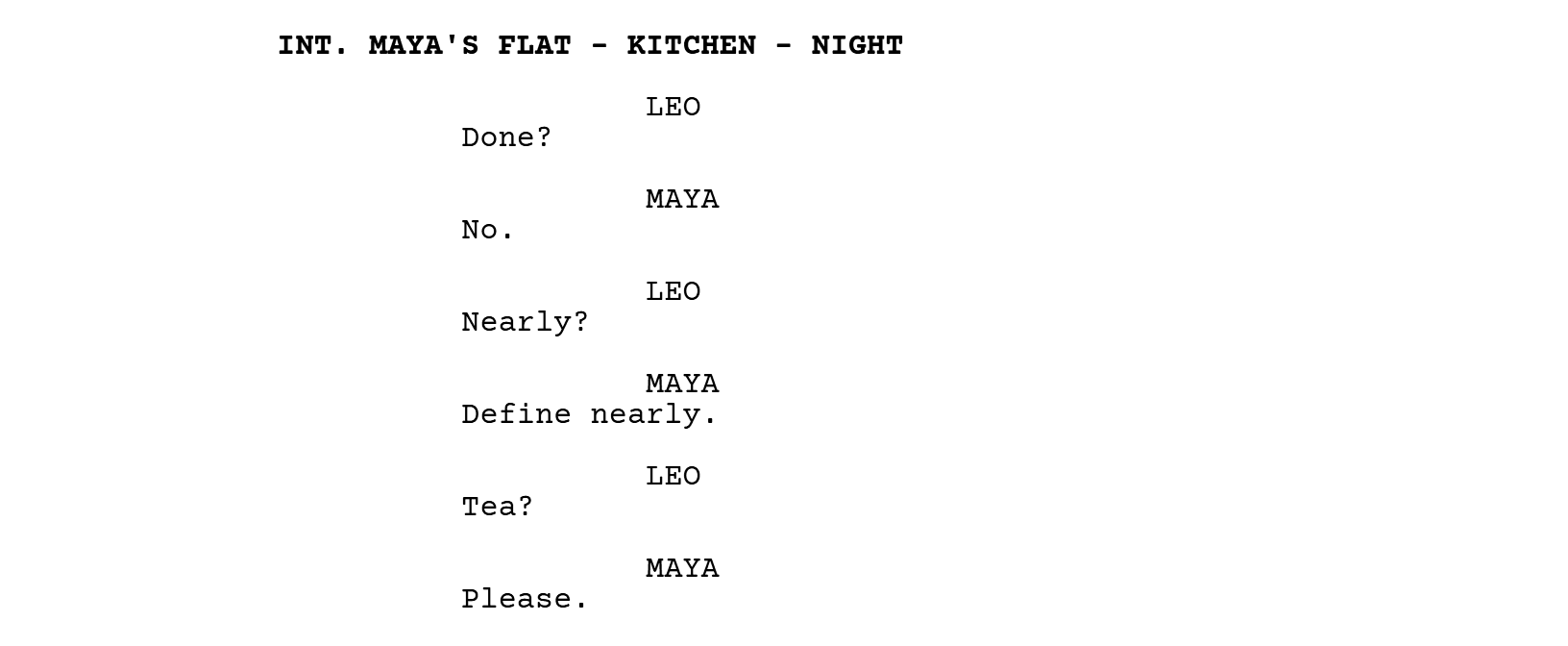

Across a whole script these differences mostly even out. They stop evening out when a script leans hard one way: a talky comedy usually plays shorter than its page count suggests, and a film built on long action sequences can play longer.
The paper matters too. Most screenwriting programs keep the text column the same width on A4 as on Letter, but the A4 page is taller, so it takes about four more lines and the same script comes out roughly seven per cent shorter. In Follows's figures the median A4 script ran 110 pages against 119 on Letter, and his advice for converting is to multiply an A4 count by about 1.07. A 100-page script on A4 is a 107-page script to an American reader.
Television, shorts and other lengths
Most other kinds of script keep roughly to the same minute a page. The exception is the multi-camera sitcom, whose dialogue is double spaced, so each page plays for about half a minute and a half-hour episode runs to twice the pages of a single-camera one.
| Kind of script | Usual length | On screen |
|---|---|---|
| Feature film | 90 to 120 pages | About an hour and a half to two hours |
| One-hour drama | 50 to 65 pages | An hour slot, less the breaks on network television |
| Half-hour single-camera comedy | 30 to 35 pages | A half-hour slot |
| Multi-camera sitcom | 45 to 55 pages | A half-hour slot |
| Short film | 5 to 15 pages for most | Forty minutes at the very most, credits included, to count as a short for the Academy |
Streaming has loosened television lengths, and the episodes of one series can differ by a good margin, so for a pilot the safest guide is a produced script of a show like yours. Our TV script templates lay out the three main formats, and the short film guide looks at what a story of ten pages can hold.
Page limits in competitions
Contests and fellowships set their own limits, and they apply them. The Academy Nicholl Fellowships are a useful reference point. Their rules for the 2026-2027 competition ask for a feature screenplay in standard format, 12-point Courier, of at least 80 and at most 125 pages. They also warn that a script outside standard format, or one whose margins were cheated to squeeze more than 125 pages of story under the limit, may have that counted against it in judging.
Entries to the Nicholl now come in through partner organisations, among them public portals run by The Black List and the Writers Guild Foundation. Other competitions publish their own maximums, sometimes a minimum too, and the figures vary, so read the current rules before every deadline. Our screenwriting events list gathers contests and fellowships from around the world with their deadlines and fees.
Cutting pages honestly
A long draft is rarely long because of one bloated scene. The extra pages are usually spread thinly through the whole script, a few lines at a time, and the fixes that win them back are small and repeatable. Go through the script once for each of these, roughly in this order, since the early ones cost the story nothing.
- Pull up the stragglers. When the last line of a paragraph or a speech holds a word or two, that line takes as much room as a full one. Rewording the sentence to bring the word back up saves a line, and most scripts have dozens of them.
- Delete transitions that only say cut. A new scene heading already tells the reader we have cut, and every
CUT TO:brings a blank line with it. - Get into scenes later. Start each scene as late as it allows and leave as soon as its point lands. Arrivals, greetings and goodbyes are the first places to look.
- Thin the action. Give each paragraph one picture and keep most of them to three or four lines. Phrases like we see, begins to and starts to can nearly always go.
- Say each thing once. Look for a character telling someone what the audience has just watched, two scenes making the same point, a joke landed twice for luck.
- Merge scenes. Two short scenes in different places that do one job can often become one. That saves a heading on the page, and on the shoot it may save a location.
- Then, if you must, lose a strand. Dropping a subplot or a minor character is the big cut. Leave it until the small ones are done, because they often find the pages first.
The cheats readers spot
Any program will let you lose pages by changing the page instead of the writing. It seldom fools anyone, because readers look at screenplay pages every day and a crowded one stands out before they have read a word.
- Smaller type. Courier at 11 or 11.5 point fits more letters on every line. Because every Courier letter has the same width, the shrinking shows across the whole page at once.
- Narrower margins. A quarter of an inch off the bottom margin adds a line or two to every page, and the right margin is easy to nudge as well. The Nicholl rules mention cheated margins by name.
- Tighter line spacing. Courier at 12 point sets six lines to the inch. Squeeze them closer and every page holds more than it should, which a reader feels as density even without measuring anything.
- Missing blank lines. Taking out the extra space above scene headings, or the blank line between paragraphs, saves lines by making every page harder to read.
The tricks run in reverse too, and a short script padded out to a minimum with wide margins or loose spacing looks just as odd. The real trouble with all of them is that the page count stops meaning anything. A script squeezed from 128 pages to 118 still plays like a 128-page script, and the first person to budget it will find out.

In ScriptopusA new script starts in the Final Draft layout, and File, Page Setup switches it between US Letter and A4. The page breaks you see in the editor are the ones the PDF prints. Home shows the length of every script, and of each episode in a series, counted the same way, so the number you watch while cutting is the number a reader gets.
Questions
How many pages is a 90-minute film?
Somewhere around 90 to 98 pages on US Letter, at 55 seconds to a minute a page. On A4 that comes to roughly 84 to 91 pages.
Does the title page count?
No. A page count refers to the script itself, and the title page carries no number. If a competition's limit is tight, check its rules for exactly how it counts.
Is a 130-page script too long?
For a first feature going out to readers, usually yes. A reader will want to know what earns the extra pages, and most drafts that long have ten pages of small cuts hiding in them. Work through the list above before deciding the story needs the length.
How long should a TV pilot be?
About 50 to 65 pages for an hour drama and 30 to 35 for a single-camera half-hour comedy. A multi-camera sitcom runs 45 to 55 pages because its dialogue is double spaced. The TV templates show each one.
My script is on A4. Should I convert it for American readers?
Send it on the paper your reader prints on, which for the United States and Canada means Letter. Any screenwriting program will switch the paper and lay the pages out again for you; expect the count to go up by about seven per cent.
Does a shorter script mean a cheaper film?
Generally, since fewer pages usually means fewer shooting days, but what is on the pages matters more: a page of car chase can cost more than ten in a kitchen. A script breakdown shows where the money goes.
Sources and further reading
- Stephen Follows, Does one page of a screenplay really equal one minute of screen time? (2026). The study of 2,520 Letter and 351 A4 scripts quoted on this page.
- Academy of Motion Picture Arts and Sciences, 2026-2027 Nicholl Fellowships rules (PDF), and the fellowship's page on how entries arrive through its partner portals.
- Our guide to screenplay format, on the page, its margins and the Courier type that make the timing work.
Write it formatted from the first line
Scriptopus sets every line as you type, keeps the beat board and the treatment beside the script, and exports the PDF and Final Draft file you will need. The editor is free on Mac and Windows.
- Every element in its place, with Tab, Enter and Ctrl+1 to 6.
- Beat Board, Treatment and Synopsis in the same project as the script.
- Six title page layouts, Industry Standard first.
- PDF, Final Draft, Fountain and Celtx exports.