Is the speaker in the room?
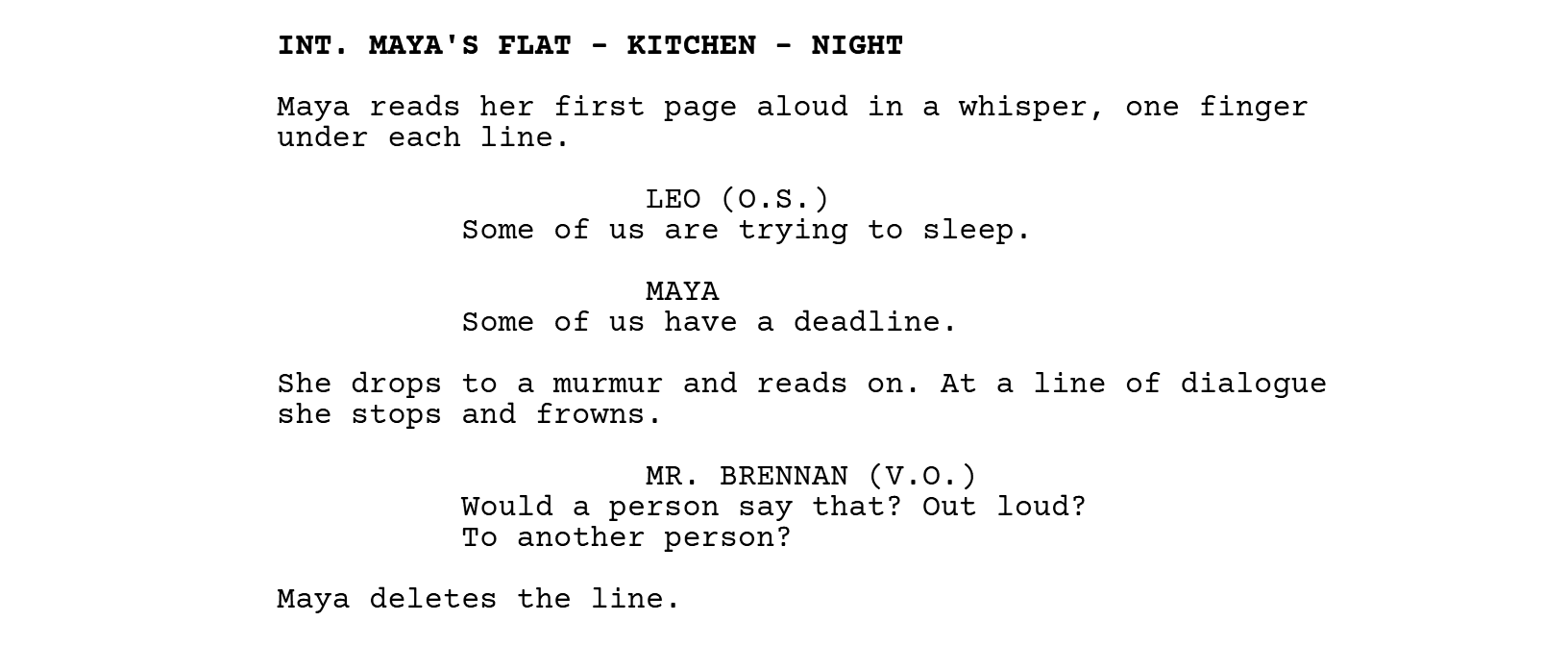
When we hear a voice without seeing who it belongs to, the script adds a short tag to the speaker's name on the cue. There are two common tags, and to pick one you only need to know where the speaker is standing. Are they in the place where the scene happens?
- Yes, but out of the picture. That is
(O.S.), off screen. Think of someone calling from the next room, or hidden behind a door. - No. That is
(V.O.), voice-over: a narrator, a memory, a recording, a voice at the far end of a phone line.
Television scripts often write (O.C.), off camera, where films write (O.S.). The two mean the same. Dave Trottier, who has answered format questions in Script magazine for years, treats O.C. as the older term and recommends O.S., but if you are writing for a particular show, use whatever its own scripts use.
The common cases
Most voices you will need fit one of these rows. Where writers disagree, the table says so.
| The voice | Where the speaker is | On the cue |
|---|---|---|
| Leo, calling from the hallway | In the flat, out of shot | (O.S.) |
| A narrator | Outside the story, or looking back on it | (V.O.) |
| Mr. Brennan, remembered | Only in Maya's head | (V.O.) |
| Maya's own thoughts | Also in her head | (V.O.) |
| Rosa on the phone, unseen | In Madrid | (V.O.), often with (on phone) or (filtered) under the name |
| A newsreader on a television in the room | In a studio, though the set is in the room | Plain dialogue if we see the screen; (O.S.) or (V.O.) if we don't, and writers differ |
| Elena on a cassette | Nowhere now; the tape outlived her | (V.O.), with (on tape) under the name |
| A letter heard in its writer's voice | Wherever the writer is | (V.O.) |
| Leo, heard before we cut to him | In the next scene | (PRE-LAP) |
Where the extension goes, and how it looks
The tag is called a character extension. It sits on the cue line, a space after the name, in capitals and brackets: MAYA (V.O.). Full stops inside the brackets are the usual form. (VO) turns up in some scripts and nobody will mind, as long as the whole script does it the same way. The speech underneath stays in the ordinary dialogue column, in ordinary type, with no italics and no extra indent.
If the same voice speaks again after a line of action, (CONT'D) follows the extension: ELENA (V.O.) (CONT'D). Anything more about how the voice sounds goes in a parenthetical under the name, such as (on tape), (filtered) or (in Spanish, subtitled), which keeps the extension itself as short as it can be.

In ScriptopusType the extension straight after the name on the Character line. The line is set in capitals as you type, so (v.o.) comes out as (V.O.). When the same cue speaks again in a scene with nobody else speaking in between, Scriptopus adds (CONT'D) after the extension for you. A new scene heading starts afresh, so narration that carries on into the next scene keeps a plain cue.
Narrators
A narrator who is also a character in the story uses their own name on the cue, with (V.O.). A narrator outside the story can be NARRATOR (V.O.), introduced in the action the first time we hear them, as you would introduce anyone: A woman's voice, dry and amused: the NARRATOR. Trottier notes that the word NARRATOR already tells the reader it's a voice-over, so the tag can be dropped, though plenty of scripts keep it.
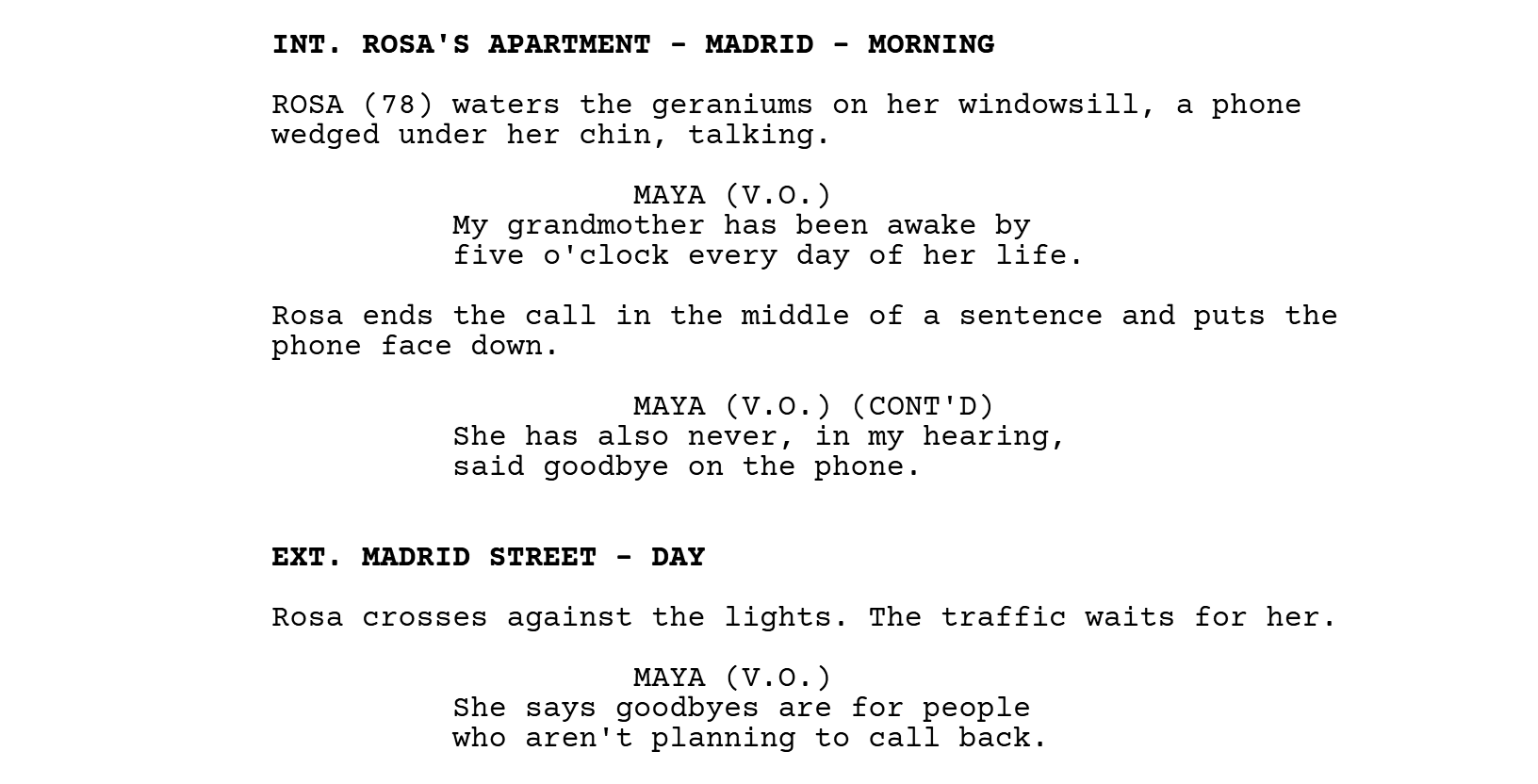
When the narrator is a character looking back on events we are watching, make that clear the first time the voice is heard. A line in the action such as Over this, Maya's voice, some years older. saves the reader from wondering how she can be in two places at once.
A voice that runs on over a cut, as Maya's does into the street, needs nothing special. The figure repeats a plain MAYA (V.O.), because a scene heading starts a fresh count of who has spoken. Other writers add (CONT'D) after the extension to show the speech hasn't broken, and an older habit puts (continuing) under the name. None of the three will confuse anyone.
Phones, radios and recordings
Writers disagree most about voices that reach a scene through a device. By the test above, Rosa at the far end of a call isn't in Maya's kitchen, so she is (V.O.), and that is how Trottier treats a voice through a phone, a radio or a walkie-talkie. Some writers use (O.S.) when the device itself is in the room, on the grounds that the sound comes from there. Others leave the extension off and write (on phone) or (filtered) under the name instead, which describes the sound the way a sound department would.
A screen in the room follows the picture. If we can see the newsreader on the television, the lines are ordinary dialogue with no tag. If the set is turned away from us, they are off screen. A video call works the same way.
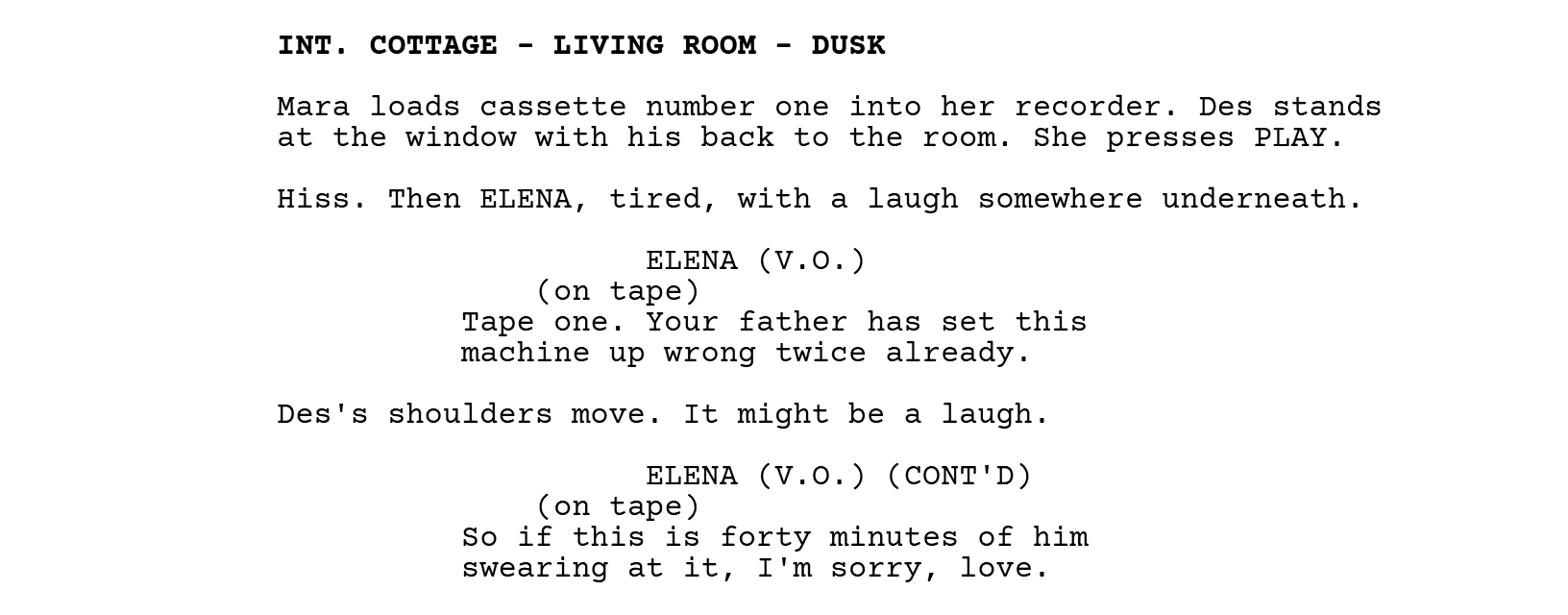
Recordings are the clearest case. Elena is not in the cottage. She died years before the story begins, and her voice comes from a machine on the floor, so (V.O.) is right by any test, and (on tape) tells the reader and the sound department how the line should be heard. When she speaks again after Des reacts, the cue picks up (CONT'D) like any other.
A full phone conversation, with both people on screen, is usually written as an intercut instead. Our formatting guide shows how that one is laid out.
Thoughts, and letters read aloud
A character's thoughts, heard while their lips stay still, are written as (V.O.) under their own name. Use them sparingly. An actor can play most of what a character is thinking, and a voice spelling out the same thing over the performance tends to read as the script trusting neither the actor nor the audience. Trottier advises against inner voices outside broad comedy, where the distance between what someone thinks and what they say is the joke.
A letter read aloud can be heard in one of two voices. If we hear it as its writer would say it, the writer speaks it as (V.O.) while we watch someone else read. If a character reads it out in the scene, it's ordinary dialogue, perhaps with (reading) underneath. In Low Tide, Mara finds a bundle of letters her mother wrote to her and never posted. If she opened one, we would expect to hear Elena, ELENA (V.O.), over Mara's face.
Pre-lap: a line from the next scene
A pre-lap is dialogue from the next scene that starts before we cut to it, so the sound arrives a moment ahead of the picture. Put the cue at the end of the earlier scene with (PRE-LAP) as its extension, then the line, then the next scene's heading. Some writers use (V.O.) for this. (PRE-LAP) is clearer about what the editor is meant to do.
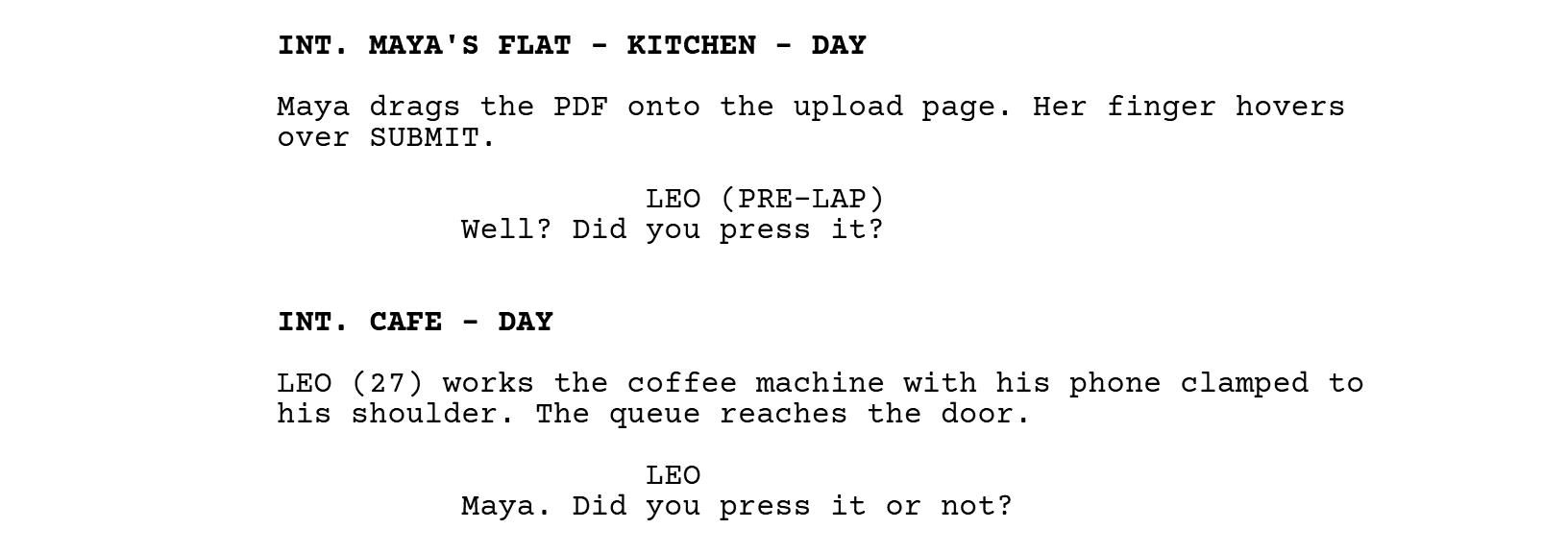
A good pre-lap does more than smooth a cut. Leo asks the question the audience is already asking about Maya's hovering finger, and cutting to the café makes us wait for the answer. Keep pre-laps for overlaps that mean something like that. Used at every change of scene, they start to feel like a habit of the edit rather than part of the story.
When voice-over helps, and when it's a crutch
Voice-over has a poor reputation among script readers. In Adaptation, a famous screenwriting teacher warns a hall full of writers that it is the mark of weak writing, and the joke is that the film opens on its own anxious screenwriter's narration. The complaint is fair about one kind of voice-over, the kind that repeats what the pictures already show, explains a feeling the actor is already playing, or holds together a story that otherwise wouldn't. Blade Runner came out in 1982 with a narration for Deckard that was added late in production. The director's cut of 1992 and the final cut of 2007 both leave it out.
Voice-over works when it gives us something the pictures can't, and these films are the examples people come back to.
- Sunset Boulevard 1950, Billy WilderThe man telling the story is the body floating in the swimming pool.We watch everything knowing how it ends, and the narration makes us want to know how he got there.
- Double Indemnity 1944, Billy WilderAn insurance salesman confesses to a murder into a dictating machine at the office, for the colleague he fooled.The voice-over has a reason to exist inside the story, because it is a recording.
- Badlands 1973, Terrence MalickA teenage girl narrates her boyfriend's killing spree in a calm, dreamy voice, as if reading out her diary.What she says and what we see never quite match, and that gap carries the film.
- Goodfellas 1990, Martin ScorseseHenry narrates his life in the mob, and his wife, Karen, takes over for part of it.Two narrators give us two views of one life.
- Stand By Me 1986, Rob ReinerA grown writer remembers a summer when he was twelve.The adult voice knows how things turned out for the boys on screen, and they don't.
- Barry Lyndon 1975, Stanley KubrickThe narrator tells us what will happen to people before it happens.With the suspense taken away, attention goes to how everyone behaves, which is what the film is interested in.
In each of them the voice and the picture are doing different jobs. Where they do the same job in your own draft, the voice-over is usually the part to cut.
Download the examples
All four examples, gathered into one short script you can open in your screenwriting program or print and mark up.
The examples
Every voice on this page, from Leo in the hallway to Elena on tape, as one short script.
Questions
What is the difference between V.O. and O.S.?
Where the speaker is. (O.S.) means they are in the scene's location but out of the picture, like Leo in the next room. (V.O.) means they aren't there at all, like Mr. Brennan in Maya's memory or Rosa at the far end of a phone line.
Is O.C. the same as O.S.?
Yes. Off camera and off screen mean the same thing. Television scripts use (O.C.) more often than film scripts do.
Should voice-over dialogue be in italics?
There's no need. It is set like any other speech, and the extension on the cue already tells the reader how it is heard. A few produced scripts use italics for voice-over, but a script you send out doesn't have to.
Can a character speak in voice-over and on screen in the same scene?
Yes. Each speech gets the cue for how we hear it: MAYA (V.O.) for the narration, MAYA for what she says in the room. Readers follow the switch easily as long as every cue is tagged correctly.
How much voice-over is too much?
There is no number. A film can be narrated from start to finish and work, and a single line can be one too many if it explains what the actor has just played. Read a scene with the voice-over covered up, then keep only the lines you missed.
Sources and further reading
- Christopher Riley, The Hollywood Standard, on character extensions, voice-over and off-screen speech.
- David Trottier, The Screenwriter's Bible, on extensions, narration and telephone conversations.
- Dave Trottier, Ask Dr. Format: Off Screen and Voice Over, Script magazine, 2019, on O.S., V.O., screens, narrators and thoughts.
- Sarah Kozloff, Invisible Storytellers: Voice-Over Narration in American Fiction Film, a study of how narration works on screen.
- Our screenwriting glossary, for the other extensions and what they mean.
Write it formatted from the first line
Scriptopus sets every line as you type, keeps the beat board and the treatment beside the script, and exports the PDF and Final Draft file you will need. The editor is free on Mac and Windows.
- Every element in its place, with Tab, Enter and Ctrl+1 to 6.
- Beat Board, Treatment and Synopsis in the same project as the script.
- Six title page layouts, Industry Standard first.
- PDF, Final Draft, Fountain and Celtx exports.