Keeping the reader in the right year
A cinema audience can usually tell that a scene is set in the past before anyone speaks. The hair has changed, the cars are older, and a character who died in the first act is laying the table. Someone reading the script gets none of that. They have a scene heading and a few lines of action, and if those don't say the story has stepped back, the reader carries on in the present until something stops making sense.
Most of the work of formatting a flashback therefore happens at its two edges. Label the jump where the story leaves the present, and make the return just as easy to see. Flash-forwards and dreams follow the same pattern, and none of them needs an element of its own; they are made from scene headings, action and the occasional transition.
The examples come from Midnight, Pacific Time, the short script in our formatting guide, where Maya Ellis keeps hearing her old film-school teacher, and from Low Tide, the sample project in Scriptopus, where Mara Welles packs up her late mother's house with the father she hasn't spoken to in thirteen years.
Labelling the heading, and getting back
The label usually goes at the end of the scene heading, in brackets: INT. FILM SCHOOL CLASSROOM - DAY (FLASHBACK). You will also see it after a hyphen, or at the front (FLASHBACK - INT. ...). Readers take any of these in their stride. What trips them up is a script that switches between them.
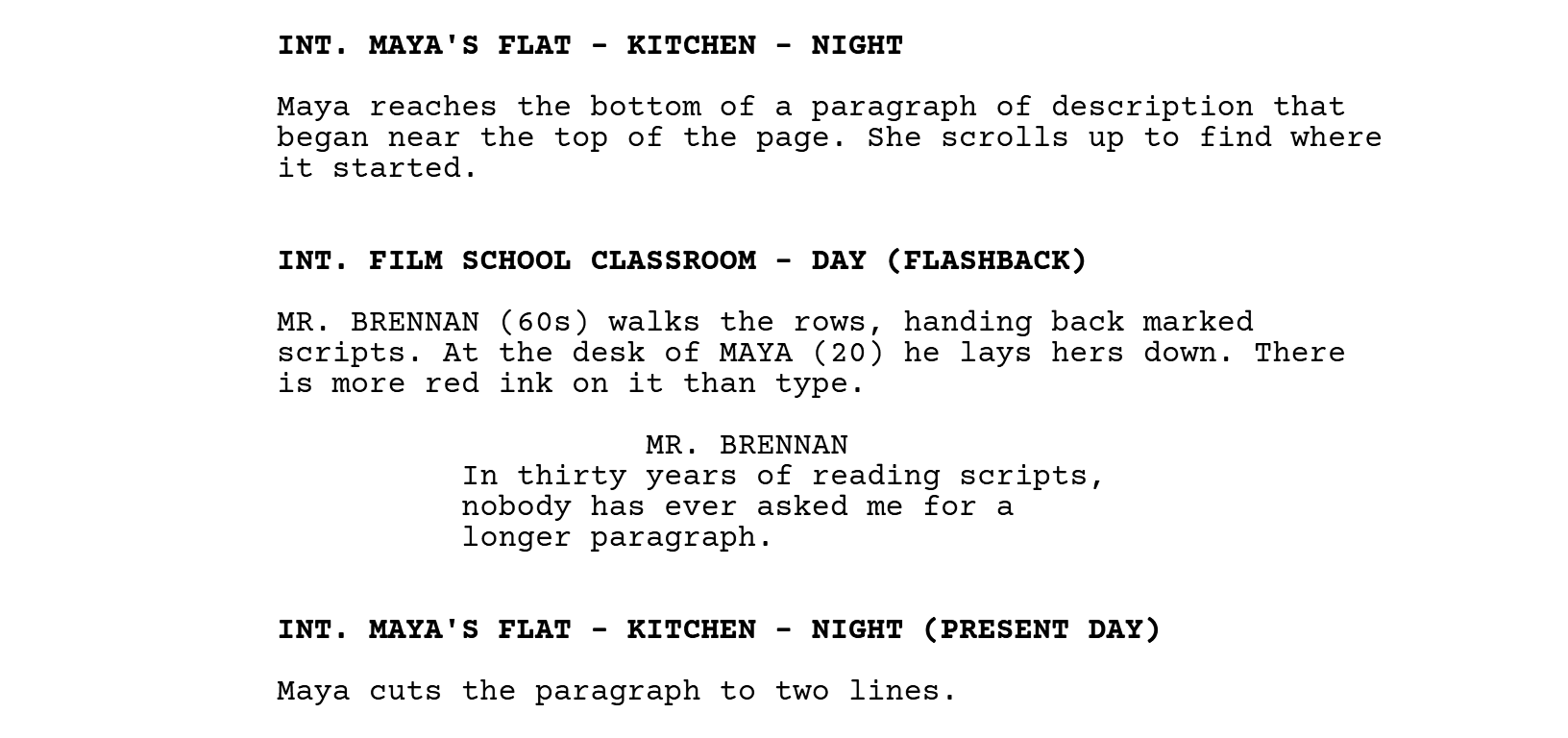
Coming back has a few accepted forms:
- A label on the next heading,
(PRESENT DAY)or just(PRESENT), as in the example. - A line of its own.
BACK TO PRESENTat the left margin, with the heading of the scene we return to underneath. - A plain heading, with an action line that does the telling. Something as short as
Present day.is enough. This form works best when we return to a place the reader has already seen in the present.
A return with no signal at all is the version that goes wrong, especially when the next scene is somewhere the reader hasn't been yet. They will assume they are still in the past, and the scenes after it will read slightly off.
Notice how Maya is introduced in the classroom. She is 31 in the present, so MAYA (20) tells the reader at a glance how far back the story has gone, and tells whoever casts the film that the part may need a younger actor.

In ScriptopusType the label straight into the heading. Scene headings are set in capitals as you type, so (flashback) comes out as (FLASHBACK). Every heading goes into the Scenes list in the sidebar, and once a script has more than eight scenes the list gets a filter box. Type FLASHBACK there and only the scenes labelled as flashbacks are left, a quick way to see how often your story leaves the present.
A flash of a few seconds
Sometimes the past needs only a moment, an image that cuts into a scene and is gone before anyone in the room has noticed. This is usually called a flash cut. Write FLASH CUT TO: as a transition, give the image a short heading and one line of action, then return with BACK TO SCENE, which tells the reader that the interrupted scene picks up exactly where it stopped.
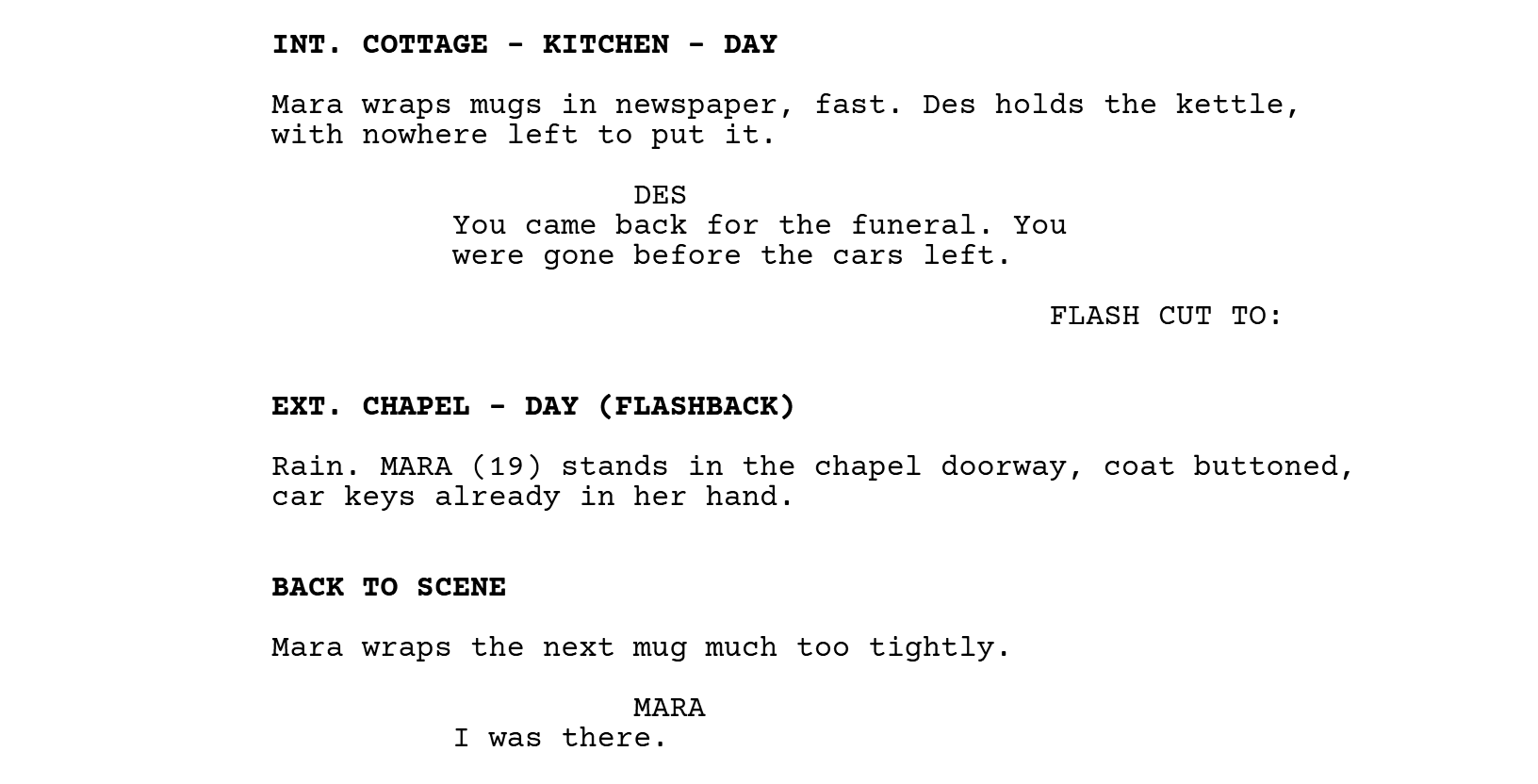
Keep it that short. Once the flash needs a line of dialogue it has turned into a flashback and wants the fuller layout above. Some writers drop the transition and tuck the flash into the action (A flash: the chapel doorway, rain, Mara at nineteen.). It reads quickly, but it hides a second location inside an action line, where whoever breaks the script down for the shoot can easily miss it.
A flashback across several scenes
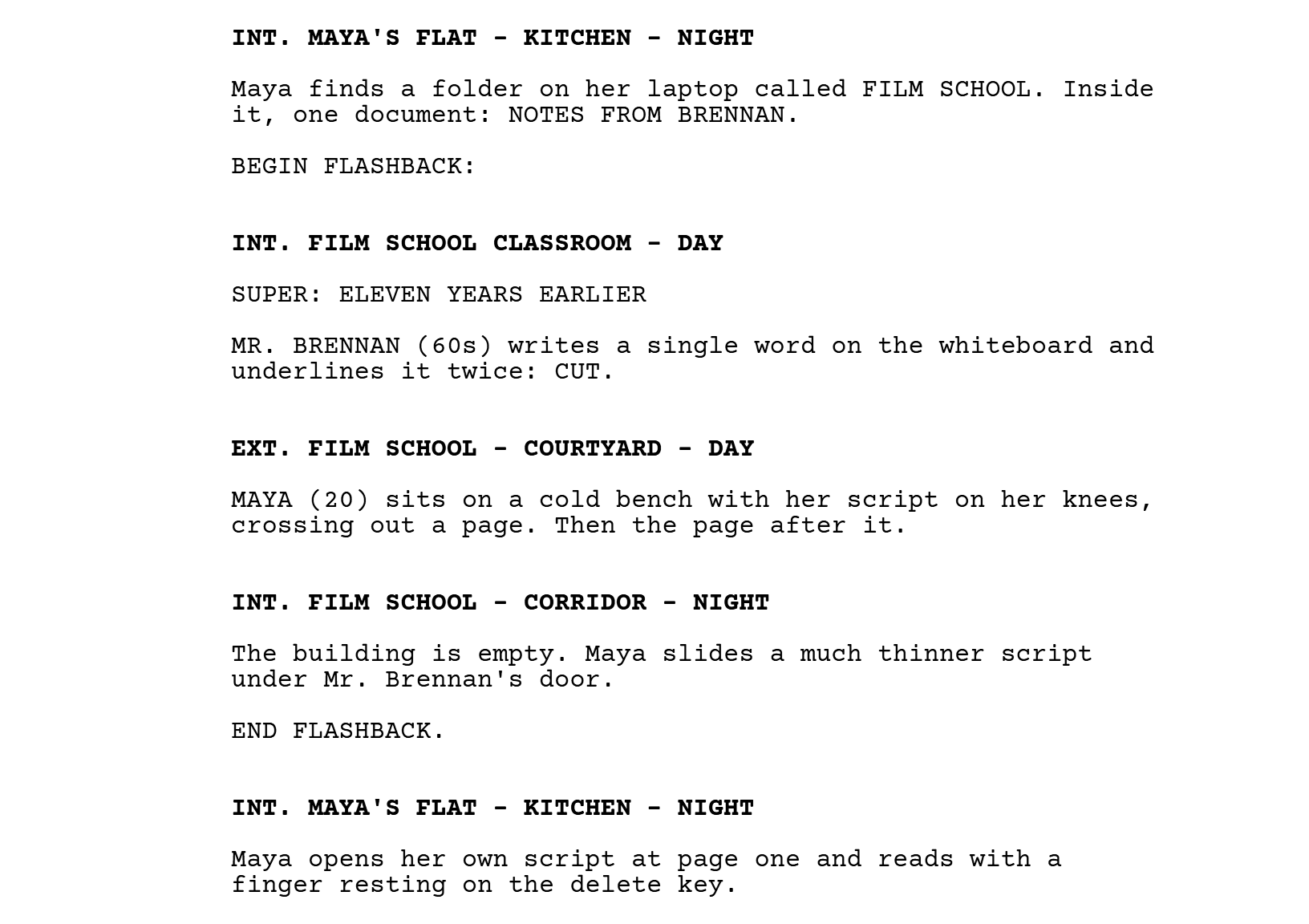
When the past runs to several scenes you could label every heading, but a column of (FLASHBACK) tags is tiring to read and easy to break in a rewrite. Bracketing the whole stretch is tidier. Put BEGIN FLASHBACK on a line of its own before the first heading and END FLASHBACK after the last, and leave the headings in between plain.
If the memory is a run of short moments rather than whole scenes, a montage says it in less space: MONTAGE - FILM SCHOOL (FLASHBACK), a line for each moment, and END MONTAGE to close. One remembered stretch of action told in quick cuts is a SERIES OF SHOTS, labelled the same way. The montage guide lays out both.
A long flashback can also raise a casting question. If a different actor will play the younger self, give that version a name of their own, such as YOUNG MAYA, in the action and on every cue. The cast list then shows two parts, and the person drawing up the schedule doesn't have to work out which Maya is which.
Dates, ages and SUPERs
The label in a heading is for the reader. An audience never sees a scene heading, so if they need the date it has to reach the screen, usually as a SUPER in the first line of action, as in the sequence above. A relative time such as ELEVEN YEARS EARLIER suits most stories, since what matters is the distance from the present. A year, or a place and a year (SUPER: MADRID, 1979), is for stories where the period itself counts.
Plenty of films use no caption at all. Manchester by the Sea moves in and out of Lee's past without a title card, and you know where you are because his brother is alive and his family is still around him. A script that works this way still labels its headings, and writes the same clues into the action:
- an age beside a name, the first time we meet the younger self;
- a detail that dates the scene, such as a phone with buttons or a shop that has since closed;
- someone who is gone in the present, still in their chair at the kitchen table;
- a place we know from the present, seen as it used to be.
Flash-forwards and jumps ahead
A flash-forward is the same device facing the other way: a scene from later in the story, shown early, after which we come back to the present. Label it (FLASH FORWARD) at the end of the heading and return as you would from a flashback. Its usual job is to plant a question. If we have seen Maya a year from now, at a table read in Los Angeles while actors perform her script, we watch every scene before it for how she gets there.
Dickens got there long before the cinema. The last spirit in A Christmas Carol shows Scrooge a future that hasn't happened yet, and it frightens him into changing while he still can.
A jump ahead that stays ahead is something else. SUPER: ONE YEAR LATER at the start of a scene moves the story on for good, and the heading needs no label, because there is no present to come back to.
Dreams, fantasies and waking up
A dream is laid out like a flashback, with (DREAM) at the end of the heading. If it runs over several scenes, bracket it with DREAM SEQUENCE before and END DREAM SEQUENCE after. Something imagined while the character is awake, a daydream or a fantasy of revenge, usually gets (FANTASY) or (IMAGINED) instead.
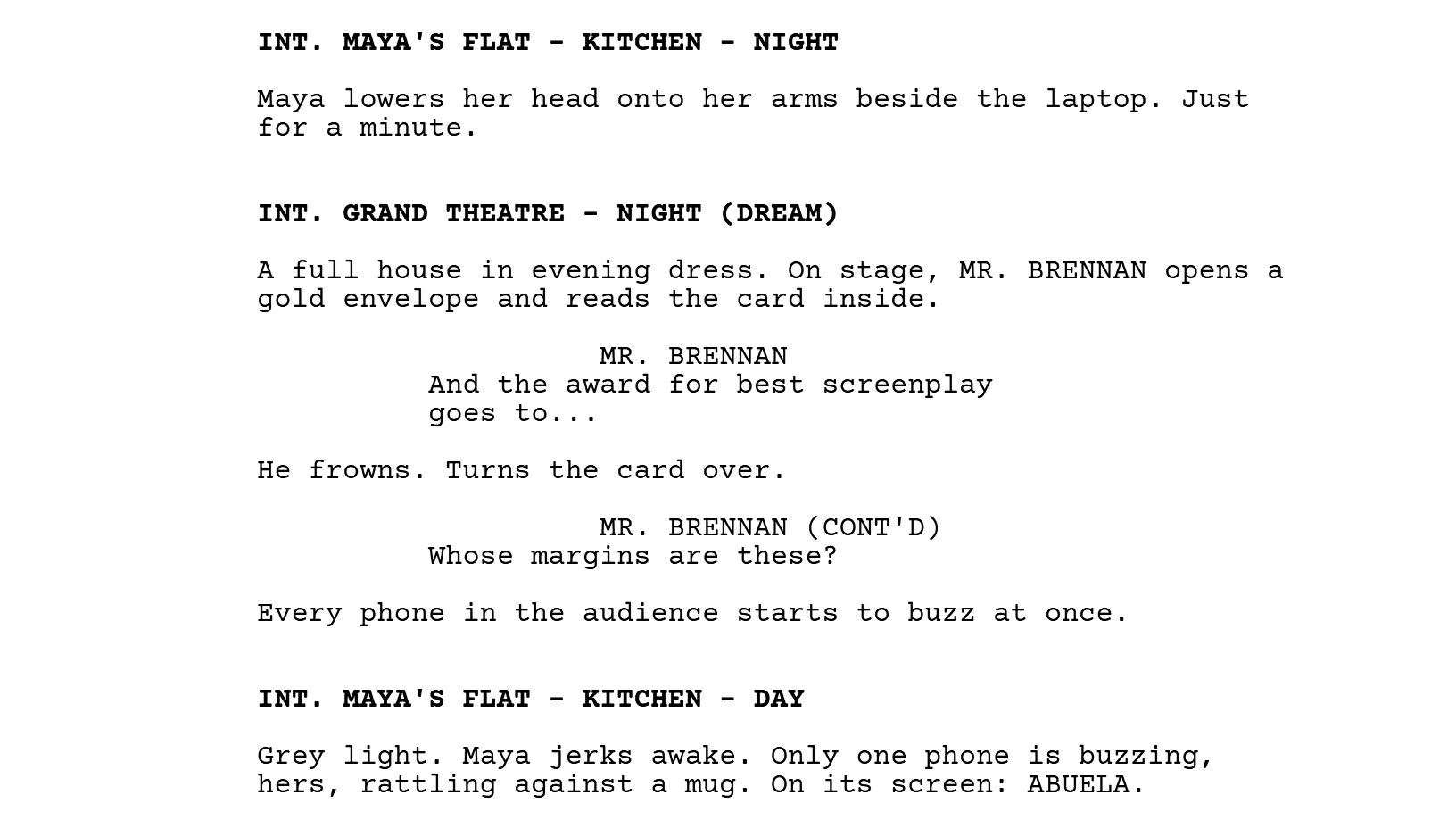
Some writers leave the label off so the reader is fooled along with the audience. It can work once, for a reveal the whole story depends on. More often a reader who finds out that the last three pages never happened feels tricked. The audience can still believe the dream while the reader is told, because only the reader ever sees the heading.
The sudden jolt awake, gasping, has been used so often that readers see it coming. A sound that belongs to both worlds makes a better exit, as the phones do here, and so does an image in the dream that matches one in the room. The first heading after the dream needs no label, as long as the action leaves no doubt that the character is awake.
The labels at a glance
Here are the labels from this page in one place, with where each one goes. All of them are in common use.
| On the page | Where it goes | What it tells the reader |
|---|---|---|
(FLASHBACK) | End of the scene heading | This scene happens before the story's present. |
(PRESENT DAY) | End of the next heading | We are back. (PRESENT) does the same. |
BACK TO PRESENT | A line of its own, at the left margin | We are back, before a plain heading. |
BEGIN FLASHBACK, END FLASHBACK | Lines of their own, before and after | Everything in between is the past. |
FLASH CUT TO: | Transition, at the right margin | A cut of a second or two. |
BACK TO SCENE | Where a heading goes | The interrupted scene carries on. |
SUPER: ELEVEN YEARS EARLIER | Action | The audience sees the jump on screen as well. |
(FLASH FORWARD) | End of the heading | A scene from later, and we will return. |
(DREAM), DREAM SEQUENCE | End of the heading, or lines before and after | None of this is really happening. |
(FANTASY), (IMAGINED) | End of the heading | A character is picturing it while awake. |
When a flashback works against the story
Every flashback stops the present story for a while, and the scene in the past has to be worth the pause. These are the usual reasons it isn't.
- It shows what we already know. If the present has made it clear that Maya's teacher was hard on her, a scene of him being hard on her adds a page and nothing else.
- It comes before we care. A film that opens in the past asks the audience to get to know its people twice. If the story really begins years earlier, begin it there with a SUPER and move forward.
- It's there to deliver backstory. A flashback written so that we understand a fear the plot will need later is exposition with a scene heading on it. Watching a character work around the fear in the present usually tells us more.
- It cuts away at the peak. Leaving an argument at the moment it turns lets out the pressure the scene was building.
- It lies. Hitchcock opened Stage Fright with a flashback that turned out to be false, and later told François Truffaut he regretted it. Audiences take what a flashback shows them as fact.
Low Tide is a story about the past with no flashbacks in it at all. Its writer decided early that Elena, Mara's mother, would exist only as a voice, the way she now does for Mara. So the past turns up in the present instead. Des carries in a box with a child's drawing in it, and a locked drawer holds a dozen cassettes in Elena's voice. The flash cut earlier on this page is a version of the kitchen scene the finished script decided against. Des's line puts the chapel doorway in the reader's head without leaving the room, and Mara has to stand there and take it.
Flashbacks earn their place when the past changes how we see the present. Casablanca holds back its Paris flashback until Ilsa has walked into Rick's bar, so it arrives just when we need it. Citizen Kane is built from the memories of people who knew Kane, each one answering part of a reporter's question. The Godfather Part II cuts between the young Vito and his son, and the two stories comment on each other.
Download the examples
The classroom flashback, the chapel flash cut, the film-school sequence and the dream, set out as one short script. It prints as it is and opens in any screenwriting program.
The examples
Every flashback, flash cut and dream on this page, as one short script.
Questions
Do I have to write FLASHBACK on every scene in the past?
Once per stretch of the past is enough. A single scene carries the label in its heading. A run of scenes can carry it on every heading or be bracketed once with BEGIN FLASHBACK and END FLASHBACK. Pick one method and use it every time.
Can a script open with a flashback?
It can, but check first that it is one. A story that starts years before the main action and moves forward from there has no flashback in it yet; it just needs a SUPER for the date. An opening flashback that we later return from works best when it is short and leaves a question the present will answer.
How long can a flashback be?
As long as it holds the audience. Some films spend most of their running time in the past, inside a frame story set in the present, as Titanic does. Length matters less than the reader always knowing which time they are in.
How do I show a memory without a flashback?
Let it come into the present. A remembered voice can play over a scene as voice-over, the way Mr. Brennan's does in Midnight, Pacific Time, and an object or a line of dialogue can carry the rest. The voice-over guide shows how a remembered voice is laid out.
Sources and further reading
- Christopher Riley, The Hollywood Standard, on flashbacks, dreams and the other ways a scene leaves the present.
- David Trottier, The Screenwriter's Bible, on flashbacks, dream sequences and superimposed titles.
- Linda Aronson, The 21st Century Screenplay, on films built from flashbacks and how their structures work.
- François Truffaut, Hitchcock, the book-length interview in which Hitchcock talks about the false flashback in Stage Fright.
- Our guide to screenplay format, where flashbacks and dreams sit with the other awkward cases.
Write it formatted from the first line
Scriptopus sets every line as you type, keeps the beat board and the treatment beside the script, and exports the PDF and Final Draft file you will need. The editor is free on Mac and Windows.
- Every element in its place, with Tab, Enter and Ctrl+1 to 6.
- Beat Board, Treatment and Synopsis in the same project as the script.
- Six title page layouts, Industry Standard first.
- PDF, Final Draft, Fountain and Celtx exports.