Start with what the audience hears
A phone call is a scene with two people in it who aren't in the same room. Before you write the first line of one, decide how much of the far end the audience gets. That decision sets the layout on the page, and it also settles whose scene this is.
| The audience | On the page | Good for |
|---|---|---|
| Sees and hears one person | One location. The far end has no lines, and the pauses carry it. | Keeping us inside one character's head, or hiding what the other side says |
| Sees one, hears both | One location. The far voice gets a cue with (V.O.) or a note such as (on phone). | A caller on speaker, or a voice whose face you are saving for later |
| Sees and hears both | Both locations, then INTERCUT. | Calls where both people matter to the scene |
The examples stay with the family from Midnight, Pacific Time, the short script in our formatting guide. Maya is a screenwriter in London with a younger brother, Leo, and their grandmother Rosa lives in Madrid and speaks Spanish on every call.
Only one side of the call
When the camera stays with one character and we never hear the other end, write the call as ordinary dialogue for the person speaking. The far voice gets no cue and no lines. The reader fills the gaps, and a well-built one-sided call lets every answer tell us what the question was.
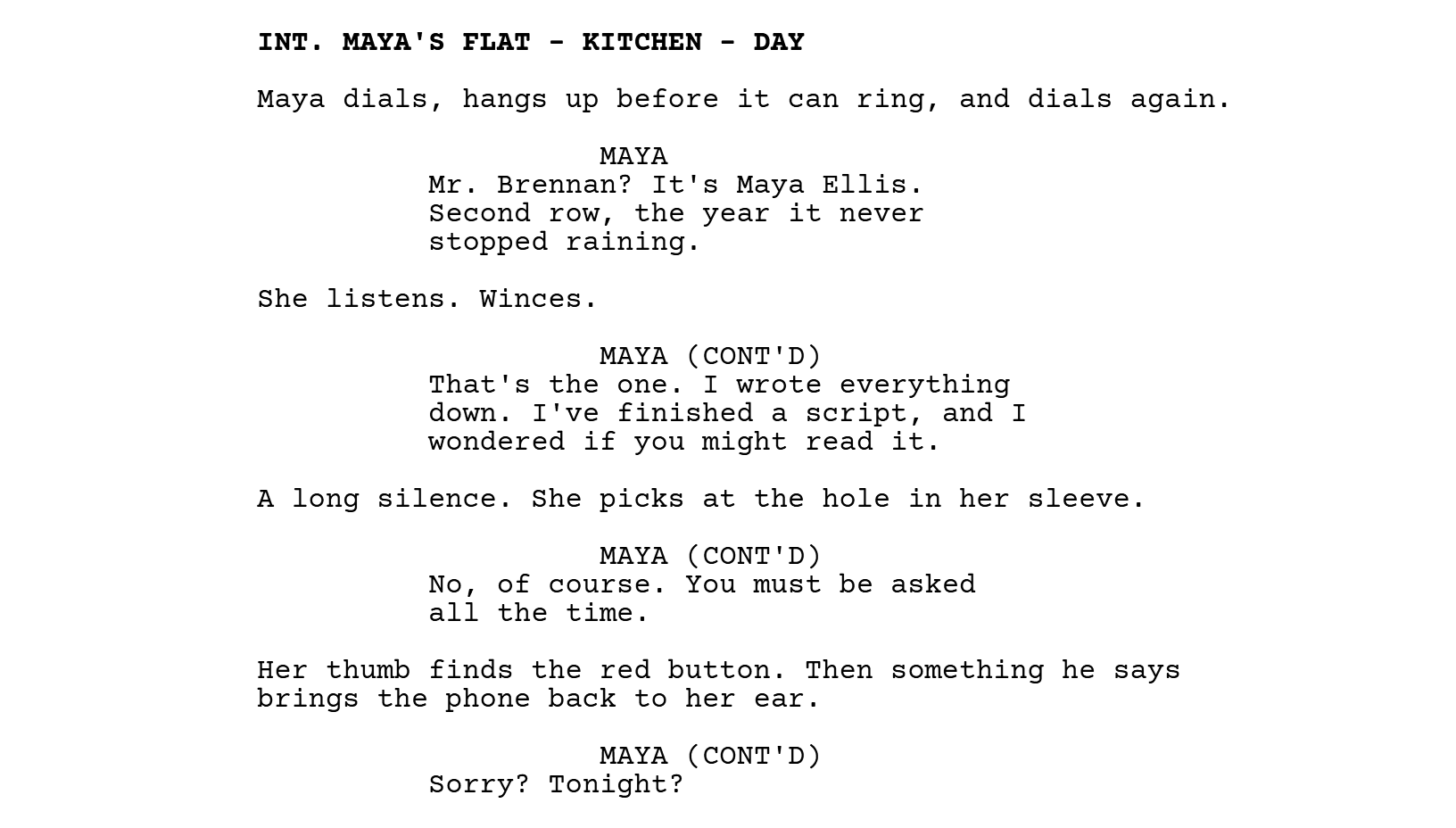
A few habits make these calls easy to read.
- Let the answers carry the questions. "That's the one" tells us he remembers her, so he never has to say it.
- Write the other person's turns as action. Short lines such as She listens or A long silence show where the far end is talking and give the actor something to play. The parenthetical
(listening)does the same in fewer words, though a page full of them starts to tick like a metronome. - Get the name in early. Maya's first line says who she has called. If the name would sound forced in a character's mouth, put it in the action: She finds his number at the bottom of an email from 2015.
- Mark lines meant for the room. When someone else is there,
(into phone)and(to Leo)tell the reader which way each line is going.
A one-sided call is also the cheapest kind to shoot, with a single actor in a single location, which on a short film can settle the question by itself.
Hearing the voice on the other end
Sometimes the camera stays in one place but the audience should still hear both people, because the phone is on speaker or because you are saving the caller's face for later. The far speaker then gets a cue and dialogue like anyone else, with a mark beside the name to say the voice is coming down a line.
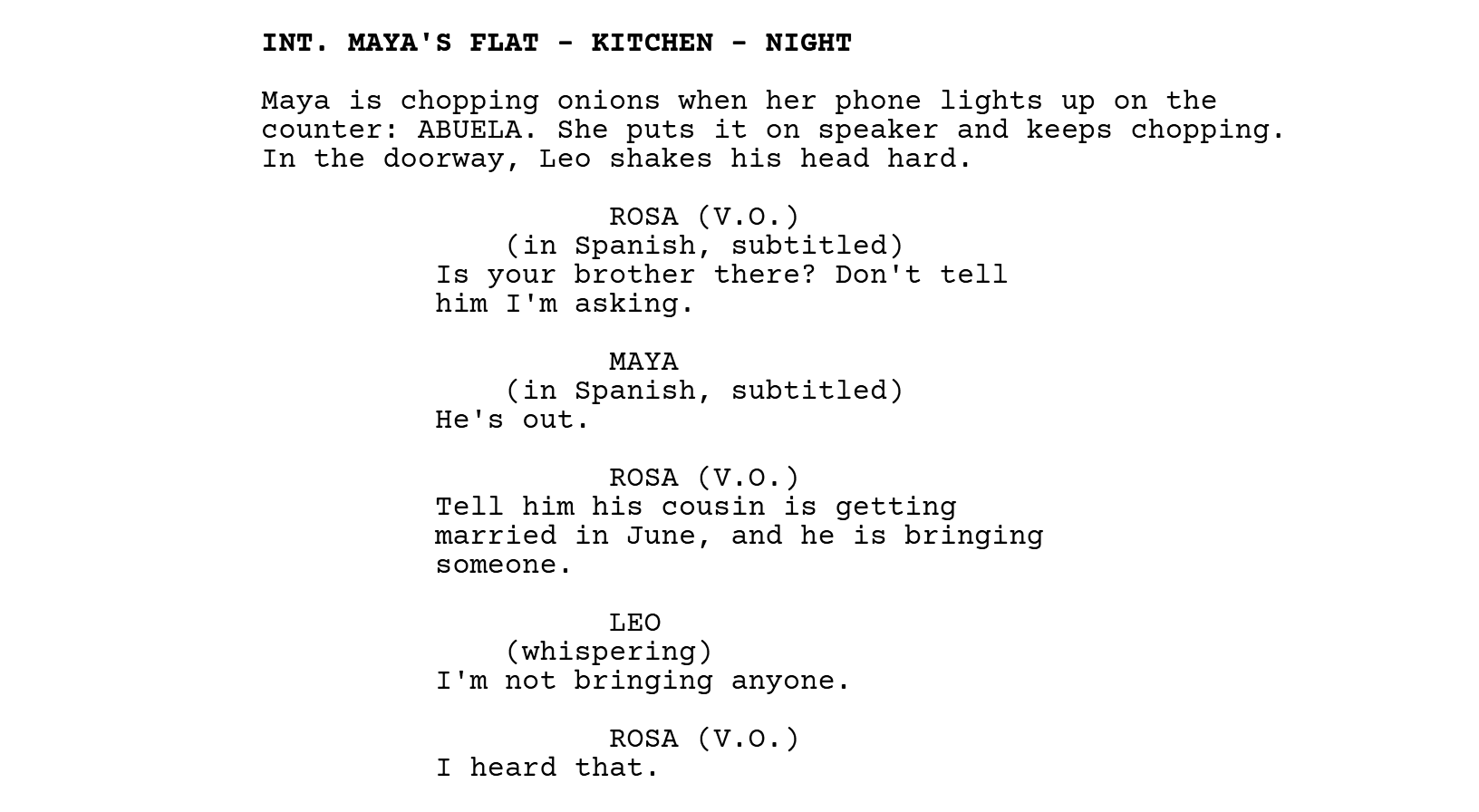
Writers have never settled on one mark, and readers have learned to follow all four of these.
ROSA (V.O.)is the most common. Voice-over means the speaker isn't in the location, which is true of anyone at the far end of a call.ROSA (ON PHONE), or just(PHONE), as the extension. It describes how we hear her, where V.O. describes where she is.(filtered)as a parenthetical under the name. The word comes from the sound mix, where a voice is filtered to sound as if it is coming out of a small speaker.(O.S.), which some writers keep for a caller who is close by: upstairs, say, or in a car outside the house.
Pick one and keep it for the whole script. If Rosa is V.O. on page 12 and filtered on page 40, a careful reader will wonder what changed.

In ScriptopusThe mark after the name, such as (V.O.), is typed on the Character line itself. For a note under the name, press Tab on the first line of the speech: inside dialogue, Tab turns the line into a parenthetical, and Enter after it carries on with the same speech.
Seeing both ends with INTERCUT
When both people matter to the scene, we want to see both faces. A heading every time the picture switched would bury the dialogue, and where the cuts fall is decided in the edit anyway. So each location gets one heading, with a line or two of action so the reader can picture it. After that, a line reading INTERCUT tells the reader the scene will move between the two, and the dialogue carries on with no more headings.
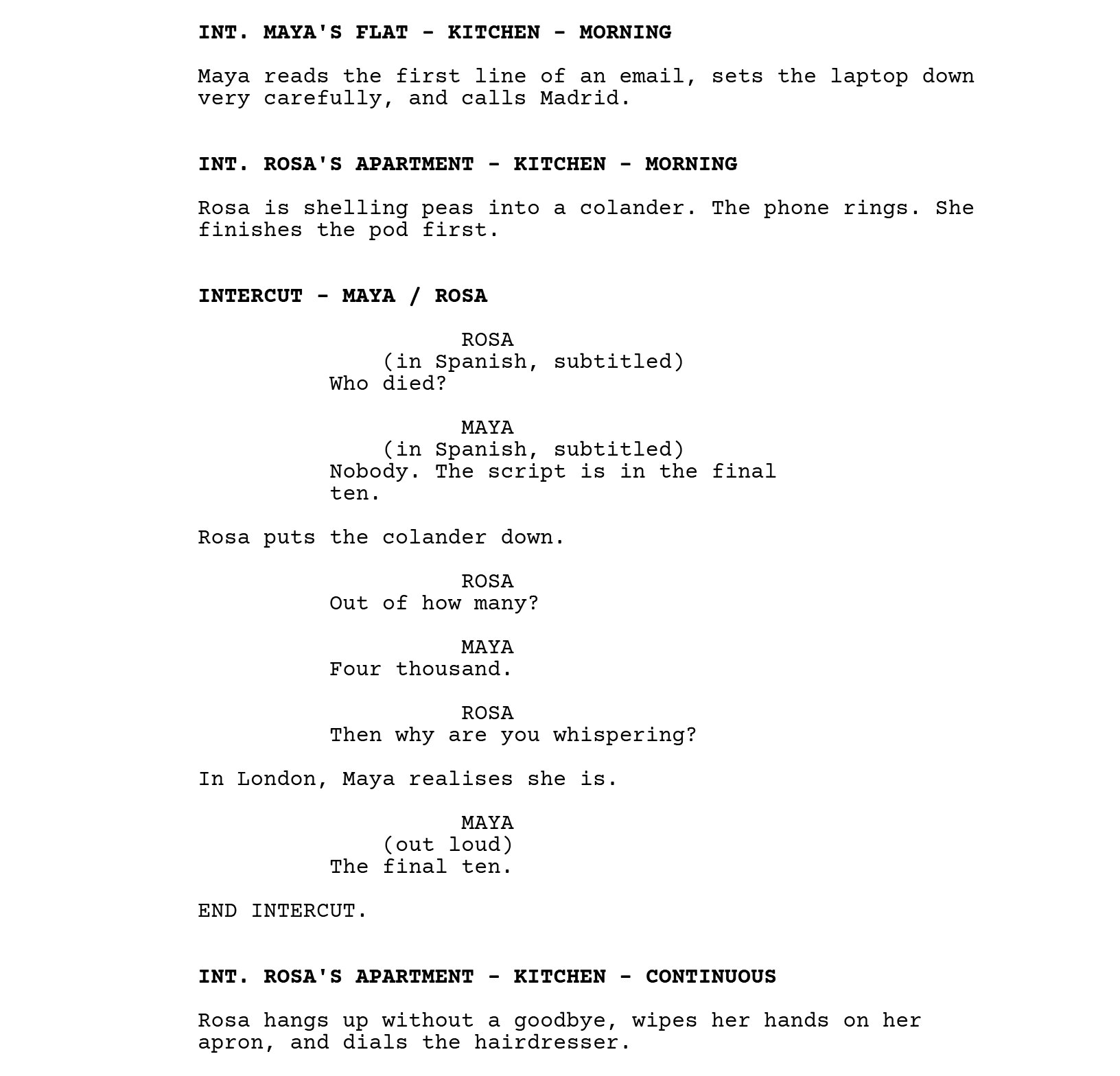
- The INTERCUT line sits where a scene heading would.
INTERCUT - MAYA / ROSAnames who is on the call; a plainINTERCUTorINTERCUT - PHONE CALLis just as common. Some writers end the first location withINTERCUT WITH:at the right margin, like a transition, and then write the second heading. - The cues stay plain. Both people are on screen during the call, so neither name needs (V.O.).
- Action lines still work. When it isn't obvious which end a line of action belongs to, say so: In London, Maya realises she is.
- The way out is
END INTERCUT, a new scene heading, or both. The heading matters most when the next moment belongs to only one of them, as it does here.
Video calls
On a video call the other person is part of the picture, on a laptop or a phone, and that changes the cue. If we can see Rosa on Maya's screen, she is in the frame like anyone else and her name needs no extension at all. If the camera stays on Maya and Rosa is only a voice from the laptop, Dave Trottier marks her (O.S.), since the laptop is in the room. A script that gives every voice down a line (V.O.) can keep doing so here, as long as it never switches.
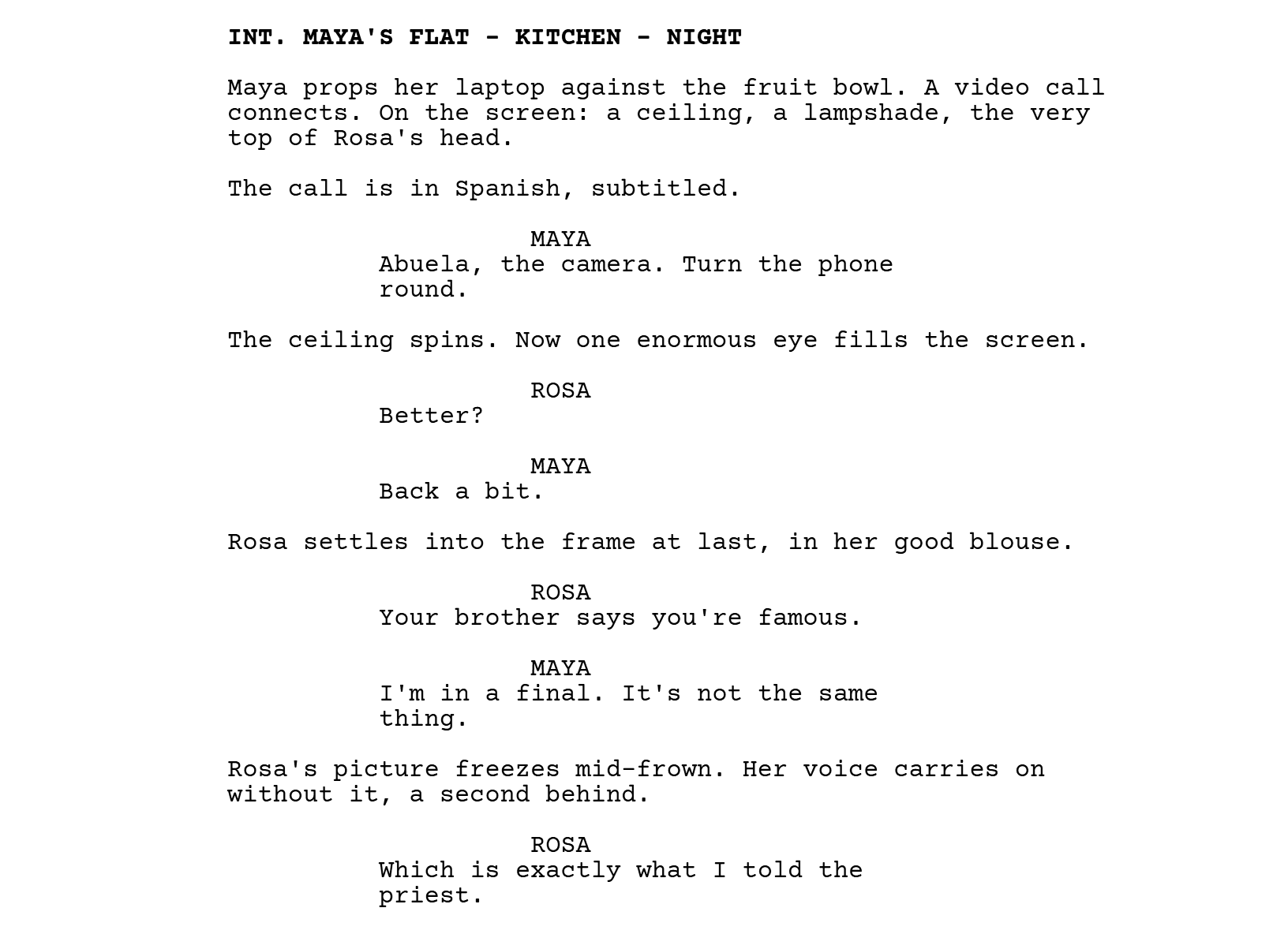
The screen is part of the action, so describe it as you would a window, with who is in it and what is behind them. The small disasters everyone knows from their own calls, such as the view of the ceiling or the voice that lands a second after the lips move, make easy laughs. In a thriller, a picture that freezes at the worst moment does the opposite job.
Write a video call unless the app matters to the story. Naming FaceTime, WhatsApp or Zoom ties the scene to one company's screen, which a production would need permission to show, and productions often invent their own. If the scene cuts between the two rooms full frame, it is an intercut again, laid out like the call above.
Voicemail and answering machines
A voicemail holds two scenes, the one where it is left and the one where it is heard, and the script writes whichever the audience sees. If we watch Rosa leave the message, she is in her own apartment talking into a phone, and her lines are ordinary dialogue. If we are with Maya when she plays it back, Rosa is a recording: ROSA (V.O.), with (on voicemail) or (recorded) beneath the name if the action hasn't already made that plain.
Keep the mechanics in the action and keep them short; The machine beeps is often all a reader needs. An old answering machine that plays the message out loud, while someone stands in the room refusing to pick up, is still one of the best tools a phone scene has.
Low Tide, the sample project in Scriptopus, uses the same layout for a different machine. Mara's mother, Elena, is heard only on cassette tapes, and each of her lines is ELENA (V.O.) with (on tape) beneath it. The montage page has a voicemail that plays across a whole montage.
When the line goes dead
Drama is hard on phones. Signals drop at the worst moment, and people hang up in the middle of a word. End the speech where the call ends and let the action say what happened.
- Cut off. Finish the line with two hyphens,
--, the typewriter's dash, and follow it with an action line such as The call drops. In Low Tide it is the tape that gives out, partway through the sentence Mara most needs to hear. - Breaking up. Three dots,
..., for a voice that fades in and out on a bad line, often with an action line to say so. - Hung up on. Say who did it, then give the person left holding the phone a moment. Their reaction is usually why the call was in the script.
- Talking to nobody. A character who hasn't noticed the line is dead and keeps talking gives you a laugh or, in the wrong scene, a very lonely moment.
Three or more on the line
A conference call follows the same rules with more headings. Set up each location once, then intercut with everyone named: INTERCUT - MAYA / LEO / ROSA. Past three or four places a reader starts to lose track of who is where, so give each place one detail worth remembering when you introduce it, and let the cues carry the rest.
A group video call seen on one screen needs only one location. Describe the grid once (four faces on Maya's laptop: Leo in a café, Rosa far too close to her camera, and two cousins nobody has introduced) and write the dialogue with plain cues. People talking over each other is what these calls sound like. (overlapping) under a name says so, and is far easier to read than dual dialogue.
When a long call is the wrong scene
Calls are easy to write and hard to play. The two actors are often filmed on different days, and neither can watch the other's face fall. When a call runs past a page, ask whether it is the scene the story needs or only the quickest way to get two people talking.
- The call is there to explain. If it mostly tells the audience something, look for a way a character can find it out somewhere that something else is going on.
- The relationship turns on it. A confession or a break-up usually hits harder with both people in one room. If the story can get them there, try it.
- Nobody is doing anything. Give each end a task. Rosa shelling peas and Maya chopping onions give the actors something to play against the words, and give the editor something to cut to.
Some films are built on the phone. Locke (2013) keeps Tom Hardy alone in his car for one night's drive, with almost everyone else heard only through the speaker, and the Danish film The Guilty (Den skyldige, 2018) never leaves the police call centre where its hero answers emergency calls. Both hold the audience because the character can't hang up and walk away. If yours could, expect the audience to wonder why they don't.
Download the examples
The four calls on this page as one short script, in US Letter and A4, to print or to open in any screenwriting program.
The examples
The four calls on this page as one short script.
Questions
Is the other end of a call V.O. or O.S.?
Usually V.O., because the caller is somewhere else. O.S. is for a voice in the scene's location that the camera doesn't show, like someone shouting from the next room. (ON PHONE) and (filtered) are the other common choices for a call.
Do I have to write END INTERCUT?
No. A new scene heading ends an intercut by itself. END INTERCUT helps when the call is long or when the next moment could belong to either place, and a heading straight after it removes any doubt.
How do I write the phone ringing?
In the action: Her phone buzzes on the counter. Some writers put the sound in capitals, RINGS or BUZZES, which is optional. If it matters who is calling, show the name: The screen reads ABUELA.
How do I write a call in another language?
Write the lines in English and add (in Spanish, subtitled) under the name the first time, as in the speakerphone example, or cover the whole call with one action line, as in the video call. The formatting guide has the other cases.
Can I put a phone number in the script?
Avoid real ones, because someone owns that number and viewers do dial what they see on screen. If a number has to appear, use one set aside for fiction. In North America that means 555-0100 to 555-0199; in the UK, Ofcom publishes ranges for drama, such as 07700 900000 to 07700 900999 for mobiles.
Sources and further reading
- Christopher Riley, The Hollywood Standard, on telephone calls, voice-over and intercutting.
- David Trottier, The Screenwriter's Bible, on phone conversations and intercuts.
- Dave Trottier, Ask Dr. Format: The Skype Hype, Script magazine, 2018, on video calls and when the far speaker needs an extension.
- Our guide to screenplay format, where phone calls sit with the other awkward cases, and the glossary for INTERCUT, V.O. and (filtered).
Write it formatted from the first line
Scriptopus sets every line as you type, keeps the beat board and the treatment beside the script, and exports the PDF and Final Draft file you will need. The editor is free on Mac and Windows.
- Every element in its place, with Tab, Enter and Ctrl+1 to 6.
- Beat Board, Treatment and Synopsis in the same project as the script.
- Six title page layouts, Industry Standard first.
- PDF, Final Draft, Fountain and Celtx exports.