Writer File 01
WRITER FILE NO. 01
Aaron Sorkin
He started out writing on napkins in a theater bar and built a whole career on the speed of words. Staffers arguing as they charge down corridors, geniuses who wait for no one, idealists who refuse to lose. This file looks at Sorkin's desk: the rule of intention and obstacle, dialogue written like music, and his most talked-about failures.
By the Scriptopus Mag desk · Edited by Ali and Umut16 Nov 202620 min read
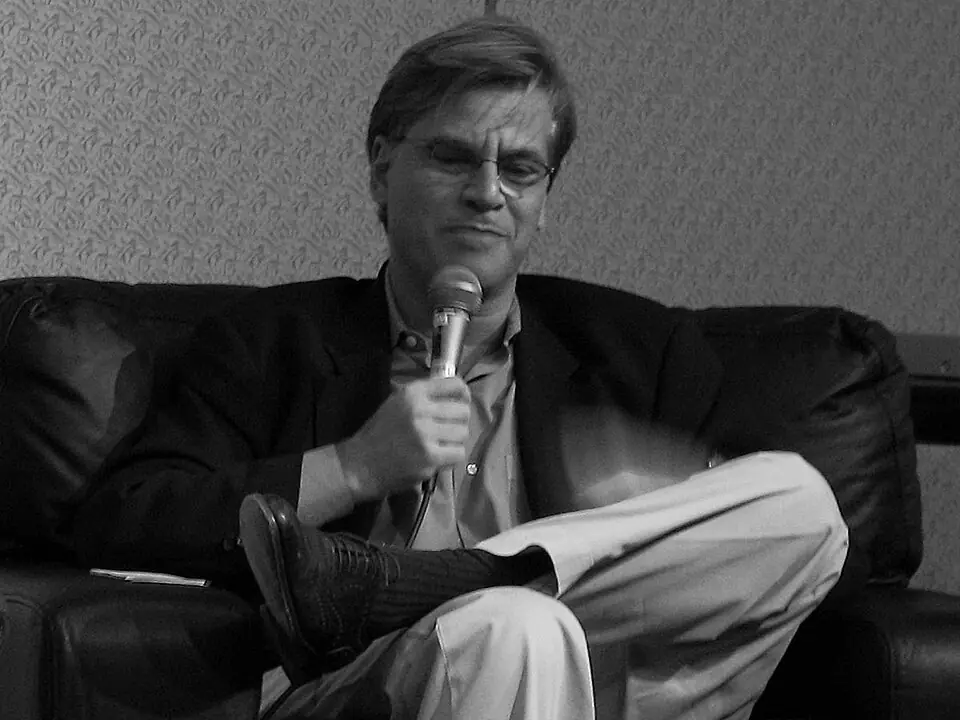
- Born
- June 9, 1961, Manhattan. Grew up in Scarsdale, a New York suburb.
- School
- Syracuse University, musical theater. Class of 1983.
- First jobs
- Busing tables, driving a cab, handing out flyers in costume, tending bar on Broadway.
- Tool
- His own voice. He acts scenes out loud before he writes them.
- Desk
- Home, office, car. The shower when he's stuck.
- Pace
- Slow. By his own account, most days he can't write.
- Record
- 4 screenplay Oscar nominations, 1 win. Four straight Emmys for best drama with The West Wing.
- Latest
- The Social Reckoning, October 2026. He wrote and directed it.
2 action lines · 12 lines of dialogue · 2.25 words a line on average
- Repetition. The question comes back, and a rhythm sets in.
- The joke doesn't ease the tension. It speeds it up.
- The scene turns on a movement: someone stops.
- Nobody says what they feel. The scene ends on a question.
Sorkin didn't write this page. We did, to show his rhythm.
You can spot an Aaron Sorkin page at a glance. You can spot one without seeing it at all, just by hearing it. Two people walk fast. One asks a question, and the other asks it right back. Lines pile on top of each other, and nobody stops to explain how they feel. Some people call this voice “Sorkinese.” The fans and the people who can't stand it agree on one thing: these characters don't talk like real people. They talk the way real people wish they could.
This file takes a look at Sorkin's desk: the rule of intention and obstacle, the way he scores dialogue like music, the structural engines he goes back to again and again. And the places where he fell flat, of which there are plenty. Next to the one Oscar there are shows canceled early, monologues the critics mocked, and a film that sank at the box office just this fall.
OneFrom a bar napkin to the White House
Sorkin was born in Manhattan in 1961 and grew up in Scarsdale. As he tells it, his parents took him to Broadway plays when he was very small. He was too young to follow what they were about, but he loved the sound of the dialogue. He often says it was like listening to music. Hold on to that comparison, because the rest of this file is built on it.
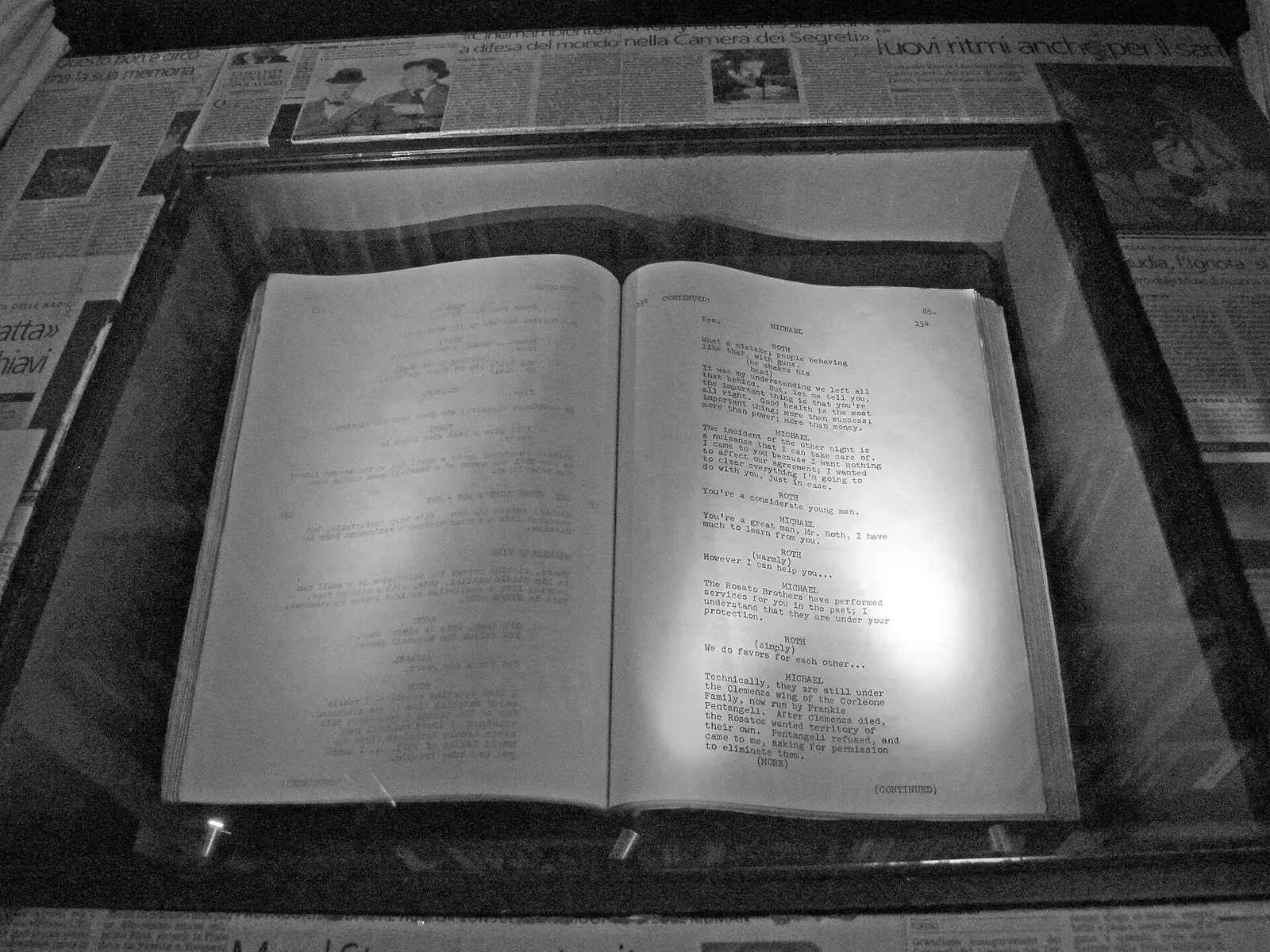
He studied musical theater at Syracuse University and graduated in 1983. He wanted to act. Between auditions in New York he bused tables, drove a cab and handed out flyers in costume. Then he started tending bar in Broadway theaters. As we told you in our piece on first scenes, he wrote much of A Few Good Men on napkins at the bar of the Palace Theatre while the first act of La Cage aux Folles played inside.
The producer David Brown had bought the film rights, but Sorkin wanted to see it on stage first. The play opened on Broadway in 1989, and Rob Reiner made the film in 1992. Sorkin was in his early thirties and suddenly one of the most wanted writers in Hollywood. Malice (1993, with Scott Frank) and The American President (1995) came next. The second followed a president and his staff through their days in the White House. The corridors that didn't fit in that film became Sorkin's biggest work four years later.
The first lesson from all this is simple. Sorkin came to writing as an actor, weighing every word in his mouth. A line had to sound right before it could look right on the page. Every strength and every weakness of his career starts there.
TwoThe screen: television first, then film
His first series, Sports Night (1998), went behind the scenes of a sports news show on ABC. Sorkin wanted it without a laugh track. The network insisted on one. The show was neither quite a comedy nor quite a drama, and the executives believed viewers wanted to be told where to laugh. The laughter was turned down bit by bit through the first season and was gone by the second. Critics adored the show. Almost nobody watched it. It was canceled after two seasons.
A year later The West Wing premiered on NBC. Built with the director and producer Thomas Schlamme, it turned Sorkin from a writer into a brand. His name was on nearly every episode of the first four seasons. The show won the Emmy for best drama four years running, from 2000 to 2003.
Then it cracked. People on the production side talked about budget overruns and delays, and the ratings were sliding. Sorkin and Schlamme left in 2003, at the end of the fourth season. Sorkin later gave two reasons. One was his contract. The new deal paid him a fixed fee instead of tying his money to the show's success, and as he saw it, that took away a strong incentive to do the job well. The other was 9/11. With so many real heroes around, he felt, audiences couldn't attach themselves to fictional ones in the same way. The show ran three more seasons without him.
Two more series followed, and both split opinion. Studio 60 on the Sunset Strip (2006) was canceled after one season. The Newsroom (2012–2014) lasted three. We'll come back to both under “Where he fell flat.”
The movies, meanwhile, never stopped. Charlie Wilson's War (2007). The Social Network (2010) with David Fincher, and the Oscar for Best Adapted Screenplay that came with it. Moneyball (2011), written with Steven Zaillian, and another nomination. Steve Jobs (2015) with Danny Boyle, and a Golden Globe. Then the director's chair: Molly's Game (2017), The Trial of the Chicago 7 (2020), Being the Ricardos (2021) and The Social Reckoning, released last month.
He went back to the theater, too. In 2018 he adapted To Kill a Mockingbird for Broadway. Harper Lee's estate sued, arguing that the play strayed from the novel, above all in the way it drew Atticus Finch. The two sides settled in May 2018, and the play opened in December. Sorkin says the change was deliberate. Atticus needed an arc of his own, because a hero who ends the play the same man he started it doesn't come alive on stage. The lesson: change a beloved character and you may end up in court.
ThreeIntention and obstacle: the method
Sorkin's whole system fits in two words: intention and obstacle. Somebody wants something, and something or someone is standing in the way. Without those two, he says, “it's finger painting.” Your sentences can be as beautiful as you like. With no intention and no obstacle, you don't have a scene.
He doesn't pass this off as a new rule, either. He often says he treats Aristotle's Poetics as the rulebook for screenwriting. To him, a book written two thousand years ago is still the best writing class there is.
The rest of the method is surprisingly messy. Sorkin says most days he can't write, and most nights he goes to bed with nothing. Anyone looking in would see a man on the couch watching sports. All the while, though, he's hunting for the intention and the obstacle. He does a lot of research, hoping to trip over something unexpected that will push the story along. And when an evening is going well, he stops and goes to bed, even if he knows how the scene goes on. That way he has somewhere to start the next morning.
His body is in on it, too. Sorkin acts scenes out before he writes them, saying the lines out loud, alone in his car or in a room. In one interview he called himself the first actor to play all the parts. You may remember this from our piece on writing rituals: acting out a scene for The Newsroom in which one character lunges at another, he lunged in his bathroom, hit the mirror and broke his nose. When he's stuck he takes a shower, then changes his clothes, as if he were starting the day over. He has said he takes up to six showers a day.
A note for the screenwriter
Write two lines at the top of every scene: who wants what, and what's in the way. If you can't, the scene isn't ready. All those days Sorkin spends not writing aren't a weakness. They're the price of this rule. He won't start until he has both.
FourDialogue is a score
Sorkin's dialogue looks easy to copy. Talk fast, talk a lot, be witty. But look at the sample page above. The speed comes from rhythm, not from word count. The lines are short, the questions repeat, the information arrives a drop at a time, and the turn of the scene hides in a silence, in someone stopping.
Saying it back
One character repeats the other's last words as a question. The answer comes back in the same words. It works like a motif returning in a piece of music. Far from wearing the audience out, it gets them ready for the next piece of information.
Dialogue carries the information
Sorkin's worlds are dense with information: law, politics, news, markets, software. He doesn't hand it to the action lines or to a voice-over. He gives it to characters who correct each other and challenge each other. The audience may not know the term, but they know who's winning, and that's what counts.
Speed is a director's decision
As we described in our piece on killing your darlings, Fincher didn't cut the long script of The Social Network. He sped it up. The actors talked much faster than normal, and the film came in at two hours. That tells us something important. A Sorkin page is only half finished until someone plays it at the right tempo.
The aria
Every Sorkin work has at least one big speech. A confession that bursts out in a courtroom, a newsman losing it on a panel, a president settling scores at the podium. “You can't handle the truth!” from A Few Good Men is the best-known example. But notice that Sorkin often gives the best aria to the hero's opponent instead of the hero. When the villain gets the strongest argument, the hero's win means something.
Borrowing from himself
Sorkin carries certain lines and ideas from one show to the next. Online you'll find supercuts that line up the same lines from different shows side by side. The clearest case is an episode title, “What Kind of Day Has It Been.” It names the first-season finales of Sports Night and The West Wing, the finale of the one-season Studio 60, and the series finale of The Newsroom. Fans call it a signature. Critics call it a rerun.
A Sorkin page is a score. Played at the right tempo, it's music. At the wrong one, it's noise.
FiveThe same four questions in the same room
Sorkin's work is set in very different worlds: the White House, a newsroom, a Harvard dorm, a baseball front office, a poker table. Underneath, the same few questions keep coming back.
Idealism against the institution, or inside it?
Sorkin's heroes don't try to tear the system down. They try to make it work the way it's supposed to: a president's staff, a newsroom's reporters, defense lawyers. The institution itself is good, and the trouble is the people who abuse it. His fans find that hopeful. His critics find it naive, even a kind of political fantasy.
Competence is a virtue
Sorkin loves people who are very good at their jobs, and the drama comes from watching them make decisions under pressure. In Moneyball a general manager sets out to prove that all of baseball has been counting wrong. In The West Wing anyone could be the smartest person in the room. In Sorkin's world, stupidity is close to the only real sin.
The workplace is the family
Sorkin's characters don't have homes, or if they do, we rarely see them. Real life happens at the office, in the studio, in the control room. Love, fights and friendships all happen on the clock. That's why his shows are always set behind the scenes of a workplace.
Who pays for genius
At the center of his films there's often a lone genius: Zuckerberg, Jobs, Molly Bloom. Sorkin neither clears them nor buries them. What he asks is who pays the price for all that brilliance. The Social Network ends with the man who built the world's most crowded network sitting alone in front of a screen. And Steve Jobs isn't really about a product launch. It's about whether a father will accept his daughter.
SixStructure: Sorkin's six engines
Sorkin sticks to the classic three acts, but he pours them into a different mold every time. Here are the molds a screenwriter can borrow.
The West Wing · Sports Night · Studio 60
A technique that became a signature with Thomas Schlamme. Characters talk as they stride down the halls, and the camera backs up ahead of them. Movement carries a scene that's heavy with information, so the audience isn't watching a meeting. It's watching a race. When the walk ends, so does the scene.
The Social Network
The film cuts between the deposition rooms of two separate lawsuits. The past is pieced together from two sides' accounts, and they don't match. Sorkin has said the parties were telling opposite stories. Rather than pin that contradiction down to a single truth, he made it the structure.
Steve Jobs
The whole film takes place backstage in the minutes before three product launches. Each act plays out in close to real time. The same people knock on the door every time and pick the fight up where they left off. Boyle shot each act on a different format, so time passes in the texture of the image, too.
| Year | Launch | Shot on | Lisa's age |
|---|---|---|---|
| 1984 | Macintosh | 16mm film | 5 |
| 1988 | NeXT | 35mm film | 9 |
| 1998 | iMac | Digital | 19 |
Back every time: Joanna, Lisa, Woz, Sculley, Andy
A Few Good Men · The Trial of the Chicago 7
Cross-examination drags the truth out. The hero wins by getting the other side to talk, not by finding evidence. The climax is a confession.
Sports Night · Studio 60 · The Newsroom · Being the Ricardos
A show has to go on the air every night or every week, so the clock runs on its own. Being the Ricardos squeezes the whole story into the one week it takes to put a single episode together.
Nearly all of them
Pressure that builds over the whole film blows out in one big speech. It's the clearest trace of Sorkin's roots in the theater.
Narrowing time
What these engines share is that they narrow time and space. A corridor, a deposition room, a backstage, a courtroom, a broadcast week. Sorkin locks his characters in places they can't get out of, and talking is all they have left. For his characters, talking is already a way to fight.
SevenHow he sees his characters
The best thing about Sorkin's characters and the most criticized thing about them are the same: they're all very smart, and they all talk very well. The president, the staffer and the intern think at the same speed and come back with the same witty lines. To his critics, that means every character is really one person talking, and that person is Sorkin.
The women are a debate of their own. A lot was said about how the women of The Newsroom in particular were written as brilliant at work but clumsy, even ridiculous, in their private lives. Sorkin's answer was that anyone who watches the show looking for that will find evidence of it, but there's more evidence pointing the other way. That two of the films he has directed, Molly's Game and Being the Ricardos, put women at the center can be read as part of the same argument.
Real people are the third issue. Zuckerberg, Jobs, Lucille Ball, the Chicago Seven. Sorkin dramatizes real lives freely and doesn't hide it. During the fight over The Social Network, he said his fidelity was to storytelling, not to the truth. Zuckerberg, for his part, said the film got a lot wrong, though not the clothes. For a screenwriter there's no easy answer here. When you write a real person, who do you owe?
One more thing. Real villains are rare in Sorkin's world. The other side is usually someone who's right by their own logic and argues very well. The real enemy is more often the rot inside an institution, or the hero's own arrogance.
EightWhere he fell flat
You could tell Sorkin's career with one Oscar and a shelf of Emmys. For a screenwriter, though, the more useful lessons are in the work from the same pen that didn't land.
Sports Night was a show critics loved and audiences never found. The laugh track the network forced on it was the sound of fear, from a broadcaster that didn't know what the show was. The lesson: if your work can't say plainly what genre it is, other people's fears will decide for it.
Leaving The West Wing wasn't a failure, but it had a cost. Writing nearly every episode himself for four seasons was the most extreme case of the problems we described in our piece on the writers' room. The lesson: a one-person writers' room can be brilliant, but sooner or later it burns out.
Studio 60 on the Sunset Strip (2006) went behind the scenes of a sketch show along the lines of Saturday Night Live. Expectations were huge. The critics' most common complaint: the series told us this was the best comedy show in the world, and its sketches weren't funny. It also came across as self-important and preachy, and it was canceled after one season. The lesson: if you say it's hilarious, you have to show it.
The Newsroom (2012–2014) divided people even more. It was set a couple of years in the past, around real news events, and its heroes covered those events the way they should have been covered, in line with what we only found out later. Most critics saw it as heroism with hindsight. Sorkin himself admitted he got the second season off on the wrong foot. He had the first two episodes, already shot, filmed again, and the season came up one episode short. He also replaced most of the writing staff. The lesson: being right in hindsight is easy, and the audience can tell right away.
And the most recent. The Social Reckoning opened in October 2026 as a follow-up to The Social Network, and this time Sorkin directed it himself. Jeremy Strong took over Zuckerberg from Jesse Eisenberg, and at the center of the story now stood a Wall Street Journal reporter digging into the harm done by Meta. The $30 million film made just $5.5 million in its US opening weekend. It scored 55 percent on Rotten Tomatoes and a B-minus in audience polling. The reviews agreed on one point: it comes nowhere near its predecessor.
Here's our question. The first film told the birth of a company nobody fully understood yet. Telling the story of a company everyone now has an opinion about means telling a verdict, not a mystery. The lesson: a sequel finds the first film's question already answered. Going on without a new question means repeating the old answer.
Sorkin's biggest hits all had a strong partner carrying the page to the screen: Reiner, Schlamme, Fincher, Boyle. We'll just note that and move on.
Sorkin's relationship with the pressure of writing is a story he has told himself. In April 2001, at the height of The West Wing, he was arrested at Burbank Airport after hallucinogenic mushrooms turned up in his carry-on. He later admitted to using cocaine and marijuana. He entered a court-approved treatment program and was tested regularly. In the years since, he has talked openly about struggling with addiction in the nineties, too, and about staying sober as something he works at every day.
In November 2022, while writing a new book for Camelot, he had a stroke brought on by high blood pressure. As he tells it, his doctor told him he should by rights have died. He quit smoking after that.
We're not writing this as gossip. A screenwriter's desk isn't made of pages alone. Sorkin never hid what it cost him to lean on the things that got him through the pressure of the work. That belongs in this file, too.
NineIn his own words
Sorkin comes back to the same few ideas about writing in interview after interview. Here are five of them, four as he said them and one in our own summary.
- “Without a strong intention and obstacle … it's finger painting.” (On his method, AFP, 2018)
- “Most nights I go to bed having written nothing and not knowing what I'm going to do tomorrow morning.” (The same 2018 interview)
- He loved the sound of dialogue before he understood what it meant. To him it sounded like music. (On his childhood and the theater, paraphrased)
- “I'm the first actor to play all the parts.” (The Wall Street Journal, 2012)
- “I don't want my fidelity to be to the truth; I want it to be to storytelling.” (New York magazine, 2010, during the arguments over The Social Network)
FinallyWhat goes in the bag
What a screenwriter reading Sorkin can take to the desk, and what to leave at the door.
- Give every scene an intention and an obstacle. If you can't find both, you're not ready to write yet.
- Act the dialogue out loud. A line that doesn't sound right isn't right on the page either. But stay away from the mirror.
- Let movement carry the information. Two people walking can carry far more exposition than two people sitting down.
- Turn contradiction into structure. If the two sides tell different stories, you don't have to pick one.
- Narrow time and space. Three backstages, one corridor, one broadcast week. Lock your characters in where they can't get out.
- Stop while it's going well. Leave yourself somewhere to start the next morning.
- Don't make everyone talk like you. Ten characters need ten different voices, and they shouldn't all share your sense of humor.
- Don't write heroism with hindsight. The lesson of The Newsroom: being proved right later doesn't win the audience over.
- Don't preach. The moment the audience feels lectured, it stops listening.
- Show what you claim. The lesson of Studio 60: call it the funniest show on television and it had better be funny.
- Don't build a one-person room. The price of The West Wing: one writer can carry everything, but not forever.
- Don't recycle your own lines. The line between a signature and a rerun is a thin one.
Sources. The Guardian, 2005 interview (via Slashfilm) · The Wall Street Journal, 2012 interview (via TheWrap) · Grantland, 2013 · AFP, 2018 interview · New York magazine, 2010 · CBS News, April 2001 · Deseret News, August 2001 · CNN, March 2023 · TVLine · Broadway News, May 2018 · Academy Awards records · October 2026 box-office reports on The Social Reckoning (TheWrap, Looper).