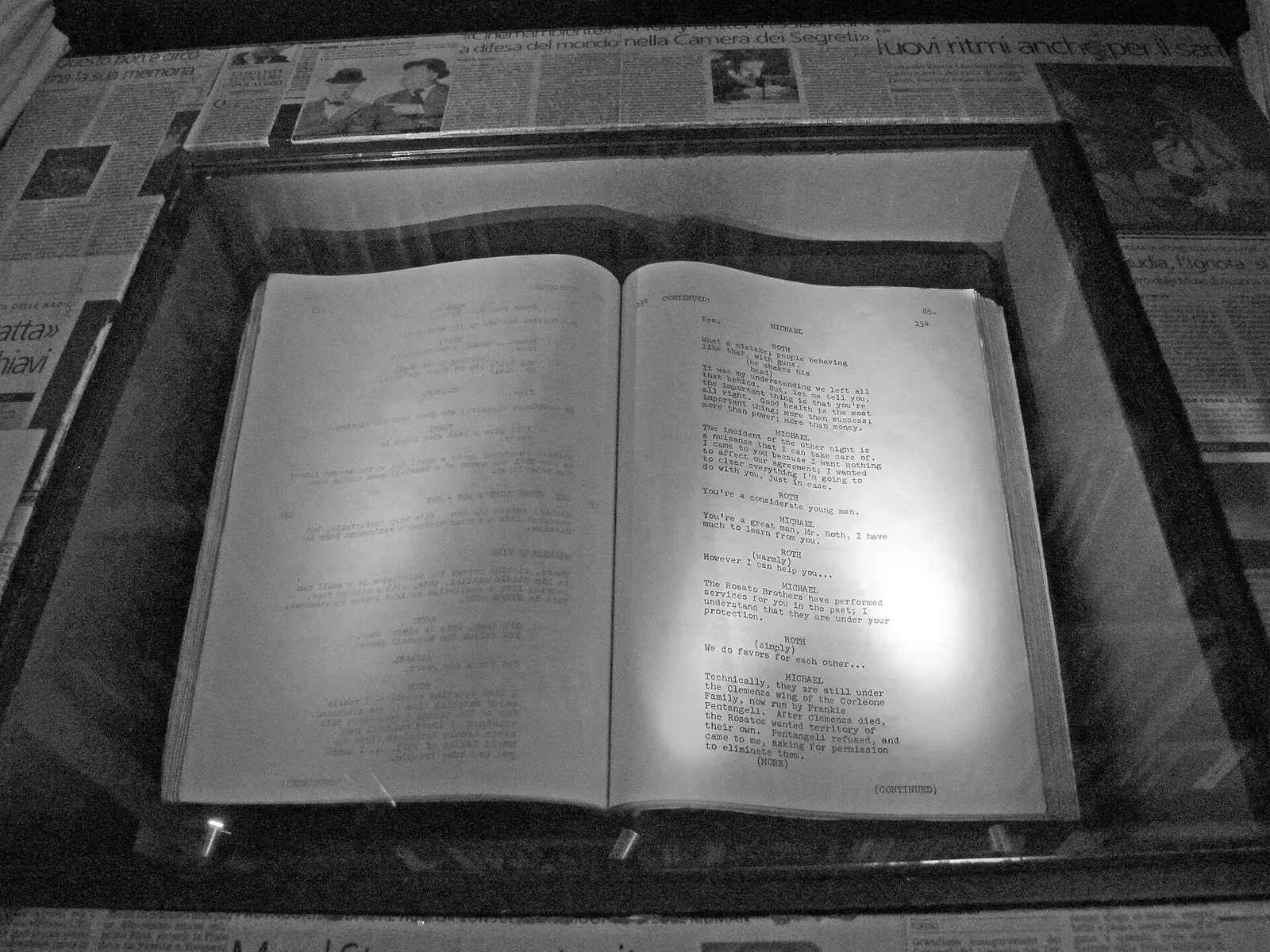
Craft
EXT. NIGHT - THE CAMERA KEEPS ROLLING
No cuts
A couple slips in through a kitchen door. Three men wander among thousands of soldiers on a beach. A camera runs through a whole Berlin night without stopping, and a series shoots each of its four episodes in one breath. The most famous single takes on screen, how they were made, and the part that matters most: how you write a scene once the cut has been taken away from you.
By the Scriptopus Mag desk · Edited by Umut13 Nov 202617 min read
Roughly how long each take in this piece runs. The scale is logarithmic, so each gridline is ten times the one before. Solid bars ran without a break; the second color marks films that look like one shot but hide their cuts.
| Film | Length | The take |
|---|---|---|
| Goodfellas (1990) | ~3 min | The Copacabana scene, about three minutes. |
| Touch of Evil (1958) | ~3 min | The opening shot, a little over three minutes. |
| Atonement (2007) | ~5 min | The Dunkirk beach, about five minutes. A thousand extras, one day. |
| True Detective (2014) | ~6 min | Episode 4, the six-minute raid scene. Seven takes. |
| The Player (1992) | ~8 min | The eight-minute opening shot. |
| The Bear (2022) | ~20 min | Season 1, episode 7, “Review”: the whole episode is a single shot. |
| Adolescence (2025) | ~1 hr | Each of the four episodes is a single shot of about an hour. |
| Rope (1948) | 80 min | Hidden cuts. 80 minutes, ten cuts: five hidden, five at reel changes. |
| Boiling Point (2021) | ~90 min | About 90 minutes. The third of four full takes is the one in the film. |
| Russian Ark (2002) | 90+ min | One shot through the Hermitage, over 90 minutes. The fourth attempt. |
| Birdman (2014) | ~119 min | Hidden cuts. Long takes joined so they look like a single shot. |
| 1917 (2019) | ~119 min | Hidden cuts. It plays as two long shots, with one visible cut between them. |
| Victoria (2015) | 134 min | One 134-minute take in Berlin. The last of three attempts. |
Lengths are approximate. For films with hidden cuts, the figure is the running time of the whole film. Sources are at the end of the piece.
The most powerful tool a screenwriter has isn't a word. It's a gap: the cut. A character walks out a door and, one scene later, is in another city. Years go by in a transition. The dull drive, the phone call everyone is waiting for, the long dinner: all of it disappears from the page. Because of the cut, a story can be made of nothing but the moments that matter.
A single take takes that tool away. The camera doesn't stop, time doesn't jump, and nothing can be saved in the edit. That's why people usually talk about the single take as a feat of cinematography. Really, it's a writing problem. This piece goes through the most famous single takes in film and television, stories from the set included, and reads them the way a screenwriter would.
OneFour kinds of single take
“Single take” means different things to different people, and the differences change what the screenwriter has to do.
- Type 1
The long take inside a scene
The film cuts normally, and one scene or sequence plays in a single take. This is the oldest kind and the most common.
Touch of Evil · Goodfellas · Atonement · True Detective
- Type 2
The “single take” with hidden cuts
The whole film looks unbroken, but it is several shots stitched together, with the seams hidden in the dark of someone's back, behind a wall, or in a digital join.
Rope · Birdman · 1917
- Type 3
The true single-take film
The camera rolls once and doesn't stop until the film is over. There is no editing, only a choice of which take to use.
Russian Ark · Victoria · Boiling Point
- Type 4
The single-take episode
One episode of a series, or every episode, is shot in a single take. The cut moves to the breaks between episodes.
The Bear · Adolescence
TwoWhat was the cut doing for us?
Before we can say what a single take costs a screenwriter, we have to count what the cut gives them.
The cut compresses time. A long drive shrinks to a second. It changes the point of view: one moment we're on the hero's face, the next on the villain's hand. It sets the rhythm, short shots for tension and long ones for calm. And it lets you fix things afterward. As we saw in our piece on the page-a-minute rule, the same script for Ridley Scott's Napoleon could turn into two different films, one of 158 minutes and one of 205. The edit is a script's second draft.
In a single take, all of that is either lost or has to go somewhere else. Time no longer jumps inside the scene. It has to walk through the space. The point of view changes when the camera moves from one character to another, not on a cut. Rhythm comes from the acting and the speed of the camera, not from the edit. And there is no fixing anything later. Alexander Dinelaris, who wrote Birdman with Alejandro González Iñárritu, Nicolás Giacobone and Armando Bo, said the worst of the pressure came right at the start, when they had to write material that couldn't be cut.
ThreeThe long take inside a scene: why this scene?
A good long take carries the meaning of the scene. Dazzling us is the least of what it does. The best ones answer the question “why didn't you cut?” from inside the story.
Goodfellas: the world behind the door
In Martin Scorsese's Goodfellas (1990), Henry Hill takes Karen to the Copacabana nightclub. They don't wait in line. They go in through a side door, down the corridors and through the kitchen, and come out into the club, where a table is set up for them right in front of the stage. According to the producer Irwin Winkler, Scorsese wanted this shot of about three minutes for two reasons: to show Henry impressing Karen, and to let the audience feel why this world is so seductive.
Here's the lesson for the screenwriter. Because the shot never cuts, it proves Henry can open every door. A cut could have told us “we're in” with the next frame. The unbroken walk shows the access itself. One near-perfect take, by the way, went in the trash when Henny Youngman, the comedian on stage, flubbed a joke he had been telling for forty years. Winkler says the shot took twelve takes in all.
Touch of Evil: the bomb is the clock
The Orson Welles opening we took apart in our piece on the first five minutes is the ancestor of the long take inside a scene. A bomb goes into the trunk of a car, and because nothing cuts away as the car rolls toward the border, it ticks like a clock. On set, the customs officer who speaks at the end kept blowing his line. Charlton Heston said Welles finally told the man to just move his lips; they would dub the words in later.
Atonement: the shot the budget made
The Dunkirk beach shot in Joe Wright's Atonement (2007) may be the most instructive story on this list, because it grew out of a constraint. Christopher Hampton, who wrote the screenplay, said his script had columns of refugees, attacks by German planes, and fighting. On a budget of around $30 million, the Dunkirk section was first in line to be cut. Instead, the team came up with a structure in which three soldiers walk out of a surreal vista and into chaos, and Wright suggested joining the scenes into a single shot. That way the whole sequence could be filmed in one day, with around a thousand extras.
Rehearsals started at six in the morning. The cameras rolled at four in the afternoon. They got three complete takes, the third in the light of the setting sun. On the fourth attempt the Steadicam operator fell. The only usable take was the third. James McAvoy called it a huge gamble. The budget nearly killed the scene. The single take turned it into the one everybody remembers from the film.
Children of Men: blood on the lens
Alfonso Cuarón's Children of Men (2006) gives the long take the feel of documentary footage. Near the end of the film, during one of the long takes through the middle of the fighting, blood spattered the camera lens. Cuarón shouted “cut,” but an explosion drowned him out and the crew kept shooting. He later came to think of that stain as the miracle of the scene. In a film that cuts, the shot would have been thrown away. In a single take, the accident became proof that it was all real.
True Detective: the most logical route
The six-minute shot Cary Joji Fukunaga filmed for the fourth episode of True Detective's first season was a landmark for television. Rust Cohle's escape from a drug raid that spins out of control was shot in a real housing project, in seven takes. Fukunaga said that when he picked the route, he was looking for the path that was the most interesting and also the most logical. For a screenwriter, that's the most useful line in the whole story. The route of a single take is not choreography. It's the way the character would try to get out.
Oldboy: the corridor
The corridor fight in Park Chan-wook's Oldboy (2003) scrolls along like a video game, with the camera tracking sideways. It was shot in one take; only the knife in the hero's back was added by computer. It took three days and seventeen takes. With no cut, the exhaustion of the fight becomes real too. You hear what every blow costs in Oh Dae-su's breathing.
The Player: making fun of the long take
Robert Altman opened The Player (1992) with an eight-minute shot in which the characters talk about famous long opening shots, Touch of Evil among them. Altman said he picked that length on purpose, because people talk about long opening shots as if they were an achievement in themselves. So the shot is partly a joke. It also leaves us with the most important question: is the shot serving the story, or serving itself?
A good long take answers “why didn't you cut?” from inside the story. With a bad one, only the people behind the camera know why.
FourHidden cuts: trick or language?
Alfred Hitchcock's Rope (1948) was the first big attempt to pass off a whole film as one take. Cameras then could hold only about ten minutes of film at a time, so the 80-minute film has ten cuts. Five of them are hidden by moving in on a character's back or a dark surface. The other five fall where theaters changed reels, and you can see them plainly. Years later Hitchcock told François Truffaut that he had taken the film on as a stunt.
Today's hidden-cut films do the same thing with digital tools. Alejandro González Iñárritu's Birdman (2014) stitched the cinematographer Emmanuel Lubezki's long takes into what looks like one continuous flow. It won the Oscars for Best Picture, Director, Original Screenplay and Cinematography. Sam Mendes's 1917 (2019) plays as two long takes. The only visible cut between them comes when the hero passes out and the screen goes black. Roger Deakins won the cinematography Oscar for it.
The interesting part for a screenwriter is that in these films the idea and the form arrived together. Mendes said 1917 started from the idea of two soldiers carrying a message for two hours in real time, and that the single take went hand in hand with it. His co-writer, Krysty Wilson-Cairns, said the constraint made her job much harder, since one unbroken shot is a tricky way to tell a traditional story. Birdman's script took about a year and a half to get ready to shoot, and it kept changing until the very end.
So is the hidden cut a trick? For the audience, the difference is usually invisible. For the screenwriter, it barely changes anything. Hidden or not, if the audience isn't supposed to feel a cut, every move from one scene to the next still has to be written as unbroken in space and time. The trick happens behind the camera. The constraint is on the page.
FiveThe true single take: say a prayer
Then there are the films with no cuts at all. The director calls “action” once and waits for the film to end. Either it works, or everyone goes back to the top.
Russian Ark: centuries in a museum
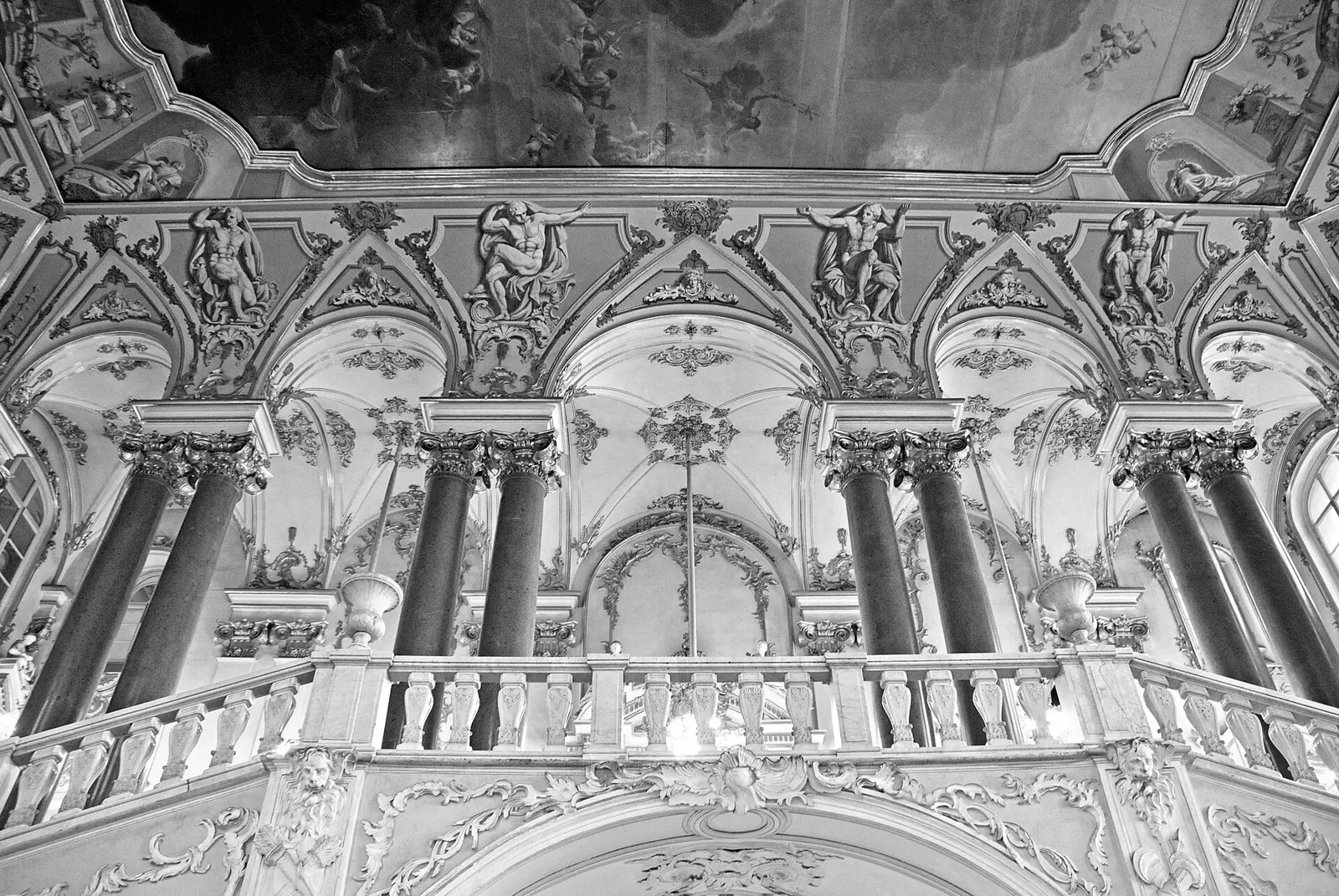
Aleksandr Sokurov's Russian Ark (2002) is one shot of over 90 minutes that moves through dozens of rooms of the Hermitage Museum in St. Petersburg, and through centuries of Russian history. It was filmed on December 23, 2001. The first three attempts broke down over technical problems; the fourth made it to the end. The German operator Tilman Büttner carried the camera on a Steadicam rig he had built himself. The cast ran to 1,300 extras, over 180 actors and a symphony orchestra. Everything was recorded, uncompressed, onto a single one-terabyte drive.
Victoria: twelve pages, one night
Sebastian Schipper's Victoria (2015) follows a young woman out of a Berlin nightclub and into a bank robbery with four men she doesn't know, all in one take of 134 minutes. Here's the fact that should surprise a screenwriter most: Schipper says there was no full script, just a text of about twelve pages. None of the dialogue was written. The actors improvised after long rehearsals. They shot three complete takes, each running until first light, and Schipper says the budget could have covered one more attempt at most.
Boiling Point: one dinner service
Philip Barantini's Boiling Point (2021) stays in the kitchen of a London restaurant through one busy evening, in a single take of about 90 minutes. It started as a 22-minute short and was then expanded into a feature. They shot four full takes over two days, two a day. Eight had been planned, but the pandemic shut the shoot down. The film uses the third. There was no script, only a list of story beats, and the dialogue was left loose inside very tight choreography.
Put these three side by side and a pattern shows up for screenwriters. The longer the camera rolls, the less dialogue the page seems to need. On Victoria and Boiling Point, the writer is less a dialogue writer than the architect of structure and events. That isn't the only way to do it, though. The next example does the exact opposite.
SixThe single take on television: the cut moves between episodes
The Bear: write it straight, then make it one take
“Review,” the seventh episode of the first season of The Bear, watches a restaurant kitchen fall apart for about twenty minutes without a cut. It was first written the conventional way. Then the show's creator, Christopher Storer, and producer Joanna Calo rewrote it from top to bottom for a single take, keeping the main story points. The cast read it aloud sitting down a few times, purely to time the words, and then got on their feet as if they were rehearsing a play. Jeremy Allen White said it mattered to him that the script was written like a blueprint for the single take, because the work starts with the words.
Adolescence: four hours, four shots
Netflix's Adolescence (2025) took the format as far as it goes. Written by Jack Thorne and Stephen Graham and directed by Philip Barantini, it has four episodes, each one a single shot of about an hour, with no hidden cuts. The plan was to shoot every episode ten times over five days, once each morning and once each afternoon. Some attempts were abandoned partway through. The school episode had over 320 students and 50 adults and took over thirteen takes. The last episode was finished on the sixteenth try. The camera passed from hand to hand among the crew, and at the end of episode two it was hooked onto a drone that carried it out of the school and on to somewhere else. Thorne said the drone shot worked because it helped the story, not because it showed off the technology.
At the 2025 Emmys the series won eight awards, among them Outstanding Limited Series and the writing and directing prizes. Owen Cooper became the youngest male actor to win an acting Emmy. Not everyone was sold on the single take, though. Some critics wrote that the form was there for the marketing, not for the story.
For a screenwriter, the real lesson of Adolescence is about structure. Each episode plays in real time and rests on one setting: a police station, a school, a session with a psychologist at a youth detention center, a single day in a family's life. Between episodes, time passes. So the cut didn't disappear. It moved to the gaps between episodes. Every time jump in the series happens in the black between one hour and the next. Inside an episode there's no way out, just as there is none for the family in the story.
SevenHow do you write a single take on the page?
The examples add up to a working method. The page looks the same as ever. What changes is the question in the writer's head.
Let the story choose the route. Take Fukunaga's point: the camera's path is the character's logic. Henry coming in through the kitchen, Cohle getting out, Schofield climbing out of the trench. A route should be a map of what someone intends, not a tour of the set.
Pass the camera from one character to the next. Without cuts, the point of view belongs to whoever the camera is following. Someone leaves the room, and the camera stays with the person left behind. These handoffs need as much writing as the scenes do. Adolescence and Boiling Point build their whole structure on them.
Use space to skip time. In a single take, time can only pass in a hallway, on a staircase, while someone stares out a window. Birdman jumps ahead in time while the camera drifts down empty corridors. The script has to design those dead moments as carefully as the scenes.
Love the dead time or get rid of it. A walk that would be cut from an ordinary film either gets a dramatic job in a single take, or it kills the film. Give every walk a conversation, a discovery or some tension.
Decide how much dialogue to write. There are two schools. Victoria and Boiling Point wrote the story beats and left the words to the actors. Birdman, The Bear and Adolescence worked from full scripts. If you go the second way, read the pages aloud and time them, the way the cast of The Bear did.
FinallyQuestions to ask before you go for a single take
- Question
What do I gain by not cutting?
Goodfellas got access out of it, Atonement the scale of the chaos, Adolescence the feeling that there's no way out. If your answer is “it'll look impressive,” remember the joke in The Player.
- Question
Where does the cut go instead?
The skipped time has to go somewhere: between episodes, into a hallway, into a drone flight. If you don't plan where it goes, the audience gets it back as a boring walk.
- Question
Is the route the character's logic?
The camera should go after what the character wants, not the prettiest corner of the set.
- Question
Who hands off to whom?
Write the transitions that shift the point of view. In a single take, the handoff does the job of the cut.
- Question
Is this the budget talking, or the story?
Atonement's shot came out of a budget squeeze, and sometimes a limit is what brings the best idea. But a single take is rarely cheap. Think of the rehearsals, the extras, the retakes.
MovieMaker, Irwin Winkler on Goodfellas · Futility Closet, The Player and Touch of Evil · Flick Filosopher, Atonement with Christopher Hampton and James McAvoy · Gizmodo, Children of Men · E! Online, True Detective · production notes on Oldboy · Kottke, the hidden cuts in Rope · One Guy's Opinion, 1917 with Mendes and Wilson-Cairns · Screenwriting Magazine, the writers of Birdman · TCM, Russian Ark · Vice, Victoria with Sebastian Schipper · Screen Global Production, Boiling Point · No Film School, The Bear · Slashfilm and Netflix Tudum, Adolescence.