Craft
INT. EDITING ROOM - NIGHT · STOPWATCH RUNNING
One page, one minute?
The oldest rule in the business says a page of screenplay equals a minute of film. Data from thousands of scripts says it almost never comes out exact. A 106-minute film from a 31-page script, a two-hour film from 178 pages, and everything in between: the most detailed map yet of how pages turn into minutes.
By the Scriptopus Mag desk · Edited by Ali11 Nov 202617 min read
Each film's or episode's running time divided by its script's page count. The dashed line is the “one page, one minute” rule.
The “Median script” bar is the dataset's median. Values marked “~” were worked out from approximate episode lengths. Sources are at the end of the piece.
Start with your page count. The estimate uses the page-to-minute ratios of real films, which shift with the length of the script.
- The ratios
- 75 pages: 0.798 · 100 pages: 1.0 · 120 pages: 1.093 · 165 pages and up: 1.361. Between these points the ratio moves in a straight line. Divide the page count by the ratio to get minutes.
- A4
- Multiply the A4 page count by 1.07 first to get its US Letter equivalent.
- Without credits
- Take off 4.3 minutes, the median length of the end credits.
- 110 pages, US Letter
- about 105 minutes · about 101 without credits · about 57 seconds a page
- 110 pages, A4
- about 118 Letter pages · about 109 minutes · about 104 without credits · about 59 seconds a page
Below 60 pages there's no data at all, so the estimate gets even rougher. Only one real film in five lands within ±5% of an estimate like this. It's a compass, not a scale.
Every screenwriter learns the rule in week one: one page, one minute. Hand a producer a 130-page script and, before reading a line, they're already picturing a film that runs past two hours. A reader opens a 95-page comedy and relaxes. Streamers, contracts, shooting schedules and budgets all rest on the same assumption.
So is it true? The short answer: surprisingly close on average, and surprisingly wrong for any given script. Here's the long answer: where the rule came from, what thousands of scripts say about it, which pages run fast and which run slow, and what all of that means for a screenwriter.
OneThe rule was born on a typewriter
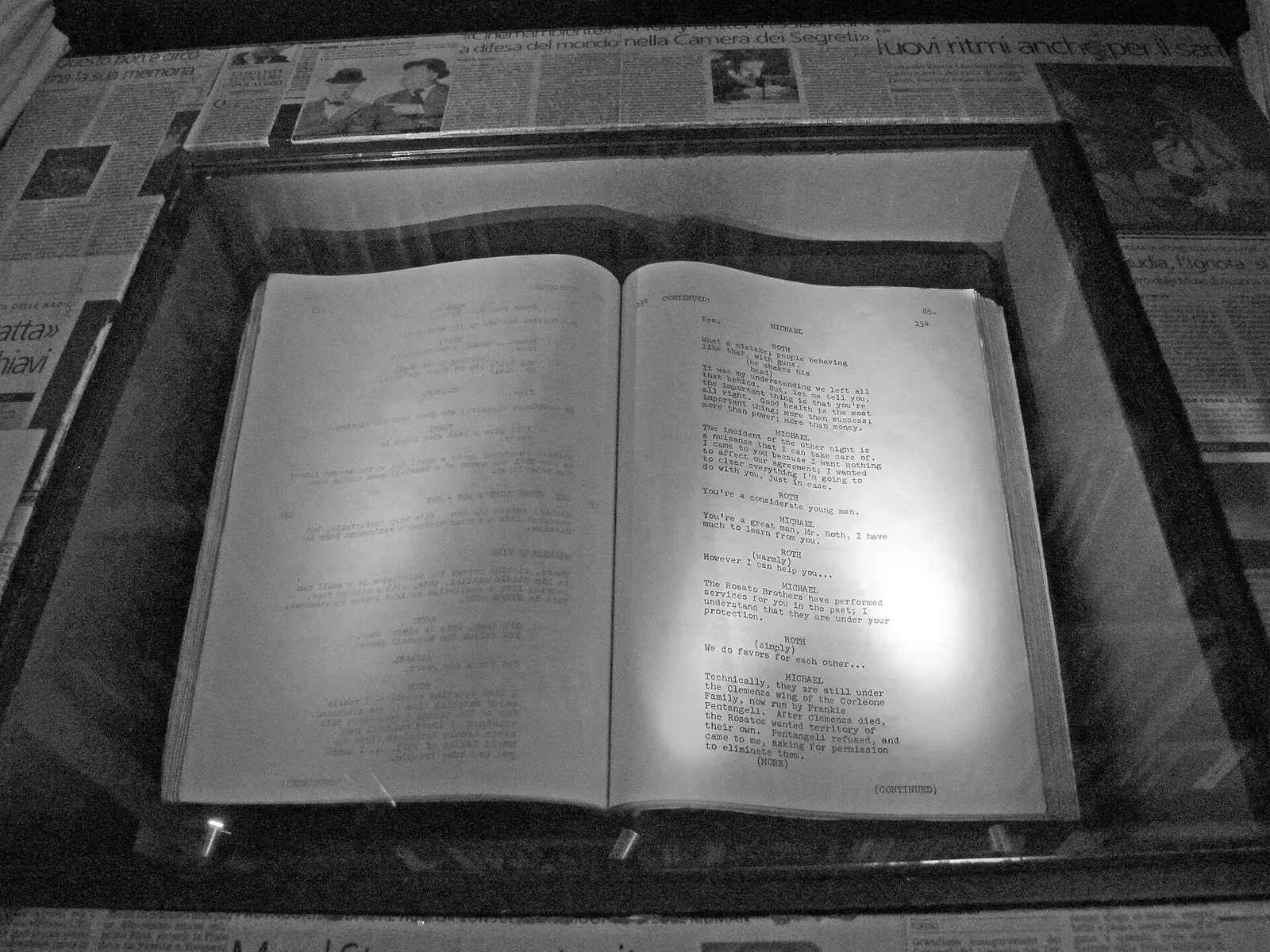
The one-minute rule came out of bookkeeping, not art. For decades, screenplays were typed, and they were typed in Courier. The typeface was designed for IBM's typewriters in 1955 and soon became the standard. What matters about it is that it's monospaced: an “i” takes up the same width as an “m”. In 12-point Courier, exactly ten characters fit in an inch.
So the page became something close to a unit of measure. The margins were fixed, the dialogue column was fixed, the number of lines was fixed, and every page held roughly the same amount of material. Producers and production crews could look at how thick a script was and guess the running time, and from the running time, the budget.
Screenwriting software still keeps that format to the letter, which is why the font tricks we covered in our piece on killing your darlings are so easy to catch. Before the page is a work of art, it's a spreadsheet. The shooting schedule even measures scenes in eighths of a page.
TwoWhat does the data say?
Stephen Follows, who researches film industry data, tested the rule on real films instead of on paper. He took 2,520 scripts in US Letter format and set them against the running times of the finished films. The results back the rule up and knock it down at the same time.
On average, a script has about 9 percent more pages than the film has minutes. So the average page is worth 55 seconds, not a minute. The median script runs 119 pages and turns into a 108-minute film. Take out the credits and each page is worth about 54 seconds of story.
But an average tells you very little about any one script. Only 18.2 percent of the scripts come within 5 percent of their film's running time. That's roughly one in five. Turn in 120 pages and the odds are about four in five that the film misses two hours by over 6 minutes, one way or the other.
The rule is a compass. It points you north. It won't walk you to the door.
ThreeShort scripts grow, long scripts shrink
The most interesting thing in the data is that the misses aren't random. Sort the scripts by page count, as Follows did, and a clear trend shows up: short scripts stretch on screen and long ones shrink.
How many seconds of film one page comes to, by the script's total length.
Source: Stephen Follows, 2,520 US Letter scripts. No separate figure was published for 131 to 150 pages.
A typical 75-page script becomes a 94-minute film. Over 151 pages, the average page shrinks to 44 seconds. The only range where the rule holds almost exactly is 90 to 109 pages.
The data doesn't say why. Here's our reading. A lot of short scripts come from writer-directors who already have the whole film in their heads. They cover action, silence and atmosphere in a single line, because they're the ones who'll open that line up on set. Long scripts, meanwhile, are the first to lose material once they reach the editing table. Not every scene that gets written gets shot, and not every scene that gets shot makes the film.
The clearest proof is one script that became two films. Ridley Scott's Napoleon (2023) ran 158 minutes in theaters. The director's cut made for Apple TV+ runs 205. Same pages, 47 minutes apart. In the end, the edit decides the running time, not the screenwriter.
FourNot every page runs at the same speed
What really ruins page count as a forecast is what's on the pages. A page packed with dialogue and a page with one line of action take up the same sheet of paper, and they play for very different lengths of time.
The fast page: dialogue
Fast talk on film goes back to Howard Hawks's His Girl Friday (1940). Its dialogue runs at about 240 words a minute. The Hollywood films of its day averaged around 90, and everyday American speech ran about 140. Hawks rehearsed his cast to talk over each other, and since multitrack sound recording didn't exist yet, he used as many as 35 microphones on the set. The upshot: material for a film twice as long fit into 92 minutes.
Today the tradition belongs to Aaron Sorkin. His script for The Social Network ran 178 pages, and the studio wanted 30 of them gone. David Fincher argued the film could still come in at two hours. He had the script read aloud, start to finish, and timed it on his iPhone's stopwatch. The opening bar scene took 7 minutes 22 seconds. When the actors played it at 7:40 in rehearsal, Fincher told them to pick up the pace: the scene worked best at 7:22. The film runs 120 minutes.
Sorkin's Steve Jobs script was 181 pages, and by his own account about 100 of them were one character's lines: Jobs's. The film runs 122 minutes. In both films, a page works out to about 40 seconds.
On television, Amy Sherman-Palladino's shows do the same thing. Gilmore Girls scripts routinely ran around 80 pages, sometimes as thick as a feature. The episodes came in under 45 minutes without ads, and the cast worked with a dialogue coach. On The Marvelous Mrs. Maisel, Rachel Brosnahan has said the scripts ran 10 to 15 pages longer than usual. For Sherman-Palladino this isn't an exception. It's her signature.
The slow page: action and silence
At the other end sits J.C. Chandor's All Is Lost (2013), in which Robert Redford tries to stay alive alone on a sinking boat in the middle of the ocean. It was shot from a 31-page script. Chandor called it “a treatment length,” but “pretty darn specific: beat by beat by beat.” Redford has barely two spoken lines in the entire film, which runs 106 minutes. That's close to three and a half minutes a page.
George Miller's Mad Max: Fury Road (2015) is a case where the page nearly handed its job to another kind of document. The film was planned on around 3,500 storyboard panels, and for years people said it was shot without a script. Miller denied it. Of course there was a script, he said, and you needed one to explain the film to the studio, the cast and the crew. But the running time came out of the editing room, not off the page. The raw footage ran to 480 hours.
The middle page: animation
Animated comedy keeps its own clock. The Simpsons scripts run around 44 pages and turn into episodes of about 22 minutes. That's two pages a minute, because a visual gag takes a lot of words to describe and almost no time to play.
“They start fighting” is three words, and it can take three minutes on screen. A page of Sorkin is over in forty seconds.
FiveGenre, era and round numbers
The genre clock
Follows's data shows clear differences between genres, too. Comedy burns through its pages fastest, at a ratio of 1.15, or about 52 seconds a page. That figure comes from 849 comedy scripts, and it fits a genre built on quick lines and short scenes. War films drop to 0.99, almost one to one. Musicals sit at 0.9: a song takes a few lines on the page and can run for minutes on screen. The musical sample is only 19 scripts, though, so read that one with caution.
The decade clock
Even more interesting, the ratio has shifted over the decades.
How many seconds of film one page of script comes to, by era.
Source: Stephen Follows. No ratio was given for the 1940s and 1950s, and the 1970s are not on the chart.
In the 1930s a page was worth just 41 seconds. Scripts back then were written in a different format, and, as His Girl Friday shows, films talked very fast. Over the next sixty years the ratio crept toward one. The 2020s are the first decade in which the median has dipped below it. A page now comes to a little over a minute.
The page didn't change. The minute did. The median script is still 119 pages, but films have gotten longer. Wide releases in North America averaged 106 minutes in the 2000s and 114 in the 2020s. Films with budgets over $100 million went from about 122 minutes to 130. In the 1980s about 13 percent of wide releases ran past two hours; in the 2020s, 30 percent. Oppenheimer runs 180 minutes, Killers of the Flower Moon 206, The Brutalist 215.
Then there are the credits. Across all the films Follows sampled, the median end credits run 4.3 minutes. In the 1970s they ran 2 minutes; in the 2020s, 5.2. So the last five minutes of a film today are a list of names that no line of the script accounts for.
The pull of round numbers
In a separate study of more than 12,000 scripts, Follows found a median of 106 pages, with 68.5 percent falling between 90 and 120. The curve isn't smooth, though. It spikes at 90, 100, 110 and 120. Writers nudge their stories toward round numbers, cutting or padding to land on one. The lesson is simple: the thresholds in a reader's head are real, and everyone writes to them. By genre, horror scripts are the shortest, at 98.6 pages on average.
SixOn television, the page is the show's voice
Television is far stricter about page count than film, because episode length is fixed. Even so, the formats vary a lot.
| Format | Pages | Example |
|---|---|---|
| One hour, ad-supported network | ~44–45 | Hannibal, 44 pages |
| One hour, premium cable or streaming | 55–65 | Game of Thrones pilot, 60 pages, 62 minutes |
| Half hour, single camera | 30–35 | Community pilot, 33 pages |
| Half hour, multi-camera | 40–45 | Friends, 44 pages |
| Half hour, animation | 44–50 | The Simpsons, 44 pages |
Friends and Community fill almost the same time on air, yet the Friends script is 11 pages thicker. A multi-camera sitcom leans harder on dialogue and uses fewer locations, and dialogue eats up more of the page than action does. The gap between network and streaming scripts comes from the length of the episode itself: ad breaks leave less screen time in the same slot.
And some shows don't fit the table at all. Gilmore Girls wrote nearly twice the pages in the same format. So if you're writing for a series, read that show's own scripts before you trust any general rule. A show's page count is a fingerprint of how fast it talks.
SevenThe trouble with writing on A4
Writers outside the US have one more thing to think about. The rule's whole history is built on US Letter paper. A4, the standard in Europe, Turkey and most of the world, is a little longer and a little narrower.
In Follows's 351 A4 scripts, the median is 110 pages, 7.6 percent fewer than on Letter. The ratio on A4 is 1.02, which means the one-minute rule actually works better on A4 than on Letter. Converting is easy: multiply your A4 page count by about 1.07. A 100-page A4 script comes out at a film of about 98 minutes. Reformat the same text on Letter and it runs 107 pages.
The difference is small until your script lands on an American producer's or manager's desk. A script of 112 pages on A4 comes to about 120 on Letter, right on one of those thresholds in a reader's head. If you're sending it to a reader abroad, look at it on their paper first.
EightWho reads the page count, and why?
For all that uncertainty, page count still matters in the business, because different people use it to answer different questions.
The reader sees page count as a measure of discipline. Final Draft recommends 90 to 115 pages for a spec script. That's not a law, but from an unknown writer, 140 pages raises an eyebrow before page one has been read. Sorkin's 178 pages got read because he's Sorkin.
The producer reads page count as a budget line. More pages mean more shooting days. What counts here isn't the minutes but the work that has to be shot. A one-line car chase can cost far more than three pages of talk in a kitchen.
The production team cuts the page into its smallest pieces. The shooting schedule measures every scene in eighths of a page. In prep, the script supervisor reads and acts out the whole script with a stopwatch running, then hands the production an estimated running time. In other words, the professionals don't trust the one-minute rule either. They measure.
FinallyThe screenwriter's stopwatch
Rules for the writer, from the math of pages and minutes.
- Rule
Measure seconds, not pages.
Do what Fincher did: read the script out loud with a stopwatch running. When you hit an action line, stop and play the moment in your head for as long as it will last on screen.
- Rule
Keep separate books for dialogue and action.
A Sorkin page is 40 seconds. A Chandor page is three and a half minutes. Know which parts of your script are Sorkin and which are Chandor.
- Rule
A long script shrinks in the edit, but a reader sees it first.
Over 151 pages, a page drops to 44 seconds. Before any of that, though, the script has to get past a reader.
- Rule
Writing on A4? Multiply by 1.07.
If a script is headed for a desk abroad, check it in US Letter as well.
- Rule
Read the scripts of the show you're aiming at.
A show's page count is how fast it talks. Write 45 pages for Gilmore Girls and you've misread the show.
- Rule
Don't forget the credits.
On the average film today, 4 to 5 minutes are credits. Not every minute of running time is story.
Sources. Stephen Follows, “Does one page of a screenplay really equal one minute of screen time?”, “Defining the average screenplay”, “Are two-hour movies the new normal?” · Slashfilm, on Sorkin and Fincher · The Playlist, on the Steve Jobs script · Rotten Tomatoes, interview with J.C. Chandor · CinemaBlend and The Drive, on Fury Road · The A.V. Club, on His Girl Friday · Looper, on Gilmore Girls · Slashfilm, on The Marvelous Mrs. Maisel · StudioBinder, on TV script lengths · the Final Draft blog · SoCreate, on the history of Courier.