Working together
INT. SHARED OFFICE - NIGHT
Fifty-fifty
What happens when two people start a story from scratch, with no head writer and nobody holding the final word? The most famous writing teams in film, their long marriages, their quiet divorces and the methods that work at the desk.
By the Scriptopus Mag desk · Edited by Umut28 Oct 202614 min read
- &
- Screenplay by A & B. They wrote together, as a team.
- and
- Screenplay by A and B. They wrote separately: one wrote it, the other rewrote it later.
- Whose idea was it, and does that change anything?
- How do we split the fee?
- Whose name comes first in the credits?
- When we can't agree, who gets the final word?
- If one of us leaves the project, what happens to the rights?
- Will we share an agent?
- What happens if one of us wants to direct?
Signed: Writer A, Writer B
When there's a head writer, every fight ends at the same door sooner or later. The final word is theirs. But when two writers go into a story from scratch as equal partners, there is no such door. If you can't agree on a scene, you're both right, and you might both be wrong. There's no third person to settle it.
A fifty-fifty partnership may be the hardest kind to run. Sometimes, though, there's no way around it. The idea came out of a conversation between the two of you. Or a producer hired you as a pair. Or you simply know you can't write this one alone. This piece looks at writing pairs who kept that kind of partnership going for years, and at others who quietly ended it one day.
OneA single character: “&”
The Writers Guild of America's credit rules contain a tiny distinction that carries a lot of weight. An ampersand between two names in a screenplay credit means the two wrote together, as a team. The word “and” means they worked separately. Usually one wrote the script and the other rewrote it later.
That distinction also sums up what co-writing means in the business. As far as the industry is concerned, a team is one writer. It often splits one writer's fee. It's credited as one unit. And it builds one career, together. That's why going solo after years on a team can feel like starting your career over.
To the industry, a team is one writer. That's a strength, and it's also a cage.
TwoLong marriages
Billy Wilder and I. A. L. Diamond
One of the most productive writing teams in film history. They started with Love in the Afternoon in 1957 and kept writing together until 1981, and the work includes classics like Some Like It Hot and The Apartment. By most accounts the routine never changed. Wilder paced the room and talked. Diamond sat at the typewriter and typed. On the wall of Wilder's office hung a famous question, a tribute to his mentor Ernst Lubitsch: “How would Lubitsch do it?” For close to twenty-five years, the two kept to much the same ritual.
Joel and Ethan Coen
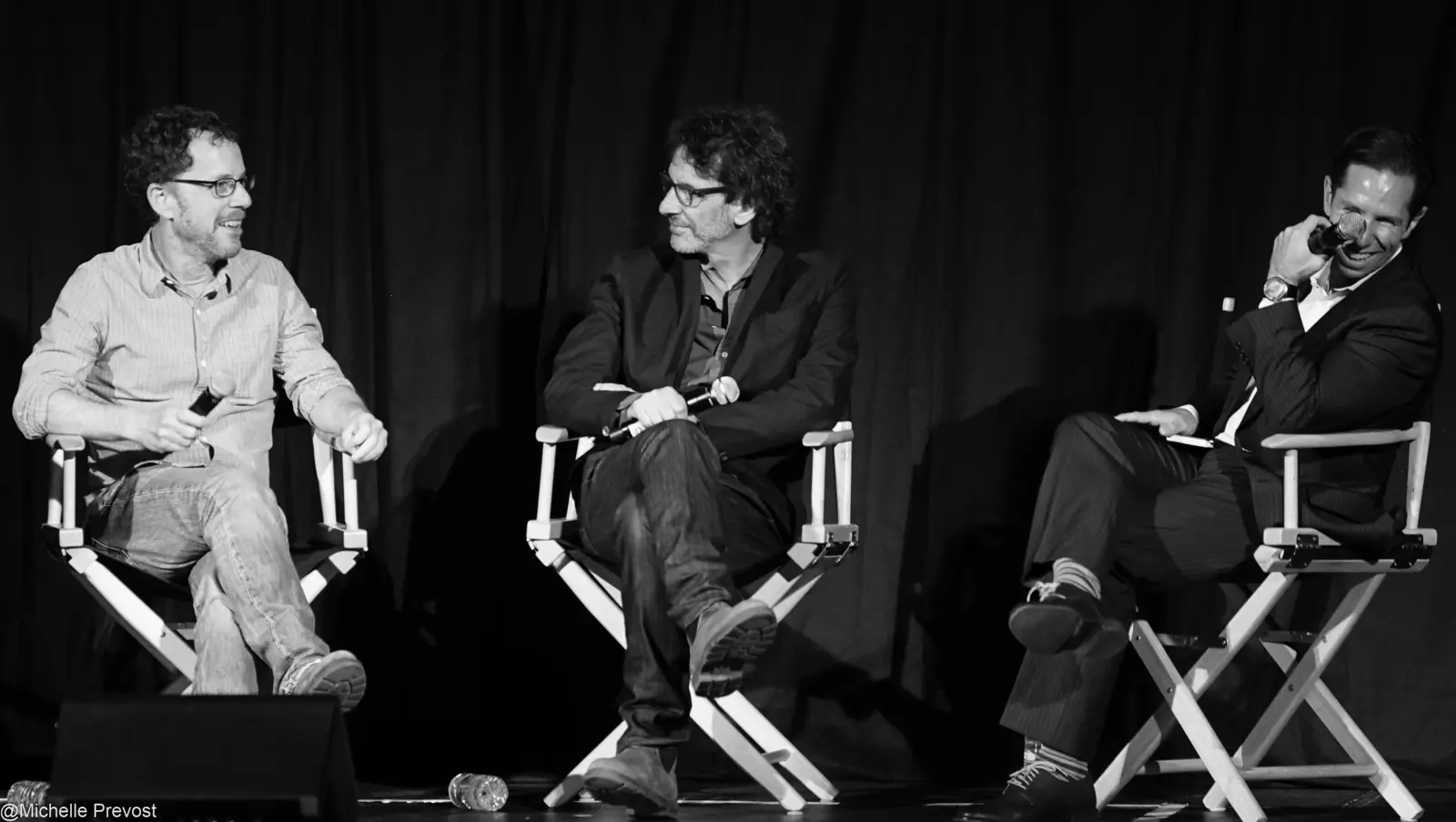
The Coen brothers wrote their scripts together for decades, and for a long time they directed their films together too. One of the best-known stories about them is about what happens when co-writers get stuck. When the script for Miller's Crossing stalled, they switched to another script to clear their heads and wrote Barton Fink within a few weeks. It was about a screenwriter who is stuck. In a partnership of two, even being stuck can be shared, and now and then it turns into a new story.
Scott Alexander and Larry Karaszewski
They met in college and wrote together for their whole careers. They also staked out a patch of their own: biographies of odd, lovable people whose lives nobody else would have thought to put on film. Ed Wood, The People vs. Larry Flynt and Man on the Moon all came from that patch. Years later they took the same approach to television and wrote The People v. O. J. Simpson. They show how long a shared taste, even a shared genre, can keep a partnership fed.
Simon Pegg and Edgar Wright
The two first worked together on the TV series Spaced, which Pegg co-wrote and starred in and Wright directed. Then they wrote a trilogy together: Shaun of the Dead, Hot Fuzz and The World's End. Pegg acted, Wright directed. Keeping their jobs clearly apart became one way to protect an equal share of the writing.
ThreeQuiet divorces and long breaks
Charles Brackett and Billy Wilder
Before Diamond, Wilder's partner was Charles Brackett. Starting in 1938 the two wrote together for over a decade, and they won Oscars for The Lost Weekend and Sunset Boulevard. Then, right after Sunset Boulevard, their biggest success, Wilder ended the partnership. By most accounts the tension had been building for years, and the split hurt Brackett deeply.
Behind that breakup sits one of the touchiest issues in co-writing. Wilder was also directing their films. When one partner is the director, fifty-fifty exists only on paper. Whoever has the final word on set starts to carry more weight at the writing desk too. That may be why Wilder set things up differently with his next partner, Diamond, from day one.
Matt Damon and Ben Affleck
The two childhood friends wrote Good Will Hunting together. The story grew out of something Damon had written for a writing class at Harvard. In 1998 it won them the Oscar for Best Original Screenplay. For years a rumor went around that the real author was the celebrated screenwriter William Goldman. Goldman denied it and said all he had done was give them notes.
Here's the odd part: after that success, the two didn't write another script together for about twenty years. Both went off to act and direct. In 2021 they teamed up again to write The Last Duel with Nicole Holofcener. Some partnerships don't end. They just take a long break.
David Benioff and D. B. Weiss
The two showrunners who ran Game of Thrones together showed both the strength and the cost of an equal partnership. They shared the show's success. And when the backlash against the final season came, the one we discussed in our piece on twists, they took that together too. In an equal partnership, the glory and the blame get split down the middle. That may be fair. It can also be heavy.
In a fifty-fifty partnership, the most dangerous moment isn't a fight. It's a big hit, because that's when everyone starts remembering who did more of the work.
FourMethods that work at the desk
Every pair has its own routine. Over the years, though, we've seen a few methods work more often than the rest.
One room, one keyboard
The Wilder and Diamond model. One talks, the other types. The upside is that every sentence goes through both of you on the spot. The downside is that it can be painfully slow, and over time the person at the keyboard ends up owning more of the voice.
Break it together, write apart, swap
A common method. You build the story's skeleton together, scene by scene. Then you divide up the scenes. Each of you writes your own, then rewrites the other's. That way every scene passes through both pairs of hands, and the script moves toward a single voice. It's the two-person version of the “break together, write alone” rule from our piece on the writers' room.
Split the roles
Bob Gale and Robert Zemeckis met in college and wrote Back to the Future together. Then Zemeckis directed it and Gale produced it. Pegg acted, Wright directed. Equal at the writing desk, different jobs on set: that can keep two people from fighting over the same turf.
Read it in one voice
When the draft is done, have one of you read the whole script aloud. If you can still tell whose scene is whose, it hasn't become one voice yet.
FiveThe partnership agreement: what to settle before the wedding
Treat the list above as a contract. The Writers Guild even offers a sample agreement for writing teams. Talking all this through on day one isn't romantic. But partnerships most often end on the day all the questions nobody ever raised come up at once.
The touchiest question is whose idea it was. Most teams ban it outright from the start. Wherever an idea came from, it belongs to both of you the moment it's on the table. That can feel unfair at first. But as the partnership goes on, a pair that starts counting whose ideas made it in has stopped writing and started keeping score.
The second touchy question is what happens if you split up. If one of you leaves the project, what becomes of the half-finished script? Can the other keep going alone? What do the credits say? If the answers aren't on paper, a breakup can take a friendship down with it.
SixRules from the desk
- Rule
Have a tiebreaker.
Decide in advance what happens when you can't agree. Whoever wrote the scene first could get the final word. Or each of you could hold one veto for the whole project. Or a third reader you both trust could decide.
- Rule
Ban the question “Whose idea was this?”
Every idea on the table belongs to both of you. The day you start counting is the day the partnership starts to end.
- Rule
Split the money evenly and the credit openly.
The fee is fifty-fifty. Settle early whose name goes first in the credits, too: alphabetical, alternating or fixed.
- Rule
Play different roles.
If one of you is stronger at structure and the other at dialogue, don't hide it. Use it. An equal partnership doesn't mean doing the same job.
- Rule
Ask the directing question early.
If one of you wants to direct the film, talk about it on day one. Remember Brackett and Wilder.
- Rule
Allow solo projects.
A partnership shouldn't be a prison. Writing alone now and then sends you back to the shared desk fresh.
- Rule
Plan the breakup too.
Start as if it will never end, but put in writing what happens if it does. A good divorce is as hard as a good marriage, and every bit as important.
LastLoneliness for two
Screenwriting is lonely work. Writing with a partner cuts the loneliness in half, but it doesn't make it go away. When you're stuck on a scene in the middle of the night, there's someone across the desk staring at the same scene. That's a huge luxury. There's also someone who disagrees with you about how to write it.
Good partnerships come from people who can live with both of those facts at once. Wilder and Diamond spent twenty-five years in the same room. The Coen brothers got a new script out of one that had them stuck. Damon and Affleck took twenty years off and found their way back. What all these stories share is two people who managed to love the story more than they loved themselves.