Craft
INT. CLICHÉ WAREHOUSE - DAY
In praise of cliché
A writer who refuses every cliché on principle is working with one hand tied. The real job is to take a cliché and write it the way nobody has written it before.
By the Scriptopus Mag desk · Edited by Ali9 Oct 202612 min read
Squares marked “covered here” are the clichés this piece shows a film rescuing.
In the first class of almost any screenwriting workshop, everyone gets the same warning: avoid cliché. No confessions in the rain, no dash to the airport, no cop with a week to go before retirement. The advice is well meant. But we have watched for years what happens to writers who refuse cliché on principle. Most of the time they end up somewhere worse, in forced originality.
So this piece is in praise of cliché. Of cliché done well, to be exact. Plenty of the best-loved scenes in film are clichés at heart. Nobody had written them that way before, that's all.
OneWhy do clichés exist?
Cliché is a language the audience and the writer already share. Say a detective is a week from retirement, and in ten seconds the audience knows a lot: he's tired, he's seen it all, it's one last case and one last risk. Setting all that up from scratch would take ten pages. The cliché gives you those ten pages for free.
A cliché and a convention aren't the same thing. A convention is a tool: a genre, a structure, a character type. A cliché is the same tool worn out and used on autopilot. One scene can be a convention in one writer's hands and a cliché in another's. What separates them is why the writer chose the scene, not the scene itself.
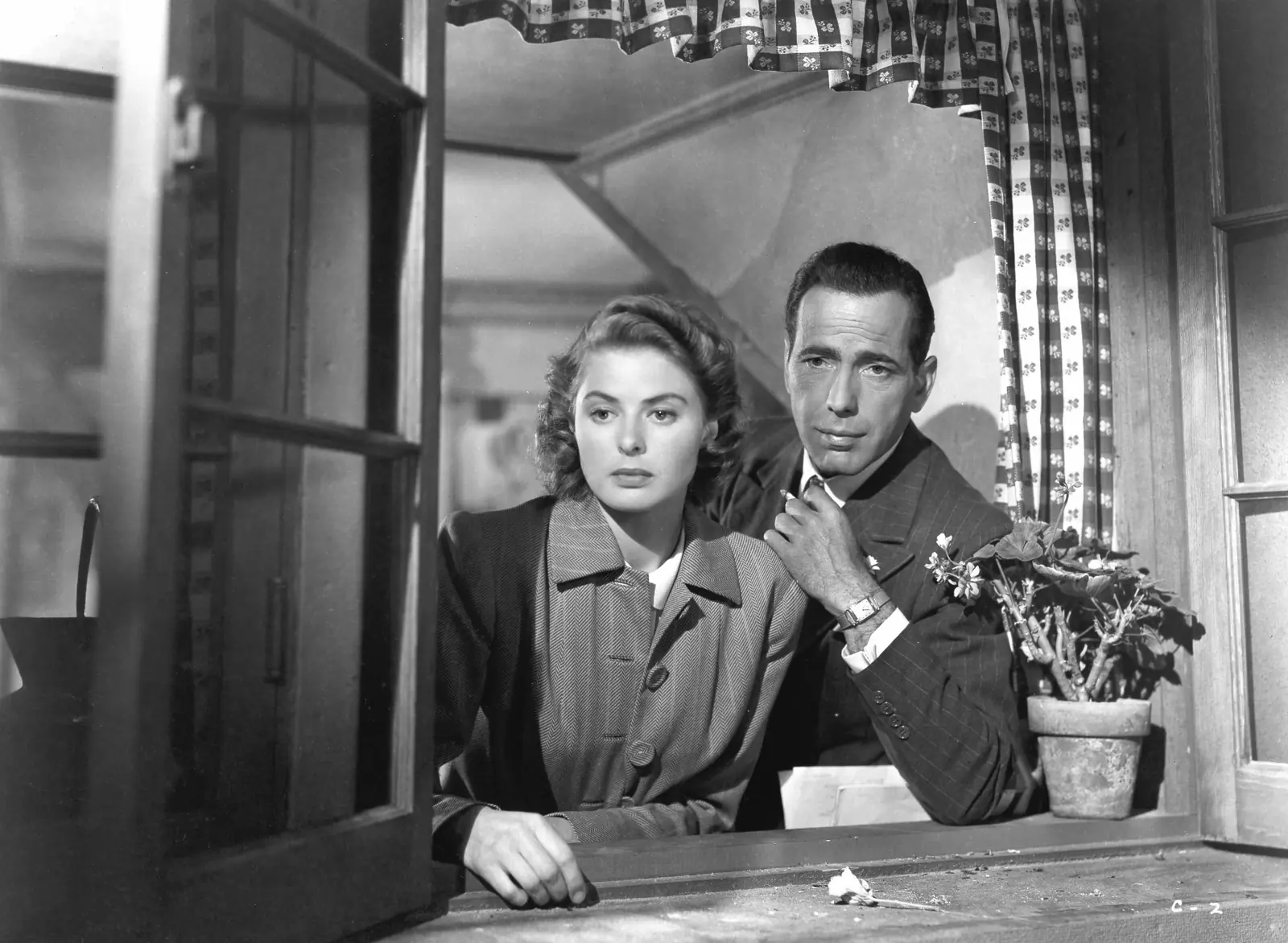
In his famous essay on Casablanca, Umberto Eco calls the film a pile-up of clichés: the love triangle, the self-sacrificing hero, the escape, the war, the old flame. That, Eco says, is exactly why it works: “Two clichés make us laugh. A hundred clichés move us.” The clichés crowd in so thickly that the film rises above its separate formulas and becomes a kind of myth.
Cliché is the dictionary the audience and the writer share. A writer who throws it away ends up speaking a language nobody understands.
TwoThe cliché of refusing cliché
There's an illness that shows up all the time in first scripts. The writer tries to dodge every cliché and wants every scene to do something unexpected. The result is exhausting rather than interesting. The audience has nothing to hold on to, no genre contract and no familiar feeling.
Running from cliché, some of these writers fall into twist inflation. As we said in our piece on twists, a story that tries to surprise you in every scene soon can't surprise you at all. The turns built to escape cliché end up as clichés themselves. Readers at production companies know these scenes by heart: “Something unexpected happens here just so something unexpected will happen.”
One more thing has to be said: flipping a cliché is also a cliché. The rescued princess who turns out to be the rescuer, the villain who was a good guy all along, the romantic comedy where the couple splits up at the end: by now they're all as familiar as the originals. Reversing a cliché doesn't make you original. It only shows the cliché in a mirror.
ThreeHow to make a cliché your own
Keep the promise, change the route
Rocky (1976) is an underdog story. A boxer nobody gives a chance gets to fight the world champion. The genre makes you a promise: the underdog will win. Sylvester Stallone's script keeps that promise but changes what winning means. Rocky loses on the judges' decision. By then, though, the story has already moved the goalposts. The point was never to win. It was to go the distance. The audience gets the feeling it came for, by a route it didn't see coming. And here's the irony: one of today's best-known sports clichés, the training montage on the steps, largely started with this film.
Play the cliché straight, then break the genre
Se7en (1995) opens on a detective seven days from retirement. Andrew Kevin Walker's script plays that cliché at full weight, without a single wink. The tired detective, the young and eager partner, the city where it never stops raining. The audience knows this world and settles in. The ending turns exactly that comfort against them. The basic contract of the crime story, that the bad guy gets caught and the evil gets stopped, falls apart in the last scene. Here the cliché is a trap. It makes the audience feel safe so the blow lands harder.
Let the bones be cliché and the flesh specific
The montage at the start of Up (2009), a whole life in a few minutes, is technically a cliché. The meeting, the wedding, the house, the dreams, growing old, the loss. But every moment of it is built on a very specific detail: a painted mailbox, a jar, a tie straightened every morning. The audience recognizes the structure and sees the details for the first time. The cliché is the skeleton, the detail is the flesh. Your skeleton can look like everyone else's. The flesh has to be yours alone.
Let the characters know the cliché, but only once
Scream (1996) brought a whole genre back to life with characters who can recite the rules of horror movies. In Kevin Williamson's script they know that whoever says “I'll be right back” is going to die, and they make the mistakes anyway. It worked brilliantly once. Then it became a cliché of its own almost overnight, and the parodies followed. Irony is a spice, not the main course.
When the film is the one that made the cliché
Groundhog Day (1993) is about a man who lives the same day over and over. Back then that wasn't a cliché. Now it's the name of a genre. But even an idea that has hardened into cliché can be written to feel alive again. Palm Springs (2020) builds its time loop on the assumption that the audience already knows the drill, and from its first minute it follows someone who is already stuck inside the loop. Instead of explaining the cliché, it skips right past it and asks the real question: what does being stuck in the same day forever do to a relationship?
FourYeşilçam's cliché machine
Audiences of Yeşilçam, Turkey's classic studio cinema, usually knew what was coming. The rich girl falls for the poor boy, a cruel relative gets in the way, someone loses their memory, the blind girl gets her sight back in the last scene. The audience knew all of it and cried anyway. That is exactly Eco's point: used densely and sincerely enough, a cliché becomes the emotion itself.
Some of those clichés are still alive in Turkish TV series. Memory loss, the stolen baby, the brother or sister who turns up years later. It's easy to turn up your nose at them. But if millions of people are still watching, we have to admit they touch something. The cliché isn't the problem. The trouble starts when a writer puts it on autopilot and adds not one new detail.
Audiences forgive a cliché. What they don't forgive is a writer who doesn't believe in it.
FiveWhere cliché ends and laziness begins
When we're deciding whether to use a cliché, we ask one question: why did I write the scene this way? Because the story needed it, or because it was the first thing that came to mind?
If you're writing a confession in the rain, ask yourself: why rain? Does it mean something to the character? Is it keeping something from happening, washing something away, bringing back a memory? If you have an answer, the rain is a choice and not a cliché. If you don't, it's a habit.
Let's draw one more line, and it may sound harsh: a cliché of structure can be forgiven, a cliché of dialogue cannot. Audiences happily accept a familiar structure or a familiar kind of scene. But the moment a character says a line we've heard a thousand times, like “I've never seen you this happy” or “I'm getting too old for this,” that character dies on the spot. Borrow the structure if you like. Never the sentences.
SixRules from the desk
- Rule
Choose your clichés on purpose.
You should be able to name every cliché you use. The ones you can't name end up running the show.
- Rule
Keep the promise, change the route.
Give the audience the feeling the genre promised, but get them there by a route they didn't expect.
- Rule
Add a detail from your own life.
An object, a habit, a word. That detail is what makes the cliché your cliché.
- Rule
No clichés in dialogue.
Borrow the structure, never the sentences. If a line sounds like something you've heard before, cut it and find the words this character would actually use.
- Rule
One cliché per scene.
Don't put the rain, the airport and the confession in the same scene. One cliché is a foundation. Three are a parody.
- Rule
Don't hide behind irony.
Mocking a cliché is easier than believing in it. But audiences believe in the scenes their writers believe in.
- Rule
Flipping it isn't enough.
Turning a cliché upside down is a cliché too. Don't ask “what's the opposite of this?” Ask “what would this character really do here?”
FinallyA hundred clichés
The Casablanca script was still being rewritten while they were shooting. As the story goes, the actors played their scenes without knowing exactly how it would end. What came out was a film in which, as Eco put it, a hundred clichés came together and made a myth. Nobody who watches it today sees a pile of clichés. They see cinema itself.
Cliché is nothing to be afraid of. Be afraid of writing one and feeling nothing.