Why screenwriters keep profiles
Most writers keep some record of who their characters are, even if it lives in the margin of a notebook. It goes by profile, bio or character sheet, and it can be anything from a paragraph to a twelve-page questionnaire that asks for a blood type.
A screenwriter's profile has a narrower job than a novelist's. A film can't tell the audience what anyone is thinking, so everything you know about a person has to come out in what they say and do, or in something the camera can see. The profile that helps is the one you can check in the middle of a scene, to see what she wants from the person in front of her and what she would never say to them.
The fields below are chosen for that. Filled in for Mara, the lead of Low Tide, they come to about a page.
What to put in a profile
Open with a line of plain facts: name, age, job, where they live and with whom. Then work through the rest, keeping each answer short enough to carry in your head while you write.
- What they want. The goal they would admit to, concrete enough to film, like selling the house or getting her brother home by Friday. It drives the plot, and in each scene it narrows to something smaller they want from whoever else is in the room.
- What they need. What the story will make them face, often something they don't know is missing. Plenty of good endings turn on the moment a character lets go of the want and gets the need, or refuses to.
- The wound, and the wrong belief it left. Something in the past taught them a rule about the world, usually one that is false or out of date. The rule matters more than the event, since it is the rule they act on now.
- What they hide. From other people, and sometimes from themselves. A character with something to hide talks around it, which is where most subtext comes from.
- How they talk. Write two lines they might say, then note what makes them theirs: long sentences or short ones, the words they reach for, what they joke about and what they never say. Do they answer a question, or answer it with another?
- What they do under pressure. Whether they get louder or go quiet, run or take charge. You will consult this field more than any other, since most scenes put somebody under pressure. Robert McKee separates characterisation, everything observable about a person, from true character, which shows only in the choices they make when choosing costs them something.
- Where they end up. The arc in two sentences, one for how they behave at the start and one for the end. Some characters stay the same while the world around them changes; if yours is one of them, note it here.
- How others see them. The people around a character rarely see them as they see themselves. The gap gives other characters something to say about them, and gives the audience a second opinion.
- Details a camera could catch. Three or four specific things, such as an object they carry, a habit or the way they stand in a doorway. Choose details that point inward, like the headphones Mara never quite takes off.
The trouble with long questionnaires
Character questionnaires are easy to find, and many of them are long: star sign, favourite colour, first pet, what is in the fridge. Lajos Egri set out an earlier version in The Art of Dramatic Writing (1946), dividing a character into body, background and mind and listing what a writer should know under each. His underlying point holds up, since a character with no history behaves like nobody in particular. The trouble starts when every question gets an answer because it happened to be on the list.
The test for each answer is whether it could change what this person does in a scene. A favourite colour almost never could. Growing up poor might, if it means she can't leave food on her plate at a dinner the client is paying for. A father who fished for a living matters if it means his son reads the tide without looking, and the story has a scene on a beach.
Some facts earn their place without ever reaching the screen, because they keep you consistent, like how old someone was when a parent died, or how much money they have. The job is often the richest line in a profile. It decides what a character is good at and what they notice first in a room, and it hands them their words when they are rattled.
The rest can usually go. A long questionnaire feels like progress, and it can put off the harder decision about what a person does when the story corners them. Michael Brindley's notes for Screen Australia observe that the profiles written in series television help with casting, but nobody gives one to the audience, so the character still has to come through in what they say and do.
A worked profile: Mara in Low Tide
Low Tide, the 12-page short drama that comes with Scriptopus as a sample, follows MARA WELLES home to the cottage her late mother left, to record its rooms before the sale goes through. Her father is there before her, thirteen years after they last spoke. The treatment guide tells the whole story. Mara's profile uses every field above.
| Field | Mara |
|---|---|
| Facts | Mara Welles, 32. A sound recordist who records the sound of empty rooms for film crews. Left home at nineteen and lives alone in the city. |
| Wants | To record her mother's cottage one last time before the agent takes the keys, and to be gone before anyone can talk to her about it. |
| Needs | To put the blame where it belongs, and to let herself grieve. |
| Wound and wrong belief | Her mother was ill for two years, and her father told her to stay away. Mara came home for the funeral and was gone before it ended. She believes he chose to shut her out, and she has lived since by a rule: a feeling is safe once it has been recorded and labelled. |
| What she hides | That she could have gone home anyway, and didn't. Blaming her father has saved her from looking at that. |
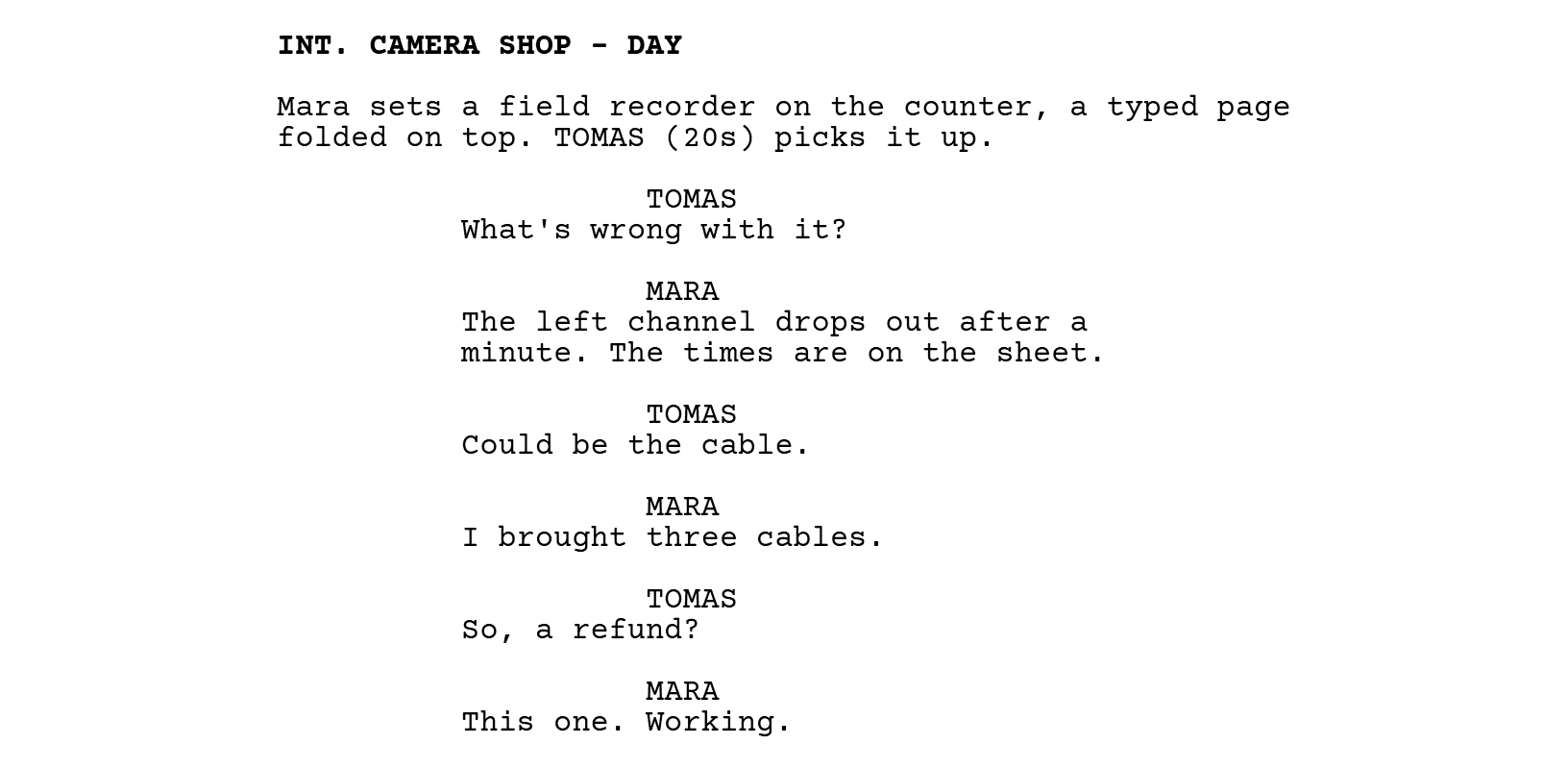
| How she talks | Short and level. Answers a personal question with a fact about work ("I record rooms. Before they go."). Turns a feeling into a timetable ("The agent comes at sundown."). Says "I manage" when she means "leave me alone". |
| Under pressure | She gets more controlled. She wraps a mug very tightly and puts it down very gently, and when a moment comes too close, she keeps the recorder running. |
| Arc | She arrives to keep the sound of a house. She leaves with a recording of her father talking about her mother. |
| How others see her | To Des, someone who has made a whole life out of managing. To the crews who hire her, the most exact recordist they know. To her mother, a daughter who would have dropped everything to come home, and so could never be told. |
| Details | Foam headphones round her neck. A field recorder riding in the passenger seat. A key to the cottage that she has kept for thirteen years, and the knack of the stiff front door. |
Set the profile beside the script and most of it is on screen. The headphones and the recorder are in the first shot, and "I manage" is her answer to her father's first offer of help. The wound never becomes a flashback; it comes out as an argument about a doorway. The one field the audience can't see is what she hides, and the porch scene near the end is there to make her say it.
Des, in brief
The film is Mara's, so her father's profile is shorter.
- Facts. Des Welles, 63. A retired fisherman who has never lived more than a mile from the sea.
- Wants. To get the house packed, and to keep the promise he made his wife.
- Needs. For his daughter to know him again, even if the promise has to go.
- Hides. That the silence was Elena's idea, and a locked drawer full of her letters and tapes.
- Talks. Plainly, and not much. Offers to do a job in place of an apology ("I can do the high cupboards."). Calls Mara "love" when he forgets to be careful.
- Under pressure. He leaves the room, or remarks on the tide.
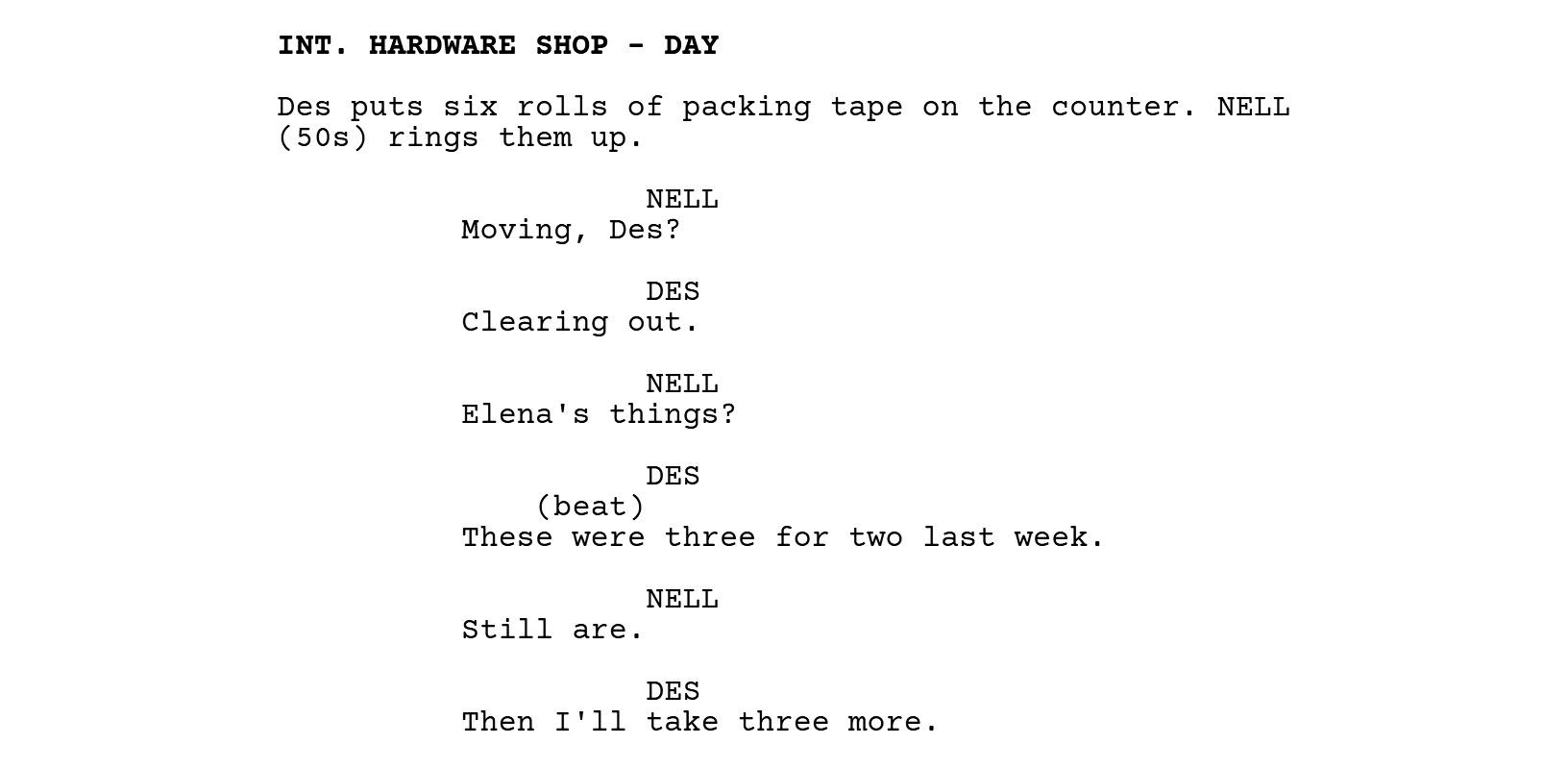
- Details. Big careful hands, a stoop, a jumper that has outlived at least one dog, and a roll of packing tape he has forgotten he is holding.
Most of the plot hangs on the field marked Hides. Everything after the scene on the beach is Mara finding out what he has kept from her.
Supporting characters and antagonists
A supporting character needs less. Note what they are in the story for, what they want in their scenes with the lead, one detail and one line in their voice. Ruth, the estate agent in Low Tide, is there to be the deadline, and she wants the keys and her evening back. She appears only as headlights in the window and a knock at the door, so three lines of profile cover her.
Some characters need more than their screen time suggests. Elena, Mara's mother, has died before the film begins and is only ever heard on tape, yet the story turns on a decision she made. Her profile matters as much as Des's, and it has to say what she wanted for her daughter, what she was afraid of, and why she believed silence was kind.
An antagonist needs a full profile, written from their own side. What do they want, and why are they sure they are right? Javert, the inspector in Victor Hugo's Les Misérables, hunts a reformed convict for years. Hugo makes him a man of principle who cannot imagine the law and justice parting company, and the reader fears him for exactly that. A villain whose profile says only "wants to cause harm" tends to behave like a plot device.
In Low Tide the opposition is Des, as Mara sees him. Write his profile from his side, as a man keeping a promise to his dying wife, and the first cassette has something to turn over.
Using the profile while you write
A profile does most of its work once the draft has started. Some ways to put it to use:
- Write a page outside the script. Put the character somewhere ordinary that has nothing to do with the story, a queue or a shop counter, and let them talk. Ten minutes of it tells you if you can hear them yet.
- Give two characters the same problem. They should handle it differently, and the difference should come from what their profiles say.
- Cover the names. Hide the cues on a page of dialogue and try to tell who is speaking.
- Read one part straight through. Only one character's lines, first to last, the way an actor reads with a highlighter. Slips in voice stand out quickly.
- Ask about the want in every scene. What does this person want from the others in the room? If the profile can't say, the scene may not have found its conflict.
- Update it after each draft, adding whatever the script found out about the character that the profile didn't know.
The two scenes below are a voice test for Low Tide, and neither is in the film. Each one puts a lead at a shop counter and asks them an easy question.

In ScriptopusEvery name you type as a character cue joins the Characters list in the sidebar by itself, and New character adds one by hand. Open a character for a card with Physical appearance, Backstory and Traits. The star beside the name marks them as main cast and pins them to the top of the list, and if you rename a character on the card, it offers to change their cues in the script to match.
Download the character profile template
Two pages. The first is a profile sheet for a lead, with every field described above and a line on what each is for. The second has room for a voice test and short profiles of three supporting characters. The PDF is for writing on by hand, and the Word file can be typed into.
Fill it in on screen
The same two pages in Word, which also opens in Pages and Google Docs.
Questions
How long should a character profile be?
About a page for a lead and a few lines for anyone else. If yours runs much longer, mark the answers that could change a scene; the rest is optional.
What is the difference between a character profile and a character breakdown?
A breakdown is written for casting: the name, an age range and a sentence or two for actors and their agents. It describes the part. A profile is your own working document, and it can hold things the script never states.
Do producers or competitions ask for character profiles?
Seldom for a feature, where the synopsis or the treatment introduces the characters as it goes. A series bible usually has a paragraph or two on each main character, and Screen Australia's guide points to a bible whose paragraphs also hint at where each character is heading over the series.
Can I build a character from a personality type?
As a starting point. A Myers-Briggs type or an enneagram number describes tendencies, and a scene needs one specific choice, so the fields that decide behaviour still have to be filled in.
Is a character bio the same thing?
Near enough. Bio, profile, biography and character sheet all get used for the same document, and nobody will mind which word you use.
Sources and further reading
- Lajos Egri, The Art of Dramatic Writing (1946), on the three dimensions of a character.
- Robert McKee, Story (1997), on characterisation and true character.
- Michael Brindley for Screen Australia, What Is a Synopsis? An Outline? A Treatment? (PDF), on the character profiles written for series television.
- Screen Australia, Story Documents: Drama (PDF), on the characters section of a series bible.
Write it formatted from the first line
Scriptopus sets every line as you type, keeps the beat board and the treatment beside the script, and exports the PDF and Final Draft file you will need. The editor is free on Mac and Windows.
- Every element in its place, with Tab, Enter and Ctrl+1 to 6.
- Beat Board, Treatment and Synopsis in the same project as the script.
- Six title page layouts, Industry Standard first.
- PDF, Final Draft, Fountain and Celtx exports.