Why outline before the pages
A scene that takes a day to write takes a minute to outline. Putting down a few lines for each scene first lets you move, merge and cut scenes while that is still cheap, and lets you see the whole film on a few pages before you commit to any of it.
An outline is a working document. It is written for you, or for the handful of people developing the script with you, so it can be plain, abbreviated and full of question marks. A treatment tells the same story as prose for someone to read and judge; the outline is the plan behind it. Screen Australia's story documents guide reckons a feature outline at about 4 to 12 pages.
Not every writer outlines in detail. Some find the story by drafting it and outline afterwards to see what they have. Even then the outline tends to turn up at the rewrite, as a list of the draft's scenes with a note against each on what it does.
Kinds of outline
The names change with the country and the teacher. These are the common forms, from the shortest to the longest.
- The scene list, or one-liner. One line per scene, giving the heading and what happens. Michael Brindley's notes for Screen Australia recommend a second line for each scene, saying why it is there. A feature's scene list fits on two or three pages.
- The step outline. Every scene numbered, with a short paragraph on the action, what each character is after, and what is different by the end. The term is most at home in Britain, and in practice it covers anything from a line a scene to half a page.
- The sequence outline. Scenes grouped into blocks of several, and every block has its own aim and its own turn. Paul Gulino's Screenwriting: The Sequence Approach sets out this way of working, with a feature divided into about eight sequences, each built a little like a short film.
- The scene breakdown. Mostly a television term, for a full scene-by-scene prose outline of an episode. In a writers' room it often goes to the script editor or story producer for approval before anyone writes the draft.
A beat sheet is shorter than any of these. It records only the turning points, where an outline has every scene, including the ones in between.
A step outline of Low Tide
Low Tide, the short drama that comes with Scriptopus as a sample, has eleven scenes in 12 pages. The treatment guide tells its story in prose. The step outline below gives each scene a row, with a column for what the scene changes and one for its length.
| Step | Scene | What happens | What changes | Pages |
|---|---|---|---|---|
| 1 | EXT. COASTAL ROAD - DAY | Mara drives to the coast, recording the sea through headphones. An old cassette in the machine plays her mother's voice, briefly. She stops it and drives on. | We learn how she copes with a feeling, by switching it off. | 1/2 |
| 2 | EXT. COTTAGE - DAY | The cottage, with a red SOLD sign in the yard. She records the outside, then lets herself in with a key she has kept. | The house is sold, and the clock starts. | 3/8 |
| 3 | INT. COTTAGE - LIVING ROOM - DAY | Half-packed boxes, one of them labelled KEEP? in marker. She sets up to record the empty room. A floorboard creaks, and DES, her father, is standing in the hallway. It is thirteen years since they last spoke. | She is no longer alone with the house. | 1 1/2 |
| 4 | INT. COTTAGE - KITCHEN - DAY | They pack the kitchen side by side. Small courtesies turn sharp, and Des brings up the funeral she left early. | The estrangement is said out loud, and sundown becomes the deadline. She stays. | 1 1/8 |
| 5 | INT. COTTAGE - HALLWAY - DAY | Des brings a box of her school things, among them a birthday cassette and the yellow house she drew as a child. He lets slip that her mother kept everything, and won't explain. | Mara knows he is hiding something. | 7/8 |
| 6 | EXT. BEACH - DAY | At low tide she records the shallows, and Des follows her out. She tells him he kept her away while her mother was dying. He says it wasn't his decision, won't say whose, and walks away. | The question the film turns on is out in the open. | 1 5/8 |
| 7 | INT. COTTAGE - ELENA'S STUDY - DAY | She finds a small key fixed to the underside of her mother's desk. Des asks her to leave the bottom drawer alone, and she opens it to find unsent letters addressed to her and a dozen numbered cassettes. | The secret is in her hands. | 7/8 |
| 8 | INT. COTTAGE - LIVING ROOM - DUSK | She plays the first tape. ELENA's voice explains that the secrecy was her own idea, meant to spare Mara, and that Des only kept the promise she asked of him. The tape snaps mid-sentence. | Everything Mara believed about her father is wrong. | 2 |
| 9 | EXT. COTTAGE - PORCH - DUSK | On the step, she admits that blaming him was easier than blaming herself. A laugh neither of them expected. The tide turns. | They are father and daughter again, carefully. | 1 1/8 |
| 10 | INT. COTTAGE - LIVING ROOM - DUSK | She points her microphone at Des and asks him for a memory of her mother. As RUTH's headlights sweep the window, he tells it. A knock at the door, and she saves the take. | She keeps a person, where she came to keep a place. | 1 |
| 11 | EXT. COASTAL ROAD - NIGHT | The same road, the other way, with the letters belted into the passenger seat. She plays back his story, laid over the sound of the sea she recorded at low tide. | The opening image, reversed. | 1/2 |
Read down the What changes column on its own and it tells the story in eleven lines. That is the first test of any outline. A scene whose change you can't name is a candidate for cutting, or for folding into the scene beside it.
The thinnest step here is the second, where Mara arrives and lets herself in. It survives because it puts the SOLD sign on screen and starts the clock, a small change but a real one. The beach, which holds the midpoint, and the first tape are the longest scenes, at about two pages each.
The page column adds up to eleven and a half, and the finished script runs onto a twelfth page. Writing the lengths in before the draft shows where the screen time goes. If the first three scenes came to five pages of a twelve-page script, you would know the opening was too slow before writing a word of it.
Building an outline from a beat sheet
- Start from the beats. Lay out your beat sheet with space under each beat.
- Find the scenes for each beat. Some beats are a single scene; in Low Tide the midpoint is the beach and nothing else. Others, like the long stretch after the catalyst, take several.
- Write the heading first. INT. or EXT., then the place and the time of day. Deciding where a scene happens often decides how it plays.
- Then what happens, in two or three sentences. Who is there, what they want from each other, and what they do about it.
- Then what changes, in one line. If it matches the line for the scene before, the two scenes may really be one.
- Give each scene a length in pages. A page of script is usually reckoned at about a minute on screen, so the column doubles as the running time.
- Add it up and read it through. Compare the total with the length you are aiming for, then read the What changes column alone, top to bottom.
Index cards and boards
Before screenwriting software, outlines lived on index cards, one scene to a card, pinned to a corkboard or spread across the floor. Cards are still popular because they are so easy to move. Swap two and the sequence around them reads differently, and you can see it at once.
Blake Snyder's Save the Cat! lays its board out in four rows, for the first act, the two halves of the second and the third, with about forty cards in all. Many writers colour the cards by storyline, which shows at a glance where a subplot vanishes for half an hour. Colour Elena's scenes in Low Tide and you find a character who never appears on screen present in more than half of them, through her voice, her belongings and the stories told about her.
When the cards stop moving, type them up as the step outline, adding the change and the length to each one as you go.

In ScriptopusThe Treatment tab can work as cards, one for each entry, with a heading, a paragraph, and optional lines for what the entry does in the story. Drag the cards into a new order, or switch the view to Editor to read it through as one document. Once you are drafting, the Scenes list in the sidebar numbers every scene heading in the script, and clicking one takes you straight to that scene.
From outline to pages
Write from one step at a time, with the outline open beside the draft. The step tells you where the scene starts and where it has to end up, and leaves the lines in between to the draft.
Step 4 of Low Tide says that Mara and Des pack the kitchen side by side, that small courtesies turn sharp, and that Des brings up the funeral. The change it asks for is the estrangement said out loud. On the page, the courtesy is an offer to reach the high cupboards, and the line that says it out loud is about a doorway.
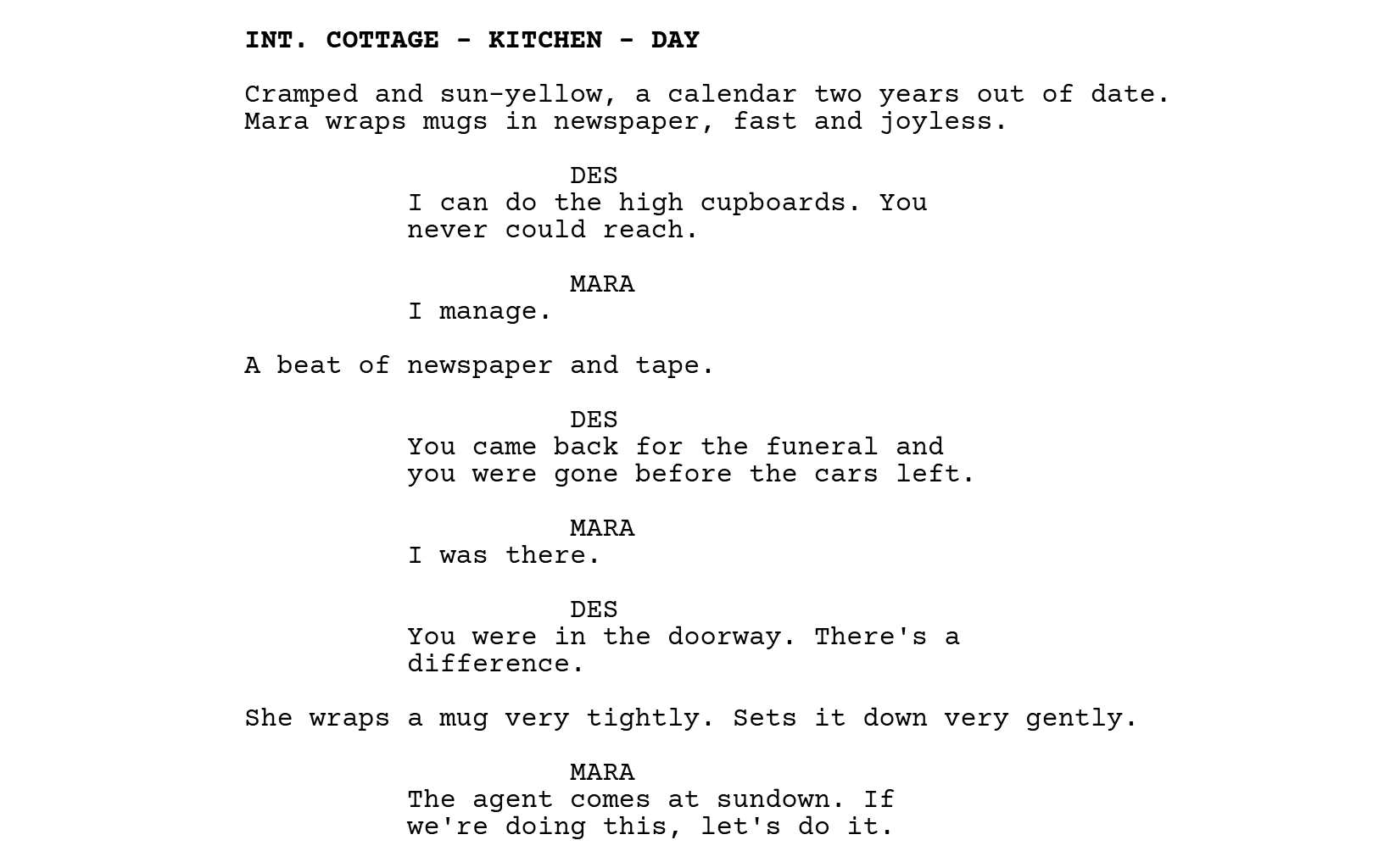
None of these lines is in the outline. When the draft finds something the outline didn't plan, update the outline to match and check what the change does to the steps after it. A rewrite can start the same way, by outlining the draft you have, scene by scene, to see what it really does.
Download the step outline template
A step outline sheet with a row for each scene and the five columns used above, followed by a one-line scene list for quick reshuffling. The Excel version adds up the pages as you fill it in and shows how far you are from your target length.
Fill it in on screen
The spreadsheet keeps a running page count against your target length. The Word file matches the PDF.
Questions
How long should a screenplay outline be?
For a feature, Screen Australia suggests 4 to 12 pages for an outline that other people will read. A working step outline can run longer, since every scene gets a few sentences. A short film's outline often fits on a page.
What is the difference between an outline and a treatment?
The outline is a map, often in note form, organised by scene or by sequence. The treatment is prose written to be read, with tone and chosen scenes, and it is the one that usually gets sent out.
Is a step outline the same as a beat sheet?
Usually not. A beat sheet lists the turning points, and a step outline lists every scene. Usage varies, though: Brindley notes that some American books call the scene-by-scene list a beat sheet, so when someone asks for one, check which they mean.
Can I outline a script I have already written?
Yes, and it is one of the best ways into a rewrite. Go through the draft scene by scene and write each step, with what it changes and how long it runs. Scenes that change nothing, or change the same thing twice, show up straight away.
Should an outline include dialogue?
Only a line you already know you need, such as one that a later scene pays off. Otherwise describe what the characters are after, and find their words in the draft.
Sources and further reading
- Screen Australia, Story Documents: Drama (PDF), on the outline, its length, and the scene breakdown.
- Michael Brindley for Screen Australia, What Is a Synopsis? An Outline? A Treatment? (PDF), on the one-liner scene list and what it is called.
- Blake Snyder, Save the Cat! (2005), on the board of index cards.
- Paul Joseph Gulino, Screenwriting: The Sequence Approach (2004).
Write it formatted from the first line
Scriptopus sets every line as you type, keeps the beat board and the treatment beside the script, and exports the PDF and Final Draft file you will need. The editor is free on Mac and Windows.
- Every element in its place, with Tab, Enter and Ctrl+1 to 6.
- Beat Board, Treatment and Synopsis in the same project as the script.
- Six title page layouts, Industry Standard first.
- PDF, Final Draft, Fountain and Celtx exports.